Tadeusz Malinski, chair of the department of Chemistry and Biochemistry at Ohio University, has a long list of prestigious awards for his groundbreaking research in biotechnology and the cardiovascular system.
The Doctor Honoris Causa is annually awarded to outstanding academics by European universities. OU’s 2009 distinguished professor now has two.
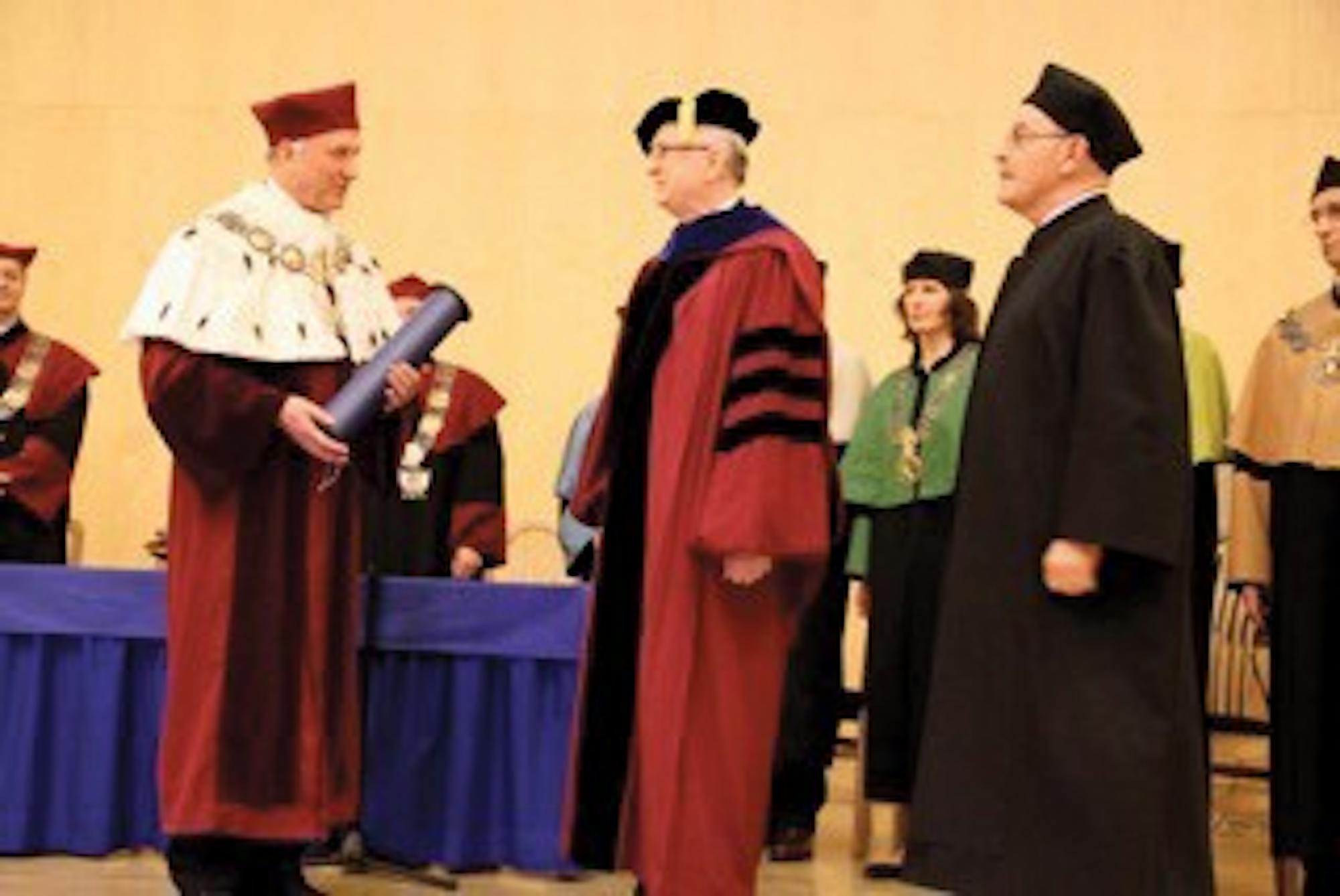
Malinski revisited his alma mater, Poznan University of Technology in Poland, last month to receive the award and deliver a lecture during the traditional Latin ceremony.
“It was pretty amazing to go back to where I started my career in science and see that what I have achieved is significant,” Malinski said. “When I started, it was only a minimal vision.”
Malinski was the first to measure nitric oxide concentration — a key component in blood — in single cells with nanosensors, leading to groundbreaking discoveries about its regulatory role in the beating heart.
“That was a major development that has spawned research in many different fields,” said Howard Dewald, dean of OU’s College of Arts and Sciences. “He really broadens and expands opportunities for students here.”
In addition to winning 25 other awards for his research in biomedical engineering, Malinski’s works have made it into more than 250 science publications.
“The award was a reminder that the work he does here is recognized more than locally, more than regionally, but internationally,” said Dewald.
During his 10 years at OU, Malinski and his team have been dubbed pioneers in the study of nanomedicine, a relatively new field.
“When I came to OU in the early ’90s, I got beautiful facilities which put my research at another level,” he said.
Malinski doesn’t plan to retire his research anytime soon.
Next, he plans to investigate why the artificial heart can only last for hours or days. Today, Malinksi focuses his research on the complex instrument so it can be modified for long-term application.
“Engineering the Heart,” the lecture he presented during the award ceremony in Poland, emphasized this message and included his latest discovery of a mechanism that may transform stem cells into cells that the body needs.
“It is very unusual and difficult to be recognized in the place you came from,” Malinski said. “They realized what we are doing here has had a great impact on medicine.”
oy311909@ohiou.edu