

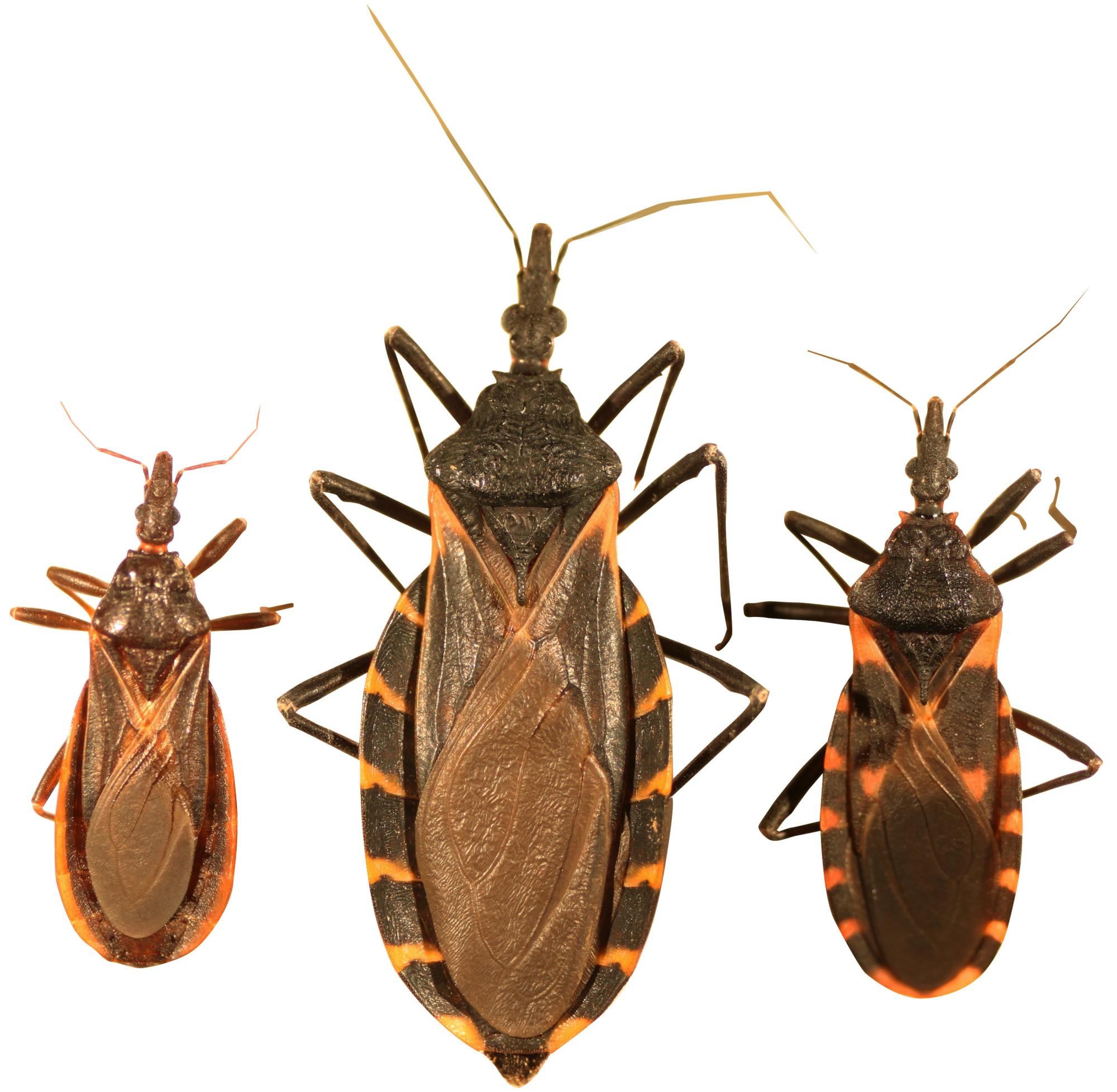
Kissing bugs, also known as triatomine bugs, which are found to cause the parasitic infection Chagas disease, have been reported in Ohio.
However, there have been no reports of bugs infected with the disease in Ohio, nor human or animal cases of Chagas disease in Ohio.
Bugs can be identified by their cone-shaped heads, thin legs and thin antennae. They tend to be black or brown with red, orange or yellow stripes around the edge of their bodies.
Chagas disease is a tropical illness caused by the parasite Trypanosoma cruzi and transmitted mainly by kissing bugs. The parasite is usually spread through the insects’ feces. It can also be transmitted through blood transfusions where the donor is infected, from mother to fetus during pregnancy or by consuming food contaminated with the parasite.
It is estimated that about 6 million people have the disease worldwide, and about 30,000 new cases are found annually. There are 12,000 deaths from Chagas disease each year, according to the Pan American Health Organization.
Jennifer Leigh, the environmental health specialist at the Athens County-City Health Department, said kissing bugs have been found in Athens County, but Chagas disease is not something the Health Department is concerned about now. However, it could become a later problem.
“I think with climate change, generally speaking, we have concerns about the expansion of vector-borne diseases within mosquitoes,” Leigh said. “We’ve certainly seen it with ticks and kind of using that same metric, it seems likely that they could be a concern in the future.”
Leigh recommends people who are concerned about the bugs to check themselves for bites and be aware of where bugs might be found.
"I think at the very least, if it's inside your house, monitor for potential bites,” Leigh said. “Be in contact with your doctor about bites that you think could be a kissing bug. Move the bugs outside. You can always submit them to us, and we can submit them to the CDC via the Ohio Department of Health for testing.”
Director of the Infectious and Tropical Disease Institute at Ohio University, Mario Grijalva, stressed the importance of not squishing the bugs, as that can spread the parasite if infected. Also, insisting on not itching any bites, as scratching is part of getting infected.
“If you are bitten by a kissing bug, remember that the bite itself does not transmit the disease,” Grijalva said. “If you are bitten, disinfect the area of the bite and do not scratch because it is the mechanical action of scratching that brings the feces in contact with the skin to enter through the skin.”
Kissing bug bites can typically be identified by larger welts than a typical mosquito bite on exposed areas of skin or around the eyes, nose and mouth, according to PAHO.
Symptoms include a mild fever, malaise, disorientation and a lack of appetite, and often go away after 6 to 8 weeks, even if the infection has not been treated, Grijalva said. If the infection continues to go untreated, the disease becomes chronic, and the parasite will stay in the heart and nervous tissue, causing long-term damage.
Grijalva claims damage can happen for many years unnoticed.
“This is known as a silent disease because it takes between five and 20 years for these chronic complications to appear,” Grijalva said. “In that long period, there are no signs and symptoms whatsoever, so that is why it is called a silent disease.”
However, there is a treatment for Chagas disease that is more effective when given right after infection, known as Benznidazole and Nifurtimox.
According to the Centers for Disease Control, several states have seen the disease in animals, and eight states in the U.S. have reported human cases of Chagas disease, including California, Arizona, Texas, Tennessee, Louisiana, Missouri, Mississippi and Arkansas.
Due to the number of animal and human cases, the CDC has also concluded that the U.S. is an endemic country for Chagas disease, along with 21 countries in the Americas.


