

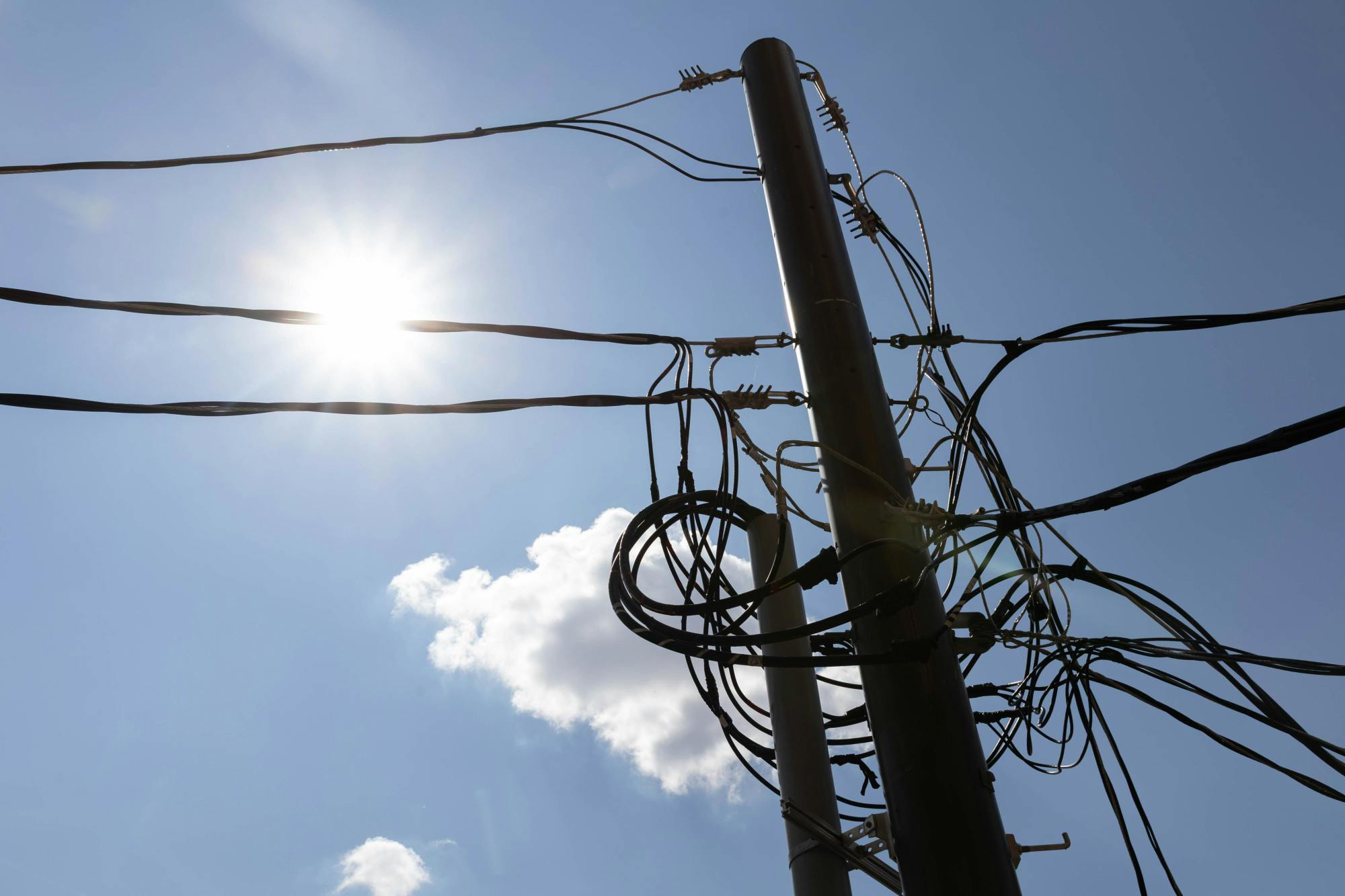
Broadband internet is something lawmakers and interest groups across the U.S. have been promising to improve for a while. Many cities and villages still lack high-speed internet even after federal goals working to increase access to rural and low-income areas were set during the Biden administration.
Southeast Ohio has consistently been an area targeted for internet improvements, but residents haven’t seen much change. However, Ohio University is hoping to help improve broadband services in the region through its research and 5G Readiness Certification and help to decrease some of the internet inequality facing Southeast Ohio.
Dr. Julio Arauz, an OU professor at the McClure School of Emerging Communication Technology, helps provide the 5G Readiness Certificate to people who want to learn how to install broadband.
Broadband is a data transmission that provides people with high-speed internet through a few different methods. One of those methods is satellite, which has been led by Elon Musk’s telecommunications provider, Starlink.
The alternatives OU has been working on expanding in Southeast Ohio are fiber and 5G wireless connectivity. 5G is already familiar to many people as it is typically what phones use to connect to cellular networks. Fiber is cables laid in the ground connecting to houses to provide internet.
Arauz said OU was approached by the Ohio state government to understand what workforce development was needed for broadband, which led to the development of the 5G certificate.
Arauz said the program is free of charge for anyone who wants to complete the certification, and they don’t have to be a current student at OU. Throughout their three cohorts, he said, they’ve taught recent high school graduates and employees of other telecommunications fields who were looking to switch and have helped them get placed into jobs after completion of the certificate.
The program at OU was partially funded by a Super RAPIDS grant of $450,000 from the Ohio Department of Higher Education, which supported the equipment, teaching and training. OU covered the cost of tuition for certificates.
However, Arauz is concerned about the future funding of this program. He said the program was promised money from the federal government through the Broadband Equity, Access and Deployment program which has since been delayed.
The 5G program was hoping the BEAD money would help pay for the tuition of more students, but now, Arauz said, they are going to have to look for funding from other places.
Arauz believes the funding may have been delayed due to the change in presidential administrations and said the new administration may have been considering strengthening the role of satellite communications such as Starlink. Many specialists in the broadband world are concerned about the future reliance on satellites. Broadband companies won’t be able to provide the low prices fiber and 5G can if satellites are used more frequently.
Laurie McKnight, a senior research manager for broadband at the Voinovich School of Leadership and Public Service, said fiber gives homes the best connection and the highest speed at the lowest price, and that’s what they would like to expand to more areas.
The difficulties facing Southeast Ohio are that remote and underdeveloped areas can make it more difficult to construct these broadband services, and it can also be more expensive because of laying more fiber lines to reach houses further away.
Randi Pokladnik, a resident of Tappan, Ohio, in Harrison County, said her community has faced these issues, especially during the COVID-19 pandemic.
“We were promised to get high-speed internet over 20 years ... nothing yet,” Pokladnik wrote in an email. “I heard of kids in our school district driving to the McDonald’s in Uhrichsville during COVID to do the online programs.”
McKnight said in a city, it’s much easier to get broadband services because laying one fiber line can reach many homes, while the same amount of line in rural areas may only reach a few homes.
“Trying to lay that line is not always as straightforward and easy to connect,” McKnight said. “We have a lot of hills, we have a lot of mountains, and we have a lot of rivers.”
The lack of broadband in rural areas has contributed to a major issue called the “digital divide.” McKnight describes the digital divide as a lack of broadband in certain areas leading to being left out of certain situations everyone else can access.
In June, the Ohio state government announced a $23.7 million broadband expansion through reimbursements for infrastructure updates. Lydia Mahalik, the director of the Department of Development, believes that by funding the maintenance updates through the state, internet providers will be able to offer services to customers at a lower rate.
McKnight said affordability is a major step in overcoming the digital divide in Ohio.
“Ohio has done a really good job of making sure the companies that are bidding are offering, and will be offering, a low-cost option to allow people the possibility of affording it,” McKnight said.


