

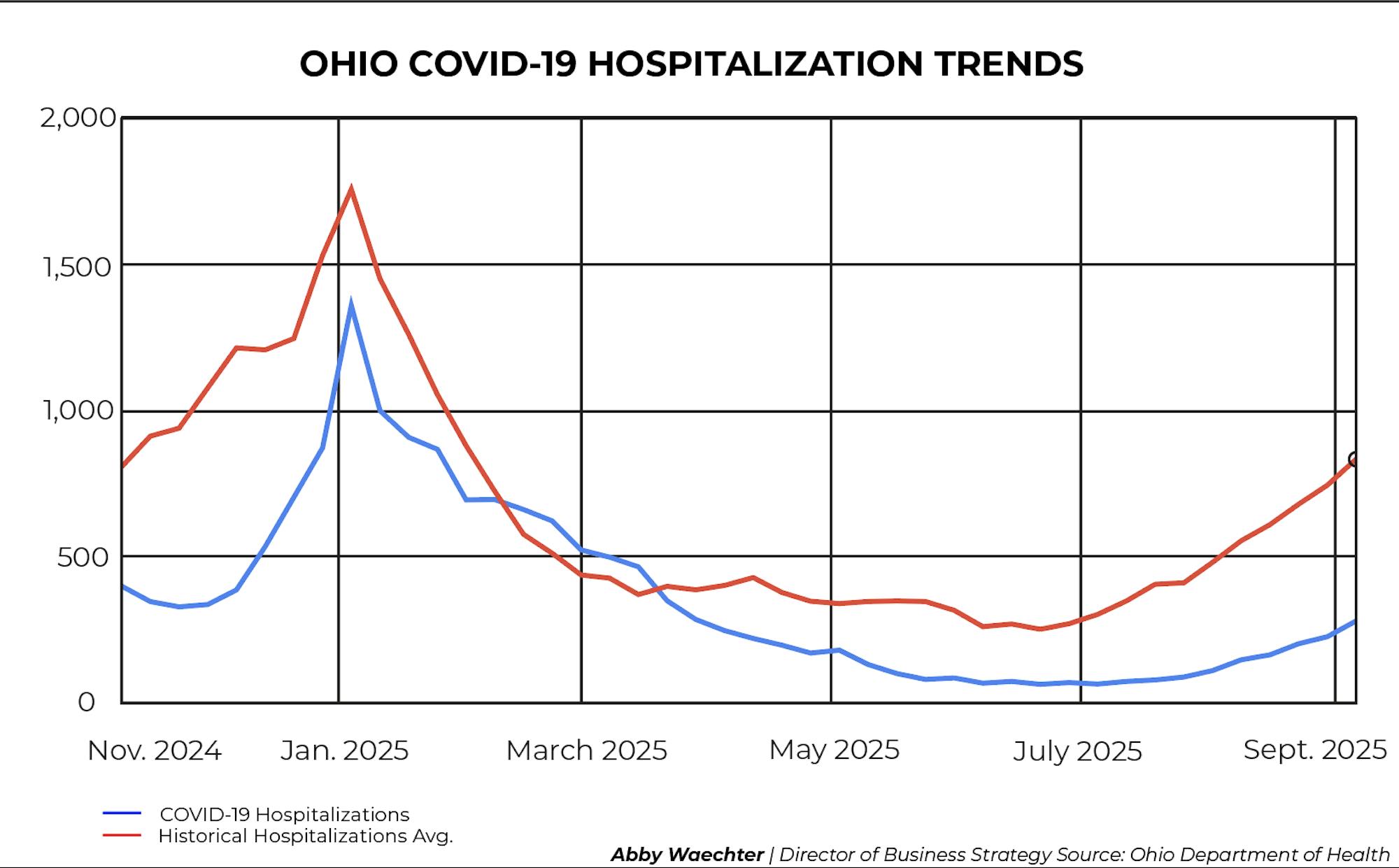
COVID-19 hospitalizations in Ohio nearly doubled during the past month, and two respiratory illness outbreaks were reported in Southeast Ohio, raising alarm as new federal restrictions limit access to the updated COVID-19 vaccine.
On Aug. 27, the Food and Drug Administration approved the new COVID-19 vaccine, along with its restrictions, according to the National Public Radio. U.S. Secretary of Health and Human Services Robert F. Kennedy Jr., a longtime critic of federal vaccine policy, said the new restrictions were delivering a framework to American demand.
Under the new guidelines, only individuals at high risk for severe illness, including those 65 and older or with specific underlying conditions, are eligible. People who do not meet the criteria, even if they want the vaccine, are no longer eligible. Previously, vaccines were available to everyone, including babies six months and older.
The change comes as public health experts warn of another difficult winter for respiratory illnesses. In the past week, 281 Ohioans were hospitalized with COVID-19, nearly double the 148 reported four weeks before. Southeast Ohio makes up 11 of those hospitalizations, according to the Ohio Department of Health.
Southeast Ohio has also reported two respiratory illness outbreaks, influenza and RSV, or respiratory syncytial virus, which often spread rapidly in shared settings like residence halls and classrooms.
Rebekah Crawford, an assistant professor at Ohio University with a Ph.D in health communication, warned limiting vaccine access could have unintended consequences and potentially backfire on the current administration’s vaccine agenda.
“If somebody dies from COVID or intense influenza that they could have not gotten if they had been able to have the vaccine, that’s a nuclear bomb these politicians are going to have on their hands,” Crawford said. “People are going to be very angry… but, ironically, RFK Jr might be starting the pendulum swing back toward acceptance by prohibiting their access. As soon as you take away humans’ autonomy, they want to reassert their autonomy.”
Zoya Bessler, a senior majoring in community and public health and president of Eta Sigma Gamma, the national professional health honorary society, said politicization of vaccine policy is discouraging some of her peers from entering the field due to concerns about job security and losing sight of the profession’s core values.
“Public health is something that can bring people together on both sides to unite for the health of this country,” Bessler said. “With the second Trump administration, it’s just completely gone out the window.”
Between July 2024 and July 2025, 13,955 Ohioans were hospitalized with COVID-19 while vaccines remained widely accessible. So far this season, 1,442 have been hospitalized. Ohio, like much of the U.S., saw its health care system overwhelmed in the early stages of the pandemic.
Hospitals exceeded capacity, rural counties lacked sufficient access to care, and more than 44,976 Ohioans have died of COVID-19 since 2020, according to the Ohio Department of Health. Although the crisis has eased, public health officials continue to face staffing shortages and reduced trust in medical systems.
The eligibility changes have heightened concern among health professionals and the public, following a May 27 video in which Kennedy. said the Centers for Disease Control and Prevention would no longer recommend COVID-19 vaccines for healthy children and pregnant women, guidance preceding the Aug. 27 decision to restrict access based on risk level. The CDC has not updated its recommendations since.
Adding to federal concerns, former CDC Director Susan Monarez was ousted Aug. 27, and Jim O’Neill, a Health and Human Services official with ties to GOP donor Peter Thiel, is set to take over amid a leadership exodus, developments fueling unease in the public health community.
Megan Buller, an infectious disease specialist with OhioHealth, said many providers are still waiting for clarity on how to proceed.
“We have recommended it for all eligible patients or patients who are interested,” Buller said. “We are still waiting for additional information to come out of upcoming meetings from the CDC to re-evaluate how exactly we are going to approach vaccination going forward in our patient population.”
Buller said patients now excluded from eligibility are uncertain whether they can still access the vaccine, and whether insurance will cover it, adding another layer of confusion.
“We don't condone falsifying health information, but I appreciate the fact that people are wanting to find a way to get these covered,” Buller said. “We know vaccinations are important. The COVID vaccines are very effective. We've seen that, there's no denying they're safe.”
The policy shift comes amid rising skepticism around vaccines and public health messaging, shaped by years of misinformation and political division.
According to the CDC, only 23% of U.S. adults and 13% of children received the updated 2024–25 COVID-19 vaccine. With eligibility narrowed and insurance coverage unclear, public health officials say those numbers may fall further.
As winter approaches, health care systems across Ohio are preparing for increased demand, both from eligible and ineligible patients, as concerns around access, communication and trust return to the forefront.
“Science is a lot messier than people want to think, and it makes its progress kind of in a zigzag way, but it still makes its progress,” Crawford said. “We have really clear, centuries of evidence about vaccines as one of the best breakthroughs for community-level human health that we've ever made as a species.”


