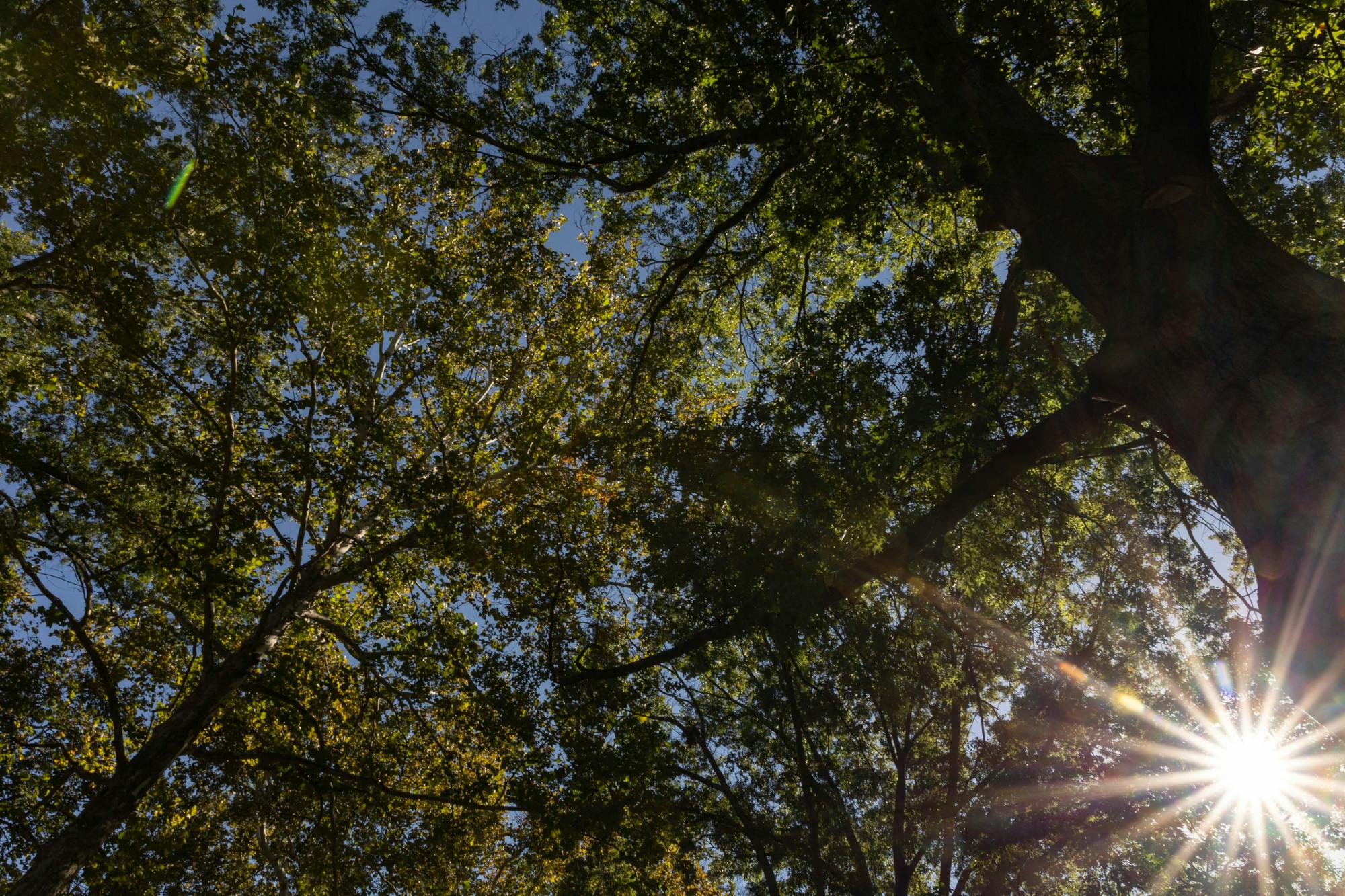
For nine years, Ohio University has been recognized as a “Tree Campus USA,” a national recognition program by the Arbor Day Foundation that seeks to support colleges and universities in planting and celebrating trees.
This award may come as no surprise, for the cherry blossom trees along the Hocking River always bring crowds excited to take pictures of the spring blossoms.
However, the main draw for Bobcats and locals is the trees on College Green. In the winter, the barren trees lay in a stark landscape against grey, snowy skies. In the fall, they glimmer with oranges and yellows, leaving crushed brown leaves underfoot.
For Travis Post, assistant director of facilities at OU, who is also a certified arborist, maintaining the health of the trees across campus is a top priority. This can include prescribed pruning, protecting trees when construction occurs and keeping tabs on possible pests.
“The trees on the campus green is what makes it iconic, in my opinion,” Post said. “Without those trees, it wouldn't have the same effect as it does for our community.”
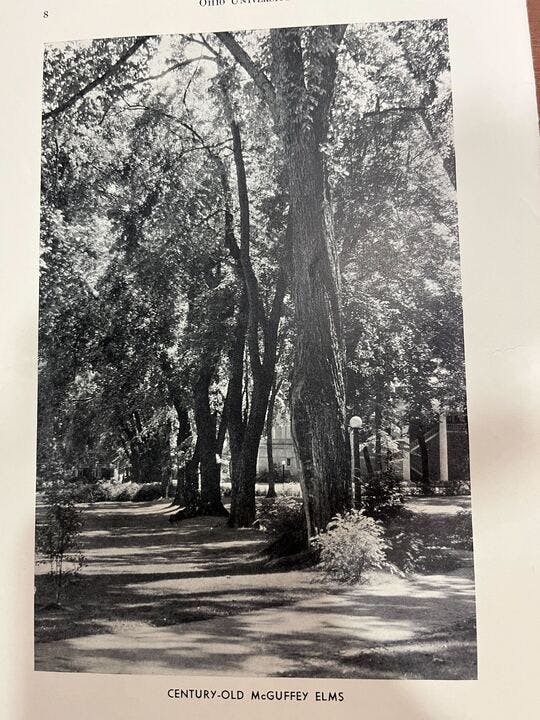
Among all the different species of trees on the college green, such as the sycamores and the ash trees, new elms are also starting to be reintroduced. Post said he helped to plant one behind Cutler Hall and American Elm trees used to be the main botanical attraction to the green.
William Holmes McGuffey, president of OU from 1839 to 1843, helped plant a row of 17 elm trees, according to a previous Post report housed in the Archives and Special Collections center at OU. Considered famous for their beauty and grand size, the trees lasted 117 years before being struck by the Dutch elm disease.
The article said only four of these trees remained that year, while the rest had been cut down to slow the spread of the disease. Nearly all American elms were affected by the Dutch Elm disease, a “lethal fungal disease” imported from European diseased logs in the 1930s, according to the USDA.
Today, only 1,000 American elms have survived and been reported to the American Elm Survivor Database.
With McGuffey’s first movement to create a more centralized, purposeful planning of a college green came the idea of curating a park for everyone to enjoy. Glenn Matlack, professor of environmental and plant biology at OU, has done research on urban forests and focuses specifically on eastern deciduous forest ecology.
While the college green isn’t technically an urban forest, Matlack said most people have a general perception that trees managed in a city setting don’t change much, which is false.
“The problem with the management of the urban forest is that we think of it on the span of human memory, which is notoriously bad and really short,” Matlack said. “What we need to do is think of it in terms of the memory of the trees, which can potentially live hundreds of years.”
Some of the largest trees on the green are only decades old, he said, and have the potential to last another 100 years. The trees, while not affected too much by foot traffic, are subjected to other ecological challenges.
One of the main challenges urban forests face is the enthusiasm from people to continue upholding and planting trees.
“You get these bursts, these cohorts of trees planted, and you'll be able to recognize them as you walk around the town,” Matlack said. “They're not continuously replanted. The structure of this forest is simply a history of human enthusiasm for planting. What you'll see recently is that there was a phase of enthusiasm for planting in the 1990s and 2000s, and then we forgot about them for 20 years.”
However, Matlack said, the climate is changing and only getting hotter. Athens itself has been suffering from a drought and recently had the driest August on record, states the National Integrated Drought Information System.
“The cheapest, easiest way to protect the population of Athens is to plant trees,” Matlack said. “They produce shade … and they have a really big impact on the environment at the level at which humans are experiencing it. This is emergency equipment. It is not about aesthetics, it's not about philosophy and it's not about tree huggers. It's about maintaining the health of people.”
The Athens Shade Tree Commission is a governmental organization that looks to promote Athens’ urban forest. It helps provide tree resources, care guides, recommendations for the types of trees planted on city streets or parks, a climate change tree atlas and much more.
Under Title 33, the commission also works with the service-safety director to help plan for planting or preservation of shade trees when a new city project, such as building a new street, is put into action.
The commission meets at 6 p.m. the second Thursday of every month. Recently, there have been some questions as to the future outlook of the commission.
During Thursday’s meeting, the chair of the commission, Tristan Kinnison, said there has been a refusal by the mayor to appoint or reappoint any new members to the commission. Meaning, if the commission doesn’t have four members, making a quorum, they can’t operate. The potential lack of a functioning commission could also remove Athens’ designation as a Tree City USA.
Gene Deubler, a member of the commission, closed Thursday’s meeting with some thoughts on the commission’s approval authority for new projects. A code change by the city council, which will be discussed at the planning commission meeting Wednesday at noon, proposes that landscape plans be approved by the planning commission and not the tree commission.
“We know our city’s canopy is in decline,” Deubler said. “We should be strengthening our tree canopy management tools and not weakening them. This is a step in the wrong direction.”
It is evident the trees on the college green and the general management of an urban forest require multiple levels of maintaining wellness, whether it’s looking back on past challenges or plans, or looking forward to preservation amid climate, weather or political changes.