

Two hundred fifty years ago, the Ohio Valley was different from how people know it today. The land was not carved with boundaries, it was a bountiful area and home to several Indigenous tribes.
Native American Heritage Month is designated in November to acknowledge the history of America’s first people and celebrate their descendants. History states U.S. Congress passed a “joint resolution” in 1990 dedicating one month of recognition to Native Americans.
Dan Harmon, a Dawson-Bryant High School career-based intervention teacher, is leading a Native American Heritage Month program.
Nov. 14 from 9 a.m. to noon, Harmon is hosting “Native Leaders of the Ohio Valley” in the Bowman Auditorium on Ohio University’s Southern campus.
“It’s going to be a celebration and hopefully a knowledgeable one,” Harmon said.
The program kicks off the 250th anniversary of the founding of the United States.
Harmon, who is a descendant of the Cherokee Nation said although he does not teach history anymore, he is often asked to teach Native American history in his coworkers’ classes. To Harmon, teaching students about this history is vital.
“The government does not want people to know about Native American history because it is such a black eye for our government,” Harmon said. “I just wish history could be taught the way it was … In middle school, history books have two paragraphs on the Trails of Tears and that is it.”
The Trail of Tears, summarized by Britannica, was caused when Andrew Jackson passed the Indian Removal Act in 1830, forcibly relocating over 100,000 Eastern Woodlands Indians during the 1830s, including the Cherokee, Muscogee (Creek) and Chickasaw Nations. Around 15,000 Indigenous peoples died during the relocation.
A 2022 article by Prism discussing curriculum requirements and the teaching of Native American history stated as of 2018, K-12 curricula in 27 states did not “mention an individual Native person.”
Harmon said he lived in the Qualla Boundary, located in North Carolina, where about 10,000 members of the Eastern Band of Cherokee Indians live. Harmon said the community is very tight-knit and proud.
“We had signs above all our doors that said, 'We forgive, but we do not forget,’” Harmon said.
Timothy G. Anderson, associate professor of geography and co-editor of the book “Settling Ohio: First Peoples and Beyond,” said the Indigenous and European American’s history of struggle is complicated. Anderson said there were centuries of conflicts, battles and negotiations between the two groups.
“History actually is never inevitable,“ Anderson said. "It is much more complex and nuanced than most of us think.”
“Settling Ohio” includes stories from scholars about archeology, education, history, geography and politics. Chief Glenna J. Wallace of the Eastern Shawnee Tribe of Oklahoma wrote the afterword, recalling memories about the removal of the Shawnee Nation to Oklahoma in the 1830s and 1840s.
Wallace also tells the story of how, more recently, she found that many historical sites across Ohio were not treated with the proper respect. She worked with the Ohio History Connection to get the Newark Earthwork Mounds declared as a World Heritage Site rather than used as a golf course, like it was previously.
“Too many mounds have been destroyed, have never been recognized, and we must never let that happen again,” Wallace wrote in the afterword.
At the program, Harmon will discuss three Shawnee chiefs who came before Wallace, beginning with Chief Cornstalk.
“They tried to … keep the Ohio Valley, but the white men eventually just overwhelmed them with numbers and the land ended up the way it is today,” Harmon said.
Cornstalk, as described by Encyclopedia Virginia, was an advocate for the Shawnee to “remain neutral” amid the American Revolution and other wars against “white settlers.” However, Cornstalk led members of the Shawnee at the Battle of Point Pleasant during Lord Dunmore’s War.
Point Pleasant was a “bloody battle” between the Shawnee and Virginians, the Warfare History Network stated.
In 1791, Chief Blue Jacket led the Shawnee into what is believed to be the “crowning achievement” of his military career: the Battle of the Wabash River or St. Clair’s defeat, according to AAA Native Arts.
An “army” of Indian tribes, led by Blue Jacket and Miami Chief Little Turtle, battled an “American expedition” conducted by Arthur St. Clair, governor of the Northwest Territory. It is described as one of the United States’ most “severe defeats” against Native Americans.
The Shawnee chief was known for his military leadership, but also fascinating stories.
“Blue Jacket is the one we are going to center the most on because of books written that he was a white man with the name of Marmaduke Van Swearingen,” Harmon said.
The story claims Van Swearingen was captured by the Shawnee wearing a “blue linsey blouse or hunting shirt,” playing a role in the name Blue Jacket.
“In 2006, DNA showed that he was not a white man, he was a full-blood Shawnee, and a lot of the books … taught that he was a white man,” Harmon said. “That is going to be debunked when we have the talk.”
Blue Jacket signed the Treaty of Greenville in 1795, which ceded most of Ohio’s territory to the federal government as part of negotiations following the end of the Northwest Indian War. Tecumseh, a citizen of the Shawnee Tribe who had fought in the war, attempted to “reclaim” Shawnee lands leading up to and throughout the War of 1812.
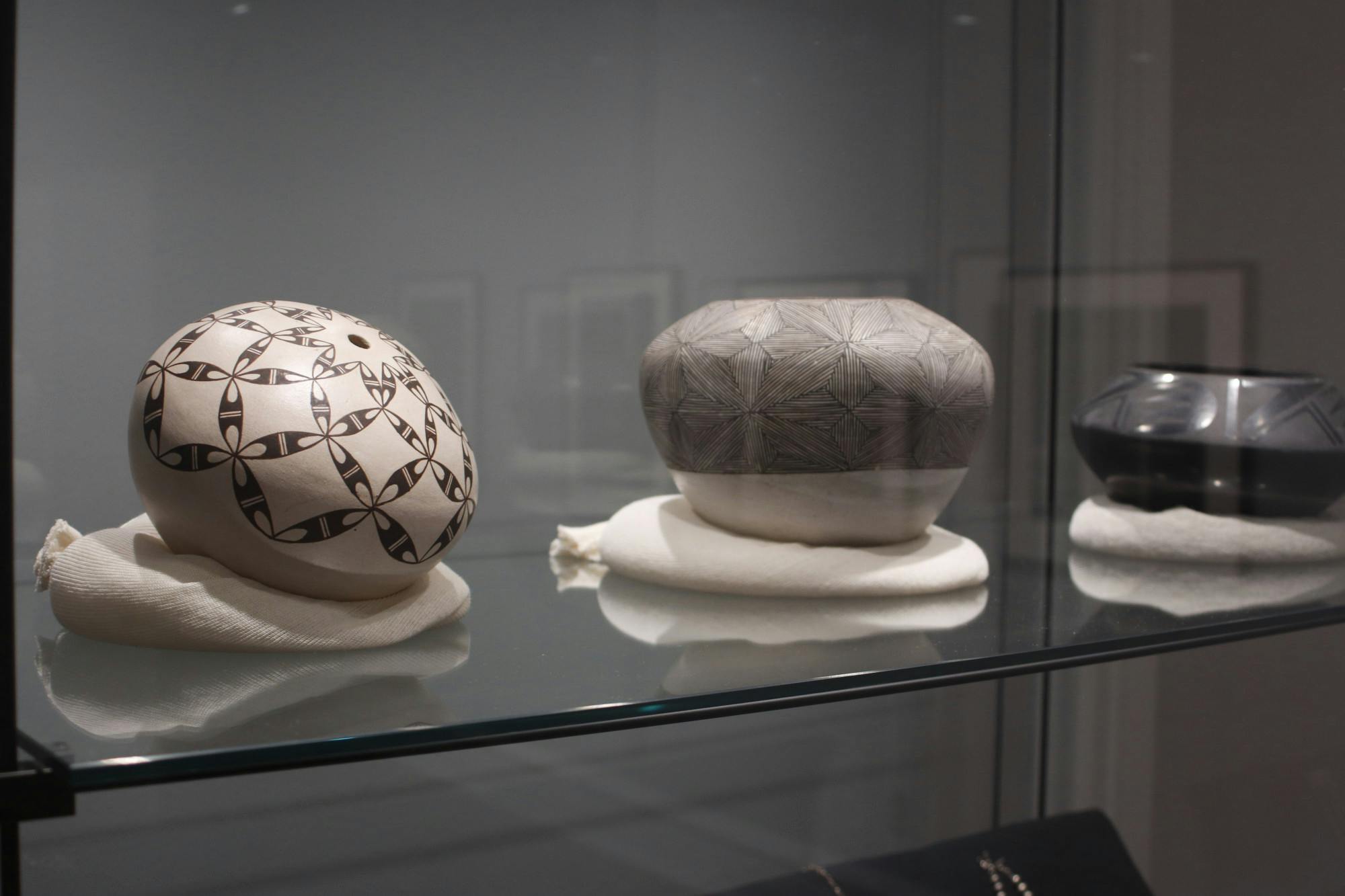
Despite the tragedies of the past, Indigenous peoples remain resilient, creating art and telling their stories in the modern day.
The Kennedy Museum of Art houses nearly 700 textiles and more than 1,700 pieces of jewelry in its Edwin L. and Ruth E. Kennedy Southwest Native American Art Collection. Most of these works, which are of Navajo, Zuni and Hopi origin, were donated by Edwin Kennedy.
Lisa Quinn, Kennedy Museum registrar, said multiple schools used to, or still have, a curriculum titled “Peoples of the Past.” When teachers would reach out, the museum’s response was always: “Native Americans are not people of the past.”
“They are people who are still creating and obviously still living (and) breathing,” Quinn said. “We would show them work in our collection that kind of illustrates those communities that are very similar to theirs in a lot of ways.”
As Harmon’s program approaches, he hopes to enlighten attendees and keep Indigenous history alive.
“I wish there were more people who knew the truth and would help (teach Indigenous history),” Harmon said. “It’s gotten to the point where it’s been hidden, (and) people are not interested anymore in the truth of what really happened with the Native Americans.”


