

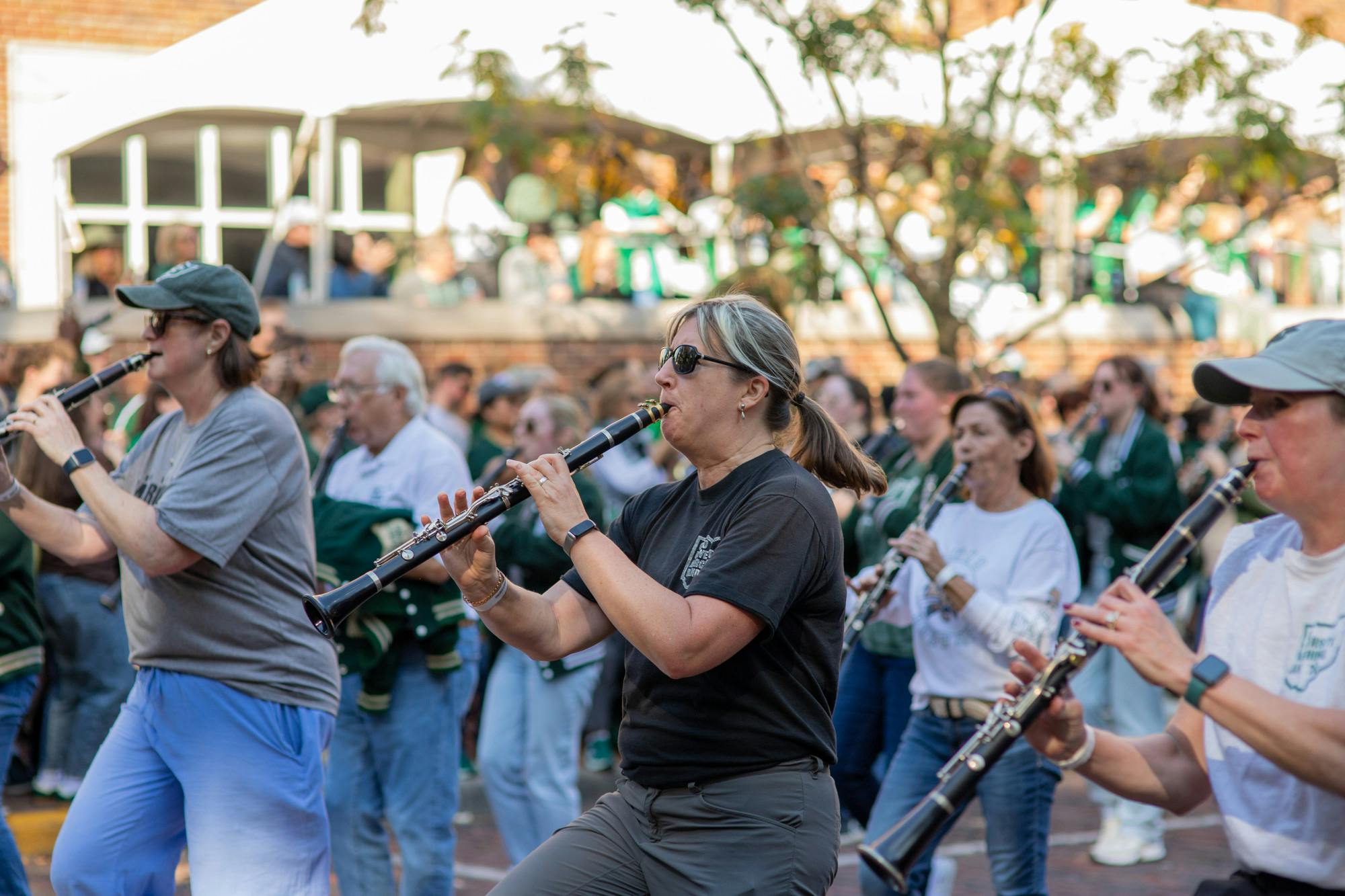
Ohio University’s Marching 110 is celebrating 50 years of its inclusion of women musicians. Before 1975, women were not allowed to march at OU, but today multiple women are proud to perform "Stand Up and Cheer."
On the second floor of Alden Library is a “Marching 110: 50 Years of Women” exhibit with band memorabilia, including uniforms and vinyl records. Maddy Zuber, a junior studying music therapy, is the euphonium section leader in the Marching 110 and said she is honored to play in the band.
“I feel a lot of pride being able to carry on a legacy of women who fought really hard for not only their spot in the band, but just being treated equally,” Zuber said.
Around 1927, just four years after the OU’s first marching band was established, Curtis Janssen formed an all-girls band. It disbanded after Curtis left the university; however, Professor Charles Gilbert re-established it and introduced majorettes.
As the Korean War began in 1950, the marching band was female-only while several of the men were serving. Women were removed from the band in the 1967 fall season under director Gene Thrailkill, who titled the band the Marching Men of Ohio.
The exclusion of women from the band caused controversy across campus. Luckily for Bobcats, Ronald P. Socciarelli readmitted women into the band in 1975, deeming it the Marching 110.
“I come from a very musical family, so being able to do music … it means everything to me.” Zuber said. “It’s (music) that brought me closer to my actual family. It’s given me all of my band families, from middle school, high school and now in college. It really shapes your relationships and who you are as a person.”
Zuber said 2025 marks the 110’s formation of its first all-female cymbal line.
“(It is) crazy because the drum line is very male heavy.” Zuber said. “Just the fact that anything is just completely female is really cool and for the 50th anniversary, it’s awesome.”
Zuber said during this year’s homecoming festivities, she met several women from the 110 alumni band and was happy to share the performance space.
Hannah Oney, a senior studying music education and trumpet performance, said she also spoke to notable alumni during homecoming, fueling her passion for music.
“She was the only woman in the section (and) this was back in the late 80s, early 90s, and it was awesome to meet her,” Oney said.
Oney said in her experience as a band member, she is the only woman on the trumpet teaching staff. Oney said female alumni noticed her position at the homecoming parade.
“I am the only woman in the front row of trumpets,” Oney said. “It’s cool because (alumni) came to me and were like, ‘You're standing in my spot … I'm so glad there's a woman in that spot. I'm so glad you're representing us on the field.’ It's awesome getting to see me be in that position … I didn't realize how much it meant to other people.”
Celebrating women alongside the 110 is OU’s Tau Beta Sigma chapter, Alpha Delta. Tau Beta Sigma, founded by Wava Banes Turner Henry in the '40s, is a co-ed “honorary music sorority” promoting “equality, diversity and the empowerment of women in all musical professions.”
The organization also serves collegiate bands, striving to develop band programs across communities. As the vice president of sisterhood for OU’s TBS, Zuber said the organization works hard to serve others.
“It was really (started) for the service of bands because we all love music, and marching bands are really hard to run … so TBS likes to help out with sorting spats and gloves (and) we try to help out local high schools if they need help,” Zuber said.
Both TBS and the 110 strive to bring Athens residents and students together, including all members, alumni and local music programs.
“(TBS) is also very much about sisterhood and … because people that are in music and love music really need to stand up for each other,” Zuber said. “So we’d like to stand up for justice with that and women who are in music.”
With generations of women making firsts in the 110, several are becoming role models for new female members. Shelby Heist, a junior studying biology and wildlife conservation, said having role models, like her big, is vital for motivation.
“My big was the second female field commander ever,“ Heist said. “Coming into the band, already having good women role models, and continuing on with that has just been like such a great transition.”
In Greek life and other student-run organizations, bigs are older members who pick younger members to be their littles. Bigs serve as mentors for their littles, helping them adapt in a larger organization, according to A List.
“I feel like having lots of strong women role models has definitely helped me want to step up and be the same for other people,” Heist said. “What you see mostly is lots of men filling in these positions. For example, as field commander, but there's been lots of women in the band that have kind of reclaimed it to be not just men, but also women doing the same.”


