

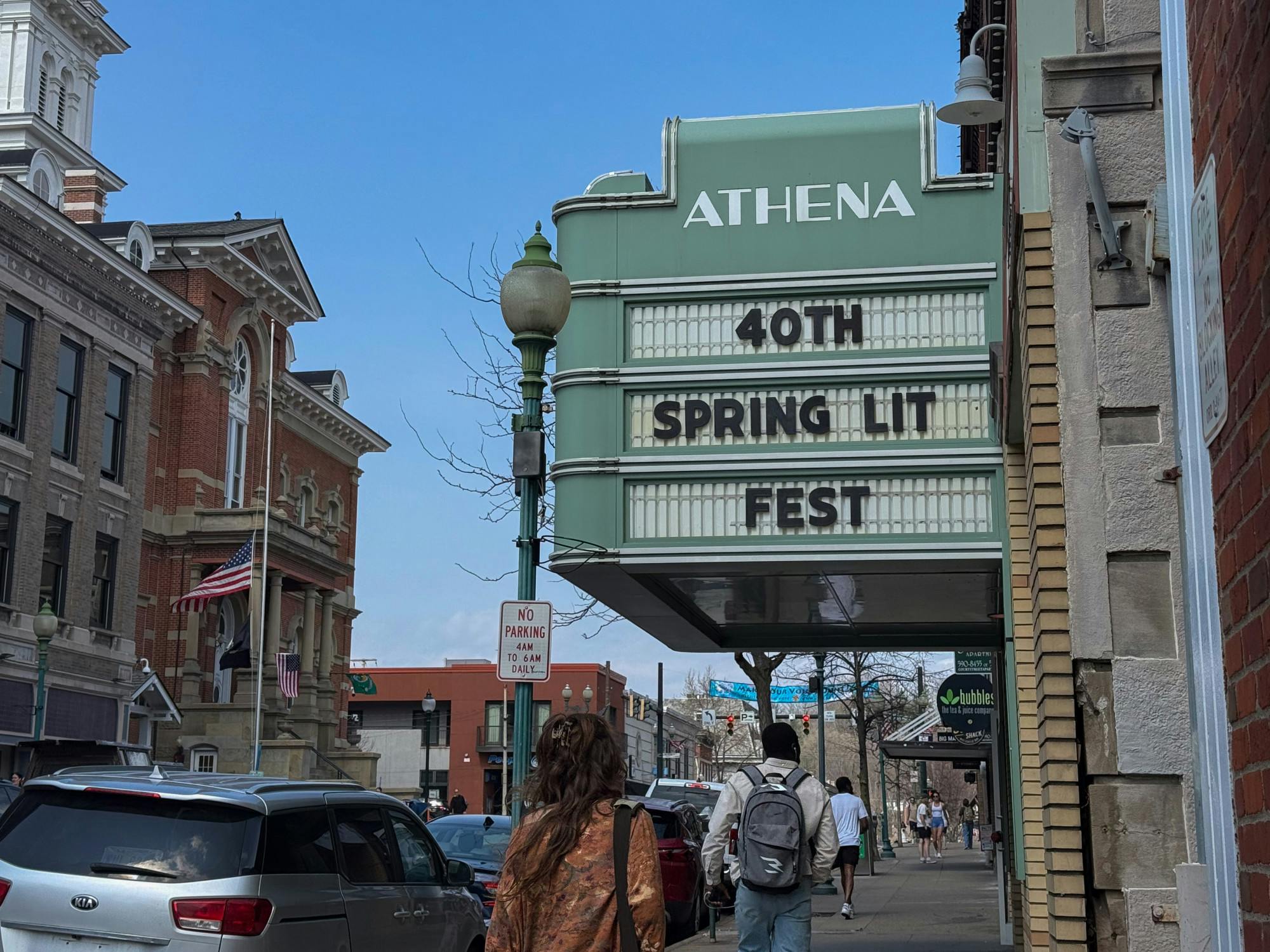
As the cherry blossoms begin to bloom, they indicate an annual spring occasion has arrived in Athens, the Spring Literary Festival. This year, it celebrated its 40th anniversary at Ohio University March 25-26.
David Wanczyk is an associate professor of instruction and a coordinator for special events in the English department at OU. This was his 16th Spring Literary Festival at OU.
“(The Spring Literary Festival) started in 1986,” Wanczyk said. “Since then, we’ve had Nobel Prize winners in literature, bestsellers and international luminaries who’ve given readings, lectures and been involved in this back-and-forth Q&A. It really is a highlight in the English department calendar.”
With the intention of reaching a variety of groups, the Spring Literary Festival is open to all. Three outstanding authors traveled to share their works and more with campus. They were warmly welcomed as they presented themes of inspiration to those who gathered.
Jeff VanderMeer is a New York Times bestselling fiction author and four-time World Fantasy Award Winner, among other honors. His novel “Annihilation” was made into a movie by Paramount in 2018.
George Bilgere is a poet who fully emerged in 2002. He was asked to read at the Library of Congress, has a Readers’ Choice Award from Rattle Magazine and an Editor’s Choice Award from New Ohio Review.
Hala Alyan writes nonfiction, fiction and poetry on different themes. She has five highly acclaimed poetry collections, as well as works published by The New Yorker and The New York Times Book Review.
These authors provide different senses of literature and points-of-view for attendees, which is the crux of the festival.
Wanczyk said there are a variety of factors in play when choosing authors to attend the festival, making sure to grant Athens a notable collaboration and means for learning.
“I think we’ve brought in more diverse voices as the years have gone on to make sure we’re reflecting on our own community and to hear voices we don’t hear as much in our community,” Wanczyk said. “We see if we can bring in that blend of a fiction writer, a nonfiction writer and a poet who will harmonize with each other in some way.”
Events took place in The Athena Cinema and Walter Hall Rotunda Wednesday and Thursday, where this year’s authors provided OU students, graduates and locals with conversations, lectures and readings.
“We’re really just trying to celebrate literature as a public good and make it part of our public campus life,” Wanczyk said. “Sometimes reading can be solitary, writing can be solitary, but coming together to make it a more communal event is what makes Lit Fest special.”
Nicholas Polsinelli, owner of Little Professor Book Center, supplied the books by the authors present at the festival. He expressed the importance of literature in today’s world and why it matters, especially on a college campus.
“(Literature and storytelling) provide us context,” Polsinelli said. “Sometimes they provide us outlets for the frustrations that we have, alternative means of viewing some of the problems that we have or fantastical ways of imagining how things could work out. They ground us and help us look forward.”
Polsinelli said his only challenge when assisting with the festival was the “anticipation of it.” A student, who has attended the festival all four years of college, couldn’t agree more.
Bridget Rexhausen, a senior studying English literature and culture, said she was curious about the Spring Literary Festival her freshman year and has returned to the annual event ever since. This year, she was drawn to the speculative work being addressed.
“I wanted more author’s perspectives on why people use speculative elements, why people opt for a more realistic setting and how they make those decisions,” Rexhausen said.
On top of the academic benefits she receives from her yearly attendance, Rexhausen articulated the significance the festival brings to the city of Athens.
“Aside from just a good communal point of community building … (the festival) kind of breaks the bubble,” Rexhausen said. “(Athens is) small, close knit … and that’s great for the college for several reasons, but it’s also cool to have people come and disturb that bubble and bring something new to it as well.”
If attendees could take away one thing from the festival, Polsinelli said he would want it to be the importance of literature.
“Not just fiction … but also poetry and creative nonfiction as well,” Polsinelli said.
The Spring Literary Festival events are free for attendees, and all are encouraged to go.
“(Literature) is what separates us from a lot of other organisms … the ability to build off of each other’s knowledge,” Rexhausen said. “We don’t exist as individuals; we exist as a collective in a way that most species don’t.”


