

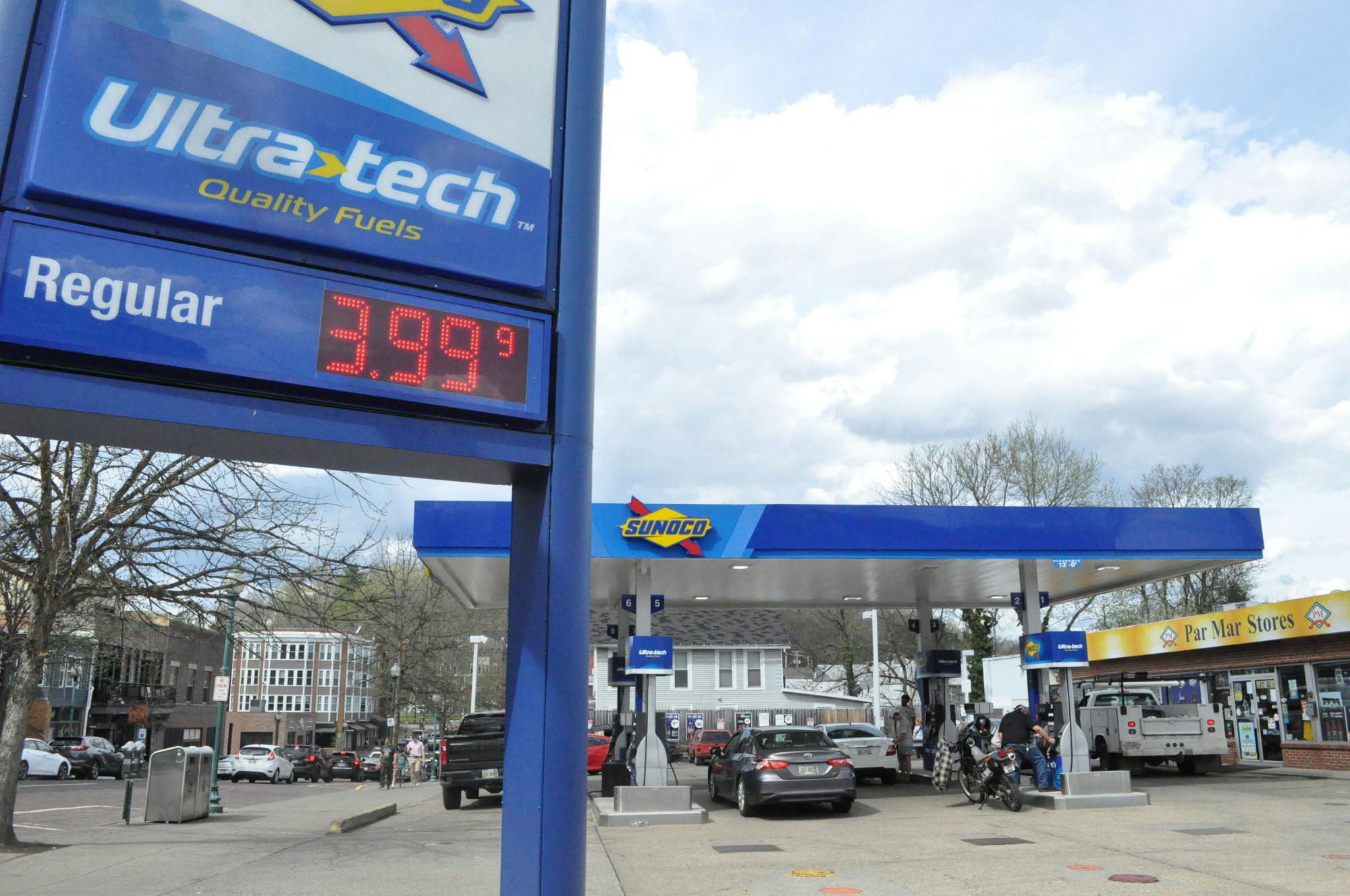
The continued war between the U.S. and Iran is drawing major geopolitical concerns. Disruptions and closures in Iran’s Strait of Hormuz, a passage that transports about 25% of the world’s seaborne oil trade, are causing price jumps for gas across the world, according to the International Energy Agency.
According to the American Automobile Association, the national average for gas on April 2 was $4.08, marking the first time in four years the national average exceeded $4 a gallon. The average cost of gas in Ohio is $3.750, as of Sunday, according to AAA.
Counties in Southeast Ohio are seeing slightly higher costs than the rest of the state. The price of gas in Athens County is $3.955, putting the county in the highest cost level, with only 17 other counties in the state.
“In Ohio right now, taking for example, gasoline is sitting at $3.81 a gallon,” Matt McClain, a petroleum analyst with GasBuddy, said. “That's up about a penny to two pennies over just the last 24 hours. For diesel, on the other hand, it's $5.06 in Ohio, and that is obviously up by quite a bit as well. So well over $1 a gallon just over the past five weeks.”
McClain said the rising gas prices can only be attributed to the war with Iran.
“We've been seeing gas prices rise basically since the Iranian, Israeli and the United States conflict or war began some five weeks ago,” McClain said. “Unfortunately, we are going to continue to see those prices increasing as we go forward, and we are going to see them increase until we have some sort of a solution with the Strait of Hormuz.”
The Strait of Hormuz has been a pivotal part of the conflict in Iran. President Donald Trump warned Iran to open the Strait by Monday, the Associated Press reported.
“Remember when I gave Iran ten days to MAKE A DEAL or OPEN UP THE HORMUZ STRAIT,” Trump wrote in a social media post. “Time is running out — 48 hours before all Hell will reign down on them.”
The U.S. is not the only country feeling the effects of the Straits closure. Diplomats from over 40 countries met in the U.K. recently to discuss methods to pressure Iran to reopen the waterway, the AP reported.
Jonathan Ernest, assistant professor of economics at Case Western Reserve University, mentioned the U.S. could tap into the Strategic Petroleum Reserve to lower the impact of the costs.
The Strategic Petroleum Reserve is the world's largest emergency crude oil supply that can be used to mitigate the impacts of supply chain disruptions, according to the U.S. Department of Energy.
“If we were to kind of release all of it, we could make it so there was essentially almost no impact of the limitations for maybe, a couple of weeks or something like that,” Ernest said. “What we would more likely do was to release some oil from this petroleum reserve to help limit the decrease overall.”
The oil would not necessarily flow into the U.S., according to Ernest. The oil would add to the world's supply, which could help stabilize prices. He said it would work well as a short-term stopgap but would deplete the reserves and could still not replace the 20% of oil that moves through the Strait.
The surge in gas prices is affecting Americans across the country. According to a recent AP-NORC poll, 45% of adults in the U.S. are either “extremely” or “very” worried about being able to afford gas in the coming months. That is up from 30% in 2024 after Trump won the presidential election.
Daniel Karney, associate professor of economics at Ohio University, said there is a typical increase in gas prices near the summer months, but not this drastic a change.
“Since the beginning of this particular conflict with Iran, oil prices have increased by about 30 to 55%, depending on how you want to measure them,” Karney said. “Gasoline prices are up 30% or so, diesel prices (up) about 40 to 50% or so.”
The rising gasoline and diesel prices have a deeper ripple effect on the economy, beyond the tank. Diesel vehicles that transport goods, such as trains, barges and semi-trucks, will also face higher prices, which will drive up costs for consumers to purchase goods.
“Higher energy prices in general drive up production costs,” Karney said. “So this will be an increase to the cost base for essentially all goods and services. It'll use some kind of energy to produce them or move them around, and so that increases that cost base.”
Karney stated it is not yet known whether that will be a temporary shock where things will return to normal, or if it will build a new baseline for higher permanent level costs.
McClain recommended using an app like GasBuddy, which can point users to the closest and cheapest gas station.
“Combine your driving if you're in a financially sensitive household, where many Americans are,” McClain said. “You combine whatever driving you need to do, don't make three trips across town to pick up three different things at three different times in the day. Combine it all into one.”


