

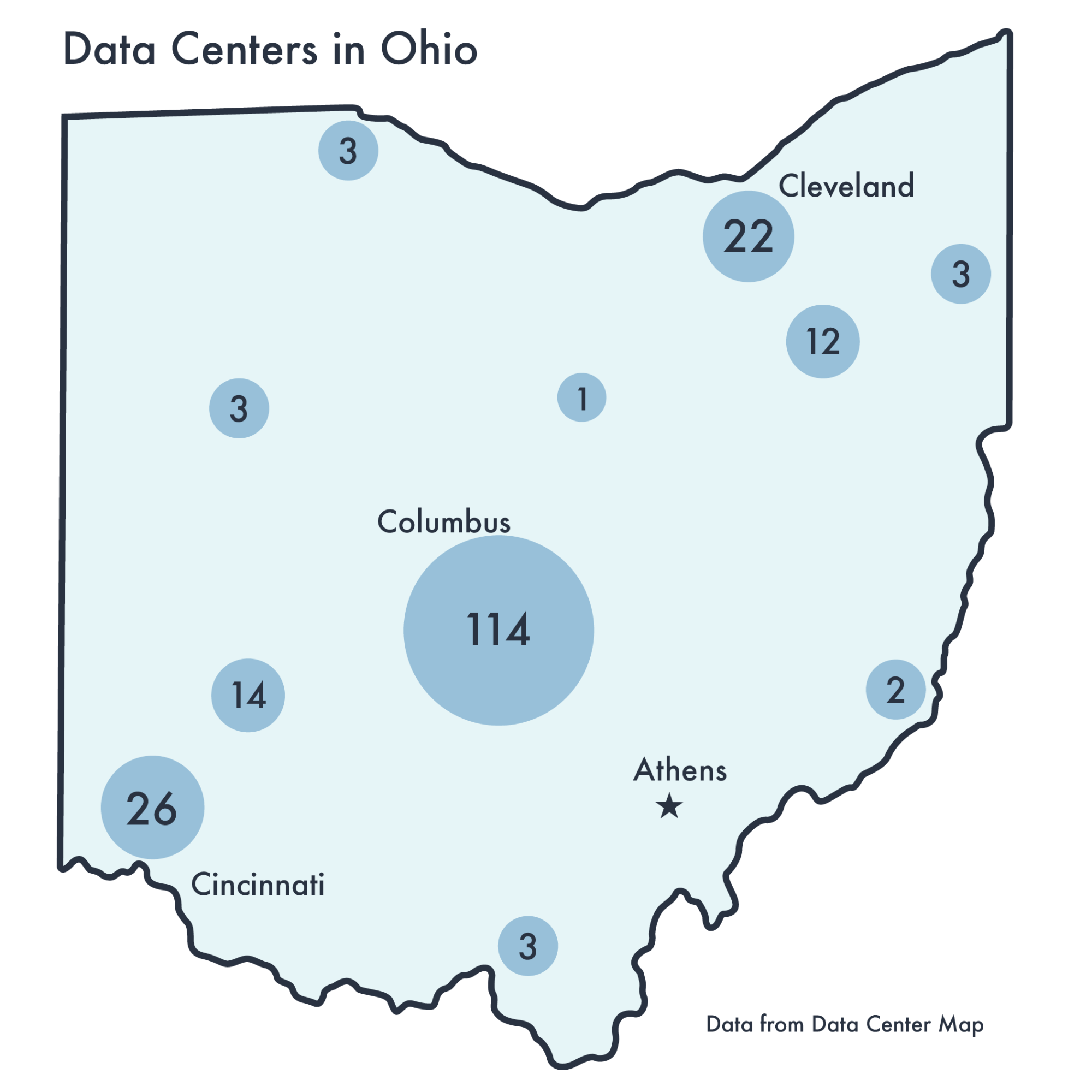
A coalition of Ohioans is collecting signatures to establish a constitutional amendment that prohibits the development of a data center exceeding 25 megawatts of electricity per month.
The Ohio Attorney General’s Office certified the petition title and summary for the amendment, known as “Prohibition of Construction of a Data Center,” on March 26. The grassroots movement is led by residents of Brown County, Adams County and Clermont County, Andrew Gula, an organizer of the petition, said.
Jessica Baker, one of the petition’s organizers and a Clermont County resident, discussed the impacts data centers have that sparked the idea for the petition.
“We started realizing that it's not going to benefit the community,” Baker said. “The tax abatements, the tax exemptions, the TIFS, the water consumption, the power consumption. We're screaming at every legislator that we can talk to our concerns, and we feel like nobody's listening, so we decided that we would just take it into our own hands.”
Republican Rep. Kevin Ritter of District 94, comprising Athens County, Meigs County and Washington County, addressed some of those concerns, urging readers to look at the specific data center being proposed and to stay informed on the issue. He said all data centers work differently and it is important to be aware and knowledgeable.
“We, of course, have the argument about the loss of farmland,“ Ritter said. "I don't think that's a big issue. I think there's lots of farmland across the state. One of the concerns I've heard is about the water usage … In the case of Washington County, the one being built here will use a closed-loop water system. So that means they will draw water once, and they'll treat it and use it over and over again, so it's not going to be an ongoing issue in terms of water usage.”
Ritter said the biggest concern people have is energy costs. However, he said the data center being built in Washington County is going to build its own gas-fired power plant and will produce more energy than it uses, eventually putting more energy in the market and lowering prices.
Baker said the movement has reached statewide levels. Their goal is to have a representative in every one of Ohio’s 88 counties, and they currently have one in more than 70 counties.
Gula, a Clermont County resident, discussed the process of meeting and talking to people about the issue. He said concerns about data centers lie on both sides of the aisle.
“I've met hundreds of people that I never probably would have met before, shaking hands, smiling,” Gula said. “I like to think of myself as an independent, probably left-leaning, and I'm hanging out with a bunch of people who are proud Trumpers, and we're getting along great. We're trying to work together as Ohioans, and I think that is one of the most positive things, whether this goes anywhere or not, it's everybody in this together. It's Ohio, it's people. It's not political.”
To address the growing rate of data centers in Ohio, Republican Reps. Gary Click of District 88 and Kellie Deeter of District 54 recently introduced House Bill 646, which would initiate a data center study commission.
The commission would consist of 13 members, appointed by the governor, speaker of the House and president of the Senate. It will require examination of various topics regarding data centers, have the committee submit its findings in a report and submit legislative recommendations to both the governor and the General Assembly no more than six months after the bill's effective date.
Baker said the study commission is a good idea, but thinks the legislature should be slowing down the expansion of data centers while the group studies its impact.
“It's good to study it, but for us down here, and actually, anyone all over the state of Ohio that these are coming into their area, we don't have time … we are in fight or flight mode down here,” Baker said. “We don't have time for them to study it, because some of these are going to be starting to break ground before they even get it passed in the Senate.”
The team landed on a 25 megawatt cap after the attorneys drafting the amendment pored over data to discover a “reasonably sized” data center. Baker mentioned Maine’s 18-month data center ban, which used a similar metric of 20 megawatts.
Ritter said the growth of data centers will have major positive effects for communities across the state. He mentioned the first concern he heard from constituents after moving to the area was that there were not enough consistent, high-paying jobs available.
“Data centers will provide that,” Ritter said. “They'll provide consistent, long-term, high-paying jobs for the area. The tax revenue that will come in will be very, very good for the school system, good for local governments, so economically, I think they're a very positive development for our part of the state.”
The group needs to collect more than 413,000 valid signatures from half of Ohio's 88 counties. The deadline to collect the signatures is July 1, providing the group with a little over three months to comply.


