United Academics of Ohio University is the labor union representing OU faculty members. Formerly OU American Association of University Professors, UAOU started organizing in 2019 and officially voted to unionize in March 2025, with 71% of faculty voting in favor of unionization.
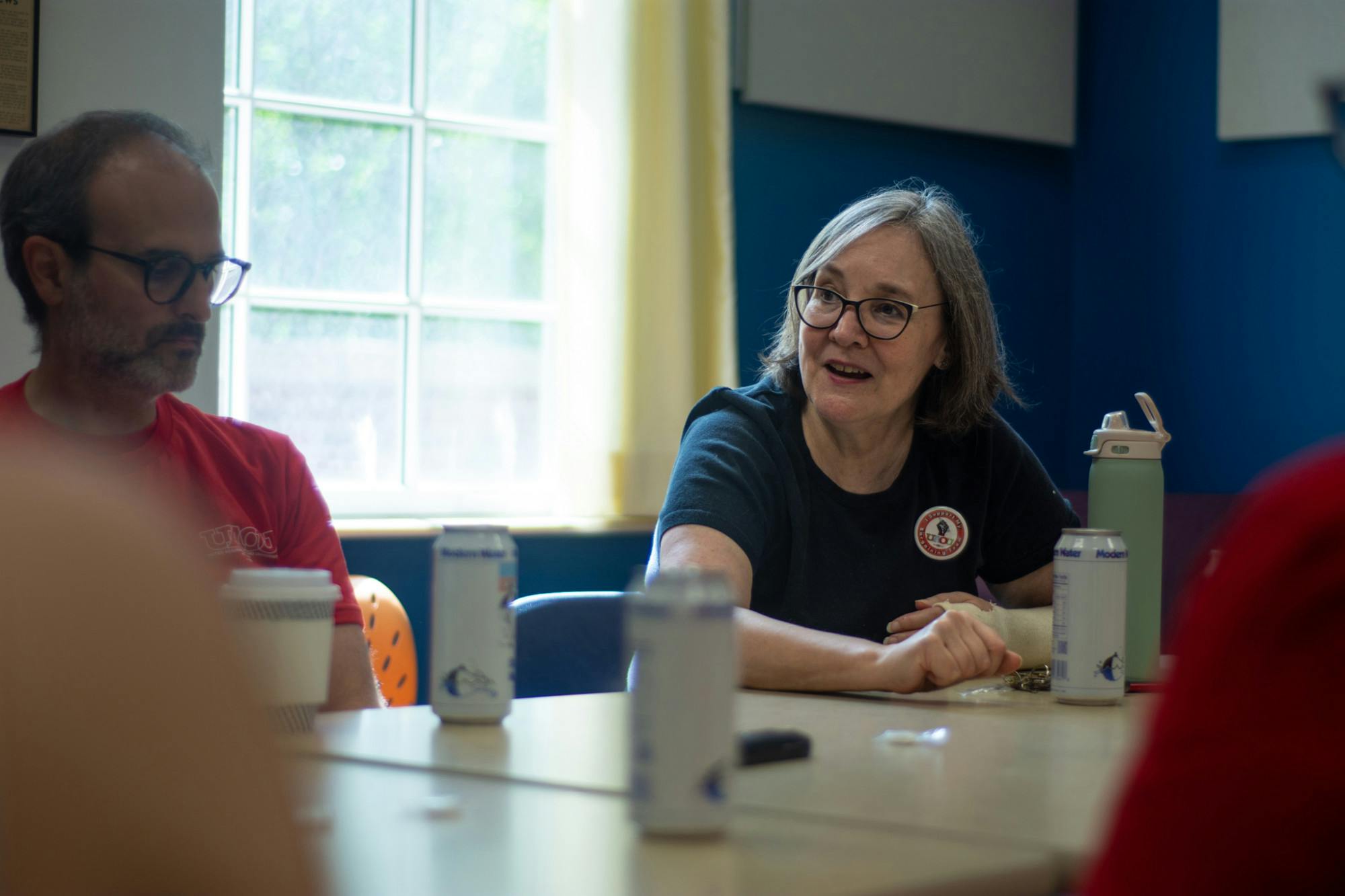
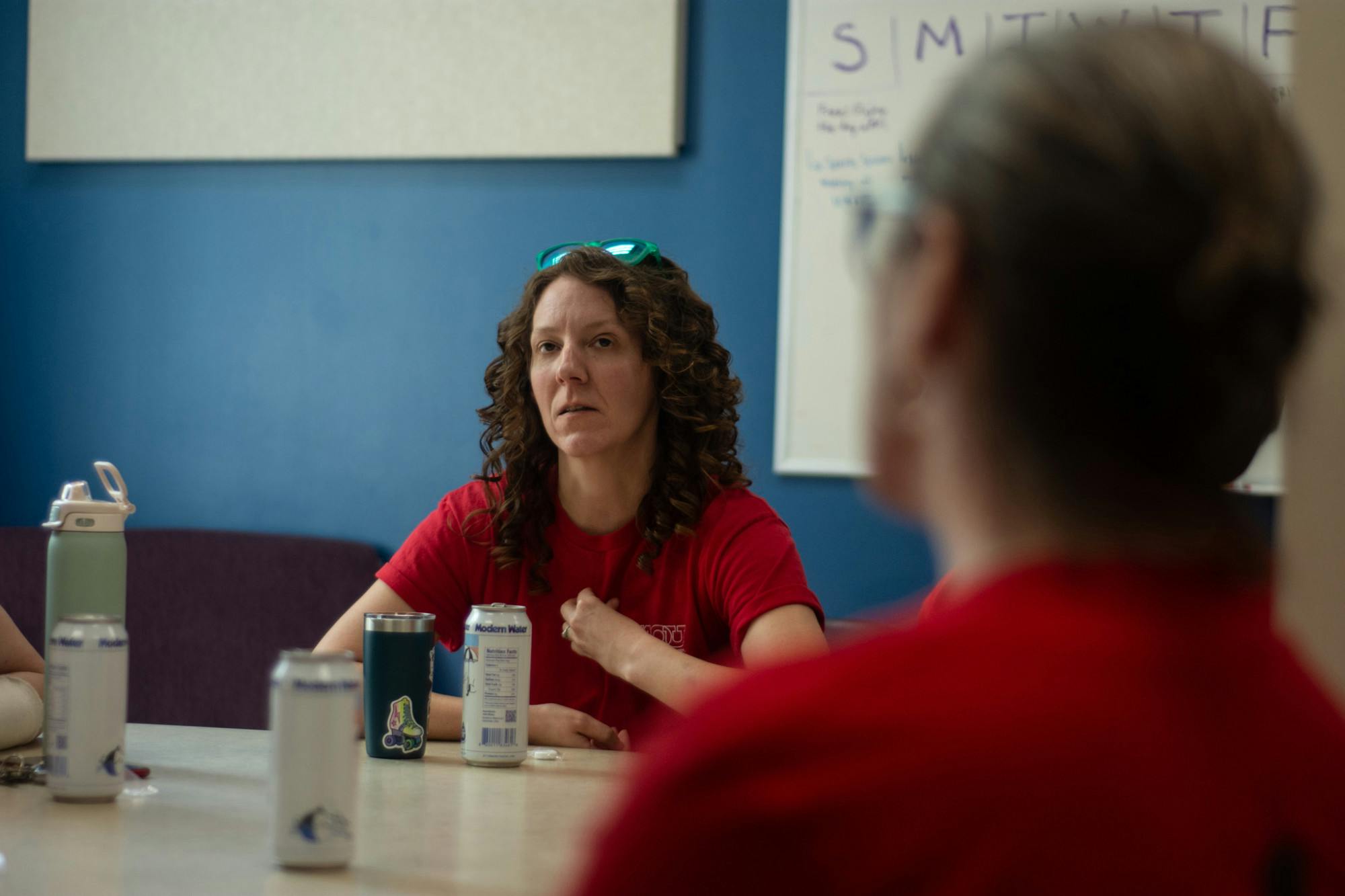
The Post’s executive editors – Jackson McCoy, editor-in-chief, Sophia Rooksberry, managing editor, and Alexandra Hopkins, community standards editor – sat down with members of UAOU for an hour-long conversation Friday. Present UAOU members included Matthew deTar, associate professor of communication students and organizing coordinator for UAOU; Miriam Shadis, associate professor of history and members of the union’s organizing, communications and nomination committees; Rachel Terman, associate professor of sociology and member of the union’s bargaining team; Joe McLaughlin, associate professor of English and member of the union’s bargaining team; and Julie White, professor of political science and member of the organizing committee.
Sophia Rooksberry: What was the moment you all knew you wanted to organize with UAOU?
Rachel Terman: It was during the pandemic, and it was a very stressful time, intense time for everyone, and faculty did a lot of work to get all of our classes online and make sure that we could finish out the semester. That semester, there had been talk about budget cuts, and there was a lot of concern, especially among instructional faculty and untenured faculty, about being laid off. I was also eight months pregnant with my second kid, and we made it to the end of the semester … and the administration was like, “We're going to pause on these budget cuts. Let's just all work together to get through it.” And we did, and then it was right after the semester ended, they were like, “Oh, budget cuts are back on the table.” They laid off several people from my department, instructional faculty and our administrative assistants, and we knew that the decision from the dean was that any untenured or instructional faculty were on the chopping block, and so I was just like, “Oh my gosh, my whole life is hanging in the balance here.” I was not laid off, but several valuable colleagues were, like I said, and I had been hearing about the unionization process or efforts, and I was like, “This is insane. We can't work like this.” So that's when I decided to join.
Matthew deTar: I think, for a lot of us, that was a moment. I was involved before then, starting in fall 2019, and that was mostly driven by my experience as an instructional faculty member at other universities. I had started on tenure track at Ohio University, and had the experience of tenured faculty and tenure track faculty not looking out for or using their tenure to protect instructional faculty, and I didn't want that to be me, so I got involved with AAUP first. I was just trying to get informed at that point, and then it was just a snowball of different things. It was the instructional faculty firings, over 50 instructional faculty in spring 2020, but at that same time, it was something like 152 staff at the university, many of them custodial staff, in the middle of the pandemic (who were fired), and it was just like, “What is happening? We need to defend ourselves, because the university administration isn't.”
Joe McLaughlin: There were also two years of buyouts where almost 200 faculty took buyouts and some departments were decimated. Despite the rhetoric from college, it was very unstrategic what they did, and the hiring back since then, despite the record enrollments, has been anemic, and that's a generous way to describe it.
Miriam Shadis: I had been involved in and out, and like Joe, (I thought), “I can't do this, but also, I don't know what I have to offer to the effort, etc.” Except that I had been involved or associated with AAUP for a really, really long time well before this, and we've had efforts in the past to form a union that were not successful, for various reasons. But for me, it seems that it's always been there. Why aren't we unionized? Faculty at other universities are, colleagues at other places have very different experiences of how they contribute to the status they have at the university in terms of their contract, but also in terms of academic freedom. I just think that to me, it seemed like a natural, obvious thing that if you have a university, the faculty should be organized. I'm a medievalist, and that's how it was in the Middle Ages.
Jackson McCoy: How have your academic backgrounds shaped your involvement differently, does that influence your approach?
deTar: I don't have any experience studying labor, but I'm a rhetoric professor, and so I do research on how emotional connection and affective connection produces either knowledge or attachment to various different things, and I started recognizing that I mean faculty do the job that they do primarily because they are invested emotionally in the success of their students and have very deep commitments to both the research that they're doing, but also the teaching and the success of students, and the more that they are personally and emotionally invested in that process, the more a university can take that for granted, and that is the location where faculty start to be exploited as labor. That is what is compensated, but is also the labor that makes the job worthwhile. It is the connection that makes the job satisfying, and then to not have the actual work being compensated makes that emotional connection more clear and makes it feel like I am participating in cruel optimism or something.
Shadis: For me, as a historian, I'm like, “Unions built in America.” I also have a little bit of background in (women’s, gender and sexuality) theory or studies. Thinking about how what we do is labor really is important, and I think that's a leap that a lot of faculty don't always make. They don't think of our jobs as labor, but looking at the historical background of not only unionization, but labor and other things in this world, that helps me see what we're doing.
Alexandra Hopkins: How has the history of labor, specifically in Appalachia, influenced and inspired UAOU organizing?
Terman: My area of expertise is in Appalachia, so I knew a lot about the history of labor organizing in the region and the contributions to labor history from this area, and within that I also know that unions don't solve everything, and that there are power structures within unions that can be problematic. So, I think that's helped me, individually, just in my own capacity and in the many years of organizing, is understanding that there is not going to be a perfect solution, necessarily, but I think that there is a lot of power in when the workers come together and talk to each other and share experiences and know what is going on across the workplace, and can use their collective power to speak to the issues that are important to what's going on at the institution. I think that we're in an area where there's a lot of rich labor history, and so I think that continues to be inspirational. I think it's always exciting when we connect with other labor unions and other unionized folks in the area, and so I see all labor organizing as part of a long tradition in our country, and of course, this area has been an important part of that, historically.
McLaughlin: To think about the state context, this has always been a huge labor state, and as you may know, after we formed our union of the public universities in Ohio, Ohio State is now the only one without a union. Miami just got theirs a couple of years ago, but most of my career, most of the institutions in Ohio have been unionized, and for most of my career, until about 10 years ago, this university was interested in keeping up and doing well competitively with faculty. Many of us knew that we were kind of riding the coattails of other institutions where the faculty had unionized and bargained for good contracts, and about 10 years ago, that stopped here. That was no longer a priority of the administration at OU, and we were kind of left hanging.
Terman: A lot of Appalachian history is about unionization within coal mining, and a part of that was because those towns were almost completely reliant on the coal mines for people's livelihoods. There wasn't a diversified economy, and so pretty much everybody worked at the coal mine or had a family member who was working at the coal mine, and so when that labor was not being treated well, that was the reason why workers came together, in a lot of ways, because everybody in the in the community relied on that employer. It's not exactly the same here, but OU is the biggest employer in this area, and so much of our community is dependent on OU, and so I think that we can draw a comparison there in terms of “the company town.”
Shadis: The faculty who come to Athens, most of us — there are exceptions — are not from around here, but I think that people invest in this place, invest in this community, understand very much the nature of not just Athens city, but Athens County and the surrounding area and what our relationship is to those places. It's not for everybody … Some people have to move to Columbus, but mostly you have a really unique situation here. When you think about it, there's no real boundary between Court Street and the green. There's just no boundary between the faculty who work here and the lives that we live in the community and out around, so I think about that sometimes. It's that commitment that people have, too.
Terman: It's been so great lately to see all of our social media posts with the businesses that are supporting the faculty union, and I think that just speaks to our community spirit here, and that our community recognizes we're all part of something together, and that we go drink Donkey Coffee everyday, whatever it is. It's not just faculty, of course, the staff and other folks who work at the university are part of that community as well.
Rooksberry: How are the negotiations going? What have the attitudes been about the negotiations, for you and for everyone on the other side of the table?
Julie White: Slow.
McLaughlin: I don't know that we can talk a lot about specifics of what goes on. I think we can reiterate something that has been at the core of our messaging since we started bargaining last August, which is it's very frustrating and it feels incredibly disrespectful, all of the delays that we've experienced, that we continue to experience. (Friday) is 170 days since we introduced our compensation proposal to them, and we have heard nothing in response. Yet, this is the time of year when administrations are planning budgets and plans for next year, and because of status quo provisions, this is a second year in a row now that 900 faculty are not going to be receiving raises, and that's not because we didn't try to push the process forward in an expeditious fashion. I think I can say this without getting into trouble, just as that wider context of delay is happening, I would say the atmosphere in the room is leisurely.
McCoy: Dr. White, you said “slow.” Is that pretty similar?
White: Yes. I will just reflect on the sense among faculty who are not at the table. Yes, I think that it's going too slow in the eyes of many faculty. Some of the proposals have been things like longer term contracts for instructional faculty, and it makes a difference to have faculty who have stable jobs, because they carry with them a kind of informal knowledge of curriculum, of students, and I think our instructional faculty more than deserve that, but it is also really in the best interest of students for those faculty to have some commitment from the institution to their employment going forward. So, understandably, many of those faculty feel very vulnerable, and I think when there's a leisurely pace adopted by administration, I think that creates conditions where we're likely to lose faculty, and we've lost a lot of faculty over the last couple years.
Shadis: It's not just leisurely in the sense of them taking their time and making an argument or presenting information. It's also the pace of the frequency of the meetings. I certainly thought that they were going to be meeting weekly until they got this thing done. The rest of us have weekly meetings and we do things, it’s our job. That they haven't been able to find the time to meet regularly is appalling. Actually, I find it shocking, and so it's got to be purposeful, and that's really upsetting.
McCoy: What's something you wish that more students specifically, or just people in general, knew about the negotiation process as you're going through it?
McLaughlin: I think it's important for students, people in general, to know that historically in bargaining, first contracts always take a long time. We're probably going to be back at the table every three years from this point forward … The other thing, which I think more people need to know, although quite a few people do know, our negotiations have been incredibly complicated because of Senate Bill One. We're the first union at a university in Ohio to bargain a new contract under Senate Bill One. As you might have noticed, our administration is hyper-cautious and over-compliant with Senate Bill One. This is one of the reasons why I think of their six person bargaining team, four of them are lawyers, one of whom is the General Counsel, Stacey Bennett, who, frankly, I was kind of surprised to see as part of the bargaining team. There were certain things, because of Senate Bill One, that we can simply not bargain anymore. There's a lot of gray area in there as well, and their response to the gray area is to just stay as far away from those issues as possible.
McCoy: What are some of those things that you can't bargain for under Senate Bill One, are there any specifics that really stand out?
McLaughlin: Tenure, and post-tenure.
deTar: In most contracts at unions in Ohio, there's a clause about how the university will fire faculty and close departments, and where the tenured faculty in closed departments will go within the university. We can no longer bargain any of that after SB 1. This happened to our colleagues at Wright State where they closed departments and they had to move faculty to other departments who were tenured, and their union fought to make that happen, and we can't have that kind of a clause in our contract. It's explicitly prohibited in Senate Bill One.
Terman: I know one thing that faculty would really like to have in our contract is workload, but that's also prohibited, not by SB 1, but previously prohibited.
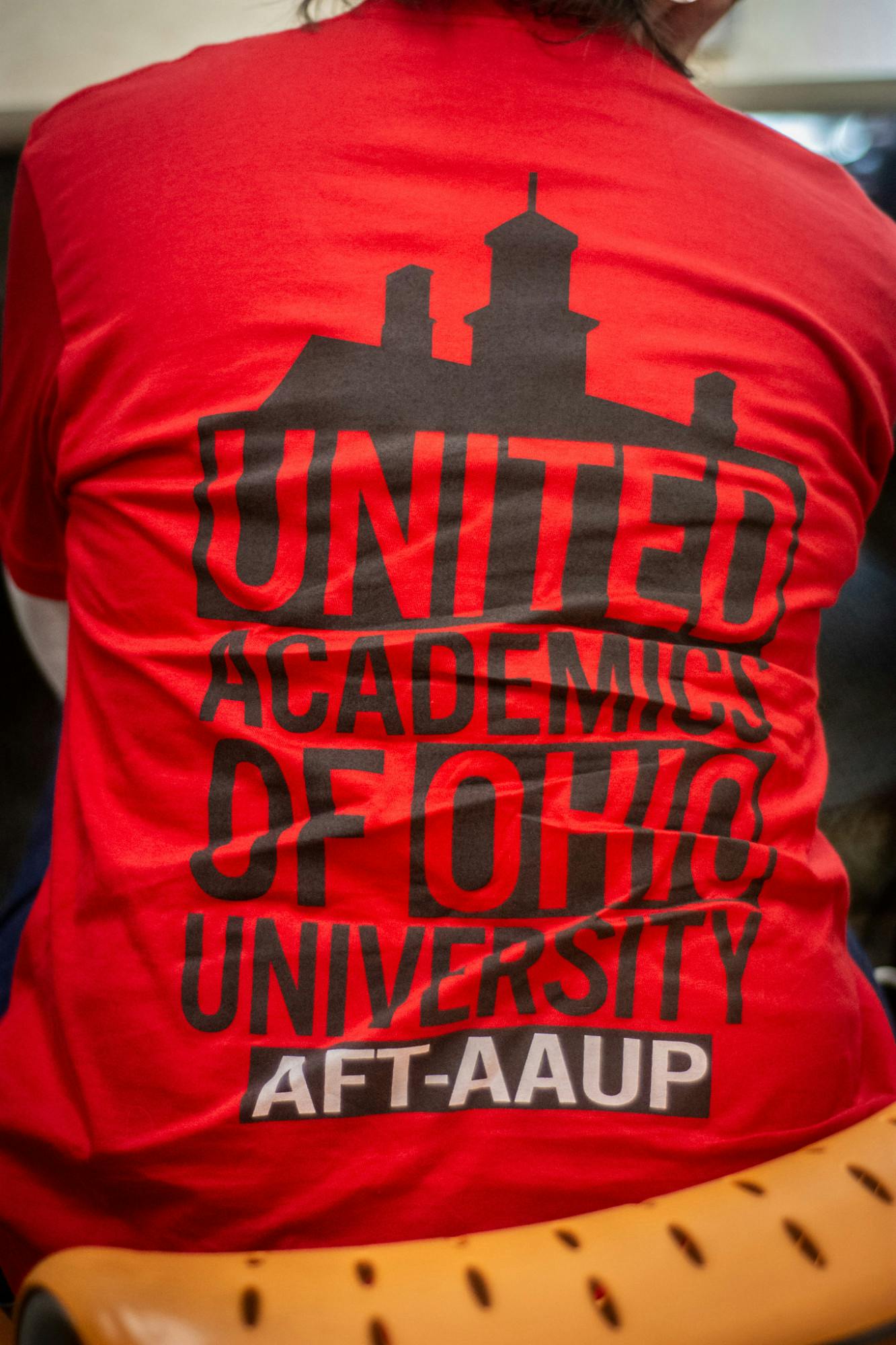
deTar: To your question about what students and faculty maybe don't know about the bargaining process, the thing that happens in the room is not the thing. That is not actually where our success will be achieved, Essentially, and this is true for the current student movements that are happening on campus, the success of those movements and the success of our movement will happen from our ability to make it inconvenient for the university to continue to delay and not respond. That's part of what our public pressure and public presence is about, is trying to get them to actually do the thing they're supposed to do at the table and that they're trying to delay doing, and so we're trying to be loud. We were at the Board of Trustees meeting this morning to do that. That's why we're all wearing red shirts.
McLaughlin: Our partners, American Federation of Teachers, when I became part of the negotiating team, sent me to a collective bargaining conference last summer, and the big takeaway for me is someone stood up there and said, “You are not going to win things because of your debating skills at the table. It's not about you. You got to go do the work, you got to negotiate, but it's pressure from other places.”
deTar: Pressure from local businesses, from students, from alumni – those are the things that will actually win us a contract, not our ability to debate at the bargaining table.
Shadis: Which is one reason why the slowness of things is so irritating, because they can really drag out the momentum … People are busy and they have full time jobs apart from bargaining or apart from organizing, and so reorganizing everybody to make a stink, to stand up, to say something on this very awkward schedule is crafty.
Rooksberry: You mentioned a little bit about Wright State being an example that you look to. Are there any other institutions in the state that you guys look to for inspiration or see examples of things you can emulate with your process?
White: We've used University of Cincinnati as a model for a compensation package. I think they have a union that's been pretty successful in terms of ensuring that faculty salaries keep up with inflation, at the very least. I also think places like Bowling Green, their faculty after unionization had a very much improved relationship with administration, because there are ways in which a union contract simplifies what administrative discretion has to be used, so I think that those were inspirational models for me.
Terman: That was part of our organizing leading up to the election. UAOU reached out to faculty unions across the state to learn about what it was like there and what the conditions were for different departments, different disciplines and that kind of thing. I think we learned a lot in that process, and I think that it's a noble goal … Faculty really want to be working at a place where they're collaborating with the administration. I think everybody has a vested interest in the success of the university and the mission of the university, and at the end of the day, we are all passionate about our jobs. We love what we're doing. We love what we teach, what we research, we devoted our careers to that, and so I'm hopeful that the ultimate outcome will be improved working conditions and learning conditions and an improved relationship with the administration.
Hopkins: What is different about this negotiation process, as opposed to other “typical,” for lack of a better word, negotiation processes?
McLaughlin: SB 1.
deTar: Joe already mentioned the number of lawyers in these meetings. I don't think that’s typical, especially at the university level. There is a lawyer employed by the university who is for negotiating contracts, Mike Courtney. He's the head of labor relations at our university, but his boss is also in all of these meetings, which is what is so surprising, and they're doing that because of SB 1 and this attempt to over comply in ways that benefit the administration. I think that, historically in Ohio, there have been lots of changes that have produced union contract development. Kent State negotiated its union contract before there was any law in Ohio about public employees, because they unionized right after the shooting, and so they were the first faculty union in Ohio, and since then, every union has sort of organized in a different atmosphere. So part of our comparative approach to these different unions is to think about, “When do they do this? Is that possible for us or not?” And some of it is not possible for us.
McLaughlin: I don't know typical or atypical, but they are a six person bargaining team. So we've got two lawyers from the OU general counsel office. We have their lead negotiator, who is from BakerHostetler firm, who also comes to the meetings with a junior partner from the firm who has been at least three or four different people at this point. David Moore, who is the vice president for finance and administration, and Cary Frith is the executive assistant to the provost. Kerry is the one person on the other side of the table who actually understands what our jobs are. That, again, is part of the disrespect, and while it is good that the president has chosen to send two vice presidents to the table, that's part of the problem too, because these people are enormously busy. I think not appointing a team who either could or were willing to make expeditious negotiations a priority is, again, something I take as a sign of disrespect on their part.
McCoy: Speaking of the president, in our interview that we did with her a couple weeks ago, she had mentioned specifically that under SB 1, faculty cannot strike. Can you talk about that a little bit? Are you looking for alternatives to a strike?
McLaughlin: As we looked at other contracts around the state, going back to things that we can't bargain, most of them have provisions in their contracts that talk about strikes. We just can't even talk about that.
deTar: It's true that we can't strike under SB 1. A union's power doesn't actually come from its ability to strike. I think a lot of people boil down the negotiation process to like, “We're either going to bargain this or one party is going to walk away from the table and go on strike,” and I don't think that is the reality of how strikes usually operate. In order to strike, your members have to vote. So, Ohio University faculty, 51% of them would need to vote in order to have a strike. I've talked to a lot of faculty in my college, the Scripps College of Communication, but also a lot of faculty in the College of Engineering. I'm not sure that that would ever happen anyway, so the point is not necessarily that we can't strike. That was never going to be the way that we wanted a contract. I think that our organizing power comes not from that. I think it's disheartening, certainly, but that's not where our organizing power is.
Terman: I think that when people hear about labor unions, they think about strikes because they're the most dramatic and they make movies about them, and that's what's in the news, when the news does cover labor unions in general. They don't cover “it was another day at the table” or “made progress on this proposal today.” It's not movie worthy.
McLaughlin: There was a strike at Wright State about 12 years ago, which was very traumatic in Columbus. Guess who the chief negotiator for the university was? Daniel Guttman (The chief negotiator in OU negotiations). One thing that people have been talking to us about, especially since this thing in SB 1, is the fact that there are public employees like police and firefighters who are not allowed to strike either, and yet they still have effective unions. We've got 800 faculty to figure out how to be creative about things that we could possibly do in the absence of striking, so those are conversations that happen.
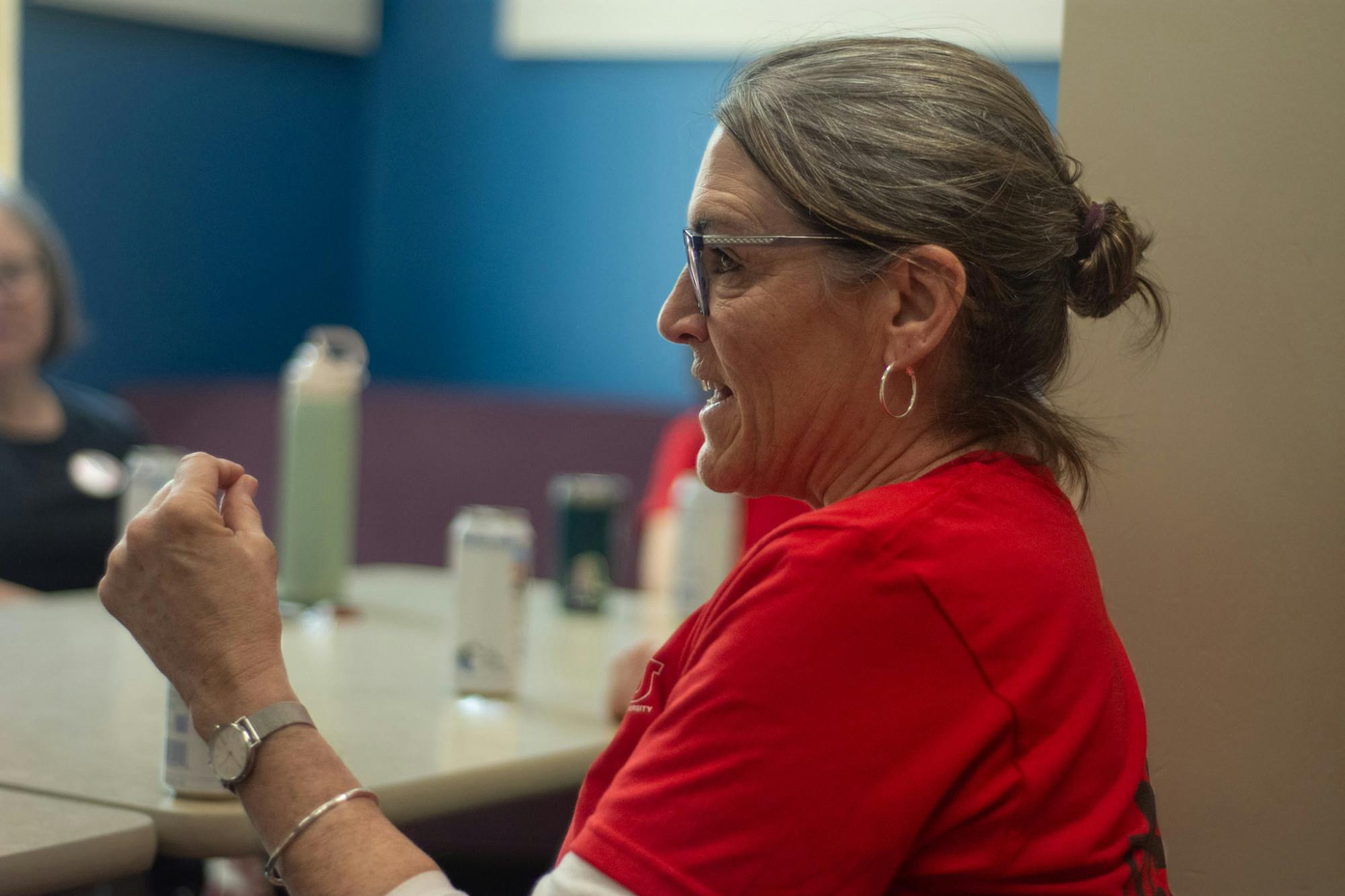
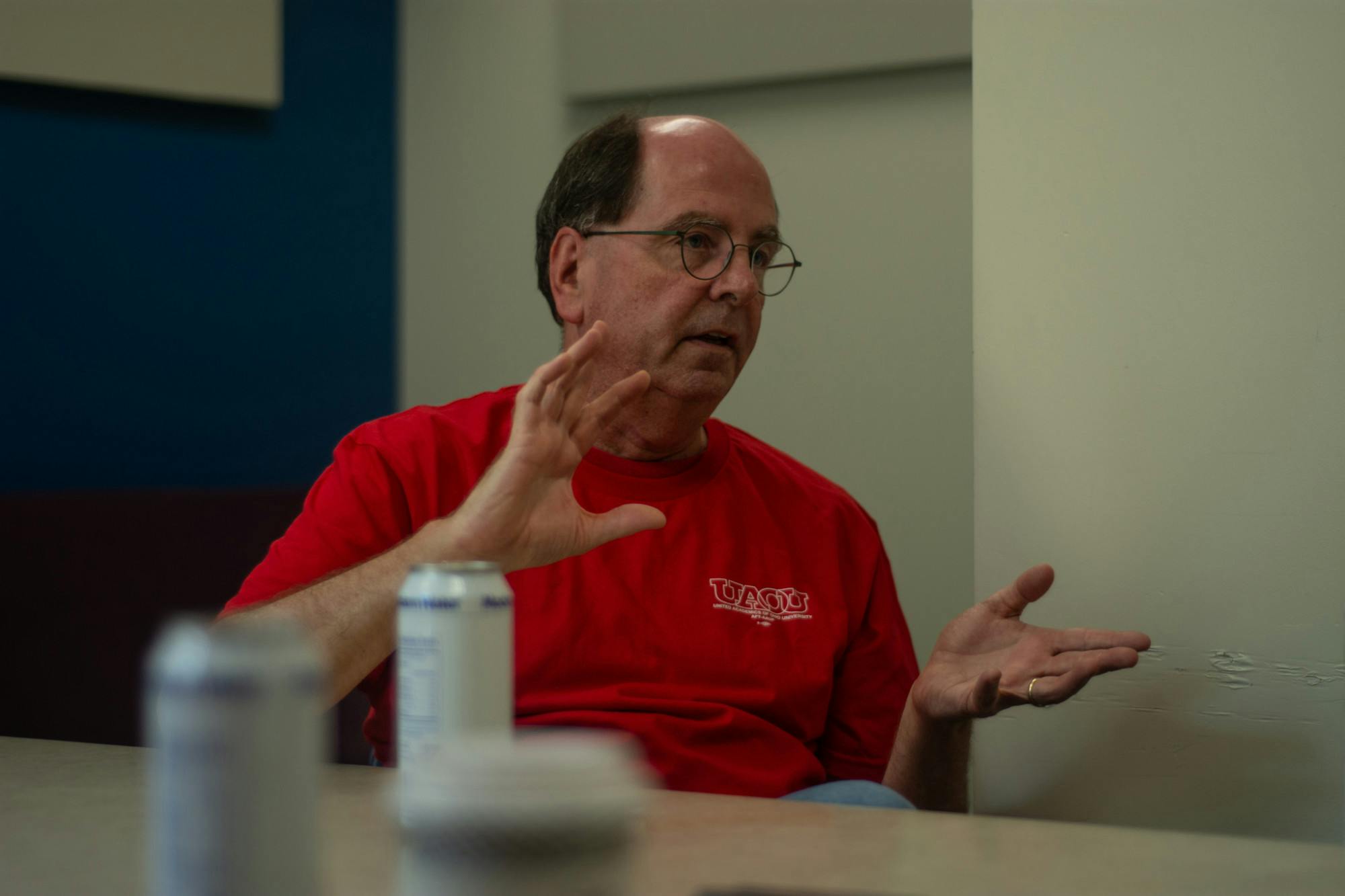
Professor Julie White speaks in The Post Newsroom in Baker University Center, April 17, 2026.
McCoy: Why do you think OU is one of the last universities to actually organize a union in Ohio, especially considering how old OU is?
Terman: I don't know the answer to this question. It would be really interesting to research this and find out … but there had been administrations that were interested in maintaining salaries and working conditions such that there wasn't as much of a need for it, or there wasn't an impetus.
Shadis: When I first came to Ohio, which is now 30 years ago, I felt like the faculty commitment to Faculty Senate was pretty strong, and Faculty Senate had a voice and people felt that it represented them. So when we started talking about unionization 20 years ago, there was a lot of skepticism about what this would do to Faculty Senate, and do we really need this? There was a particular culture here of governance that was effective enough, I think. Also, our salaries have gone down. There was a time when I think people just didn't feel the urgency of it.
McLaughlin: There was a commitment on salaries to be the top three in the state, and I served on Faculty Senate for 20 years, and I watched this happen over time. There was a lot of respect, there was a lot of feeling that it mattered. Then, by the time I was done 20 years ago, my model of what Faculty Senate had become is what I call “thank you for your input” shared governance. It was like we were being treated like a suggestion box, and that's not going to get us anywhere.
McCoy: When we interviewed President Lori Stewart Gonzalez, we asked her about UAOU, and she said, “Well, I'm a faculty member as well” and that was the ethos of her response. I just want to know, does she show up to Faculty Senate meetings? Is this something that you've seen? Is she present at these?
Terman: Yes, but as the president, not as a faculty member. (Administrators) leave, which I think is part of the procedure, they come and give a report and take a couple questions, and then they leave for the actual bulk of the meeting when the work is happening.
Shadis: It would be delightful if she really wanted to engage as a faculty member with faculty, even controversially, even on the other side of things.
McCoy: Is that different from previous presidents?
Shadis: President Duane Nellis actually liked being a faculty member. He tried to do that, even though it was not super successful. But I think it's been some administrations ago that was something the president could easily do.
McLaughlin: We’ve always complained about the same things with past presidents, but in retrospect.
Shadis: I was thinking today about President Roger McDavis, who was here for a long time and had his share of conflict with faculty. He at least had regular coffee (and) donut situations where he would invite some faculty to come and talk to him. If it was all performative, that's okay. It was something.
Rooksberry: Could you speak a little bit to the impact that specifically student support has had for you guys and how you operate?
McLaughlin: They show up. They were there at our event this morning.
Shadis: It's so encouraging. It's just personally encouraging.
McLaughlin: (A student) got arrested (Thursday) and spoke up at our rally this morning. It's inspiring to see all those students, and there's a lot of students who either come to things, say, “Hey, where can I get a button?”
deTar: Personally, there's a lot of ways in which the university reinforces the idea that students and faculty are separated. Faculty give grades, students receive grades and try to earn grades, but I think the way that these events have been working is building a community of shared support, and I feel like that is a different feeling of the university than one where it happens in the classroom, and outside of the classroom there isn't that shared community feel.
White: I think there are just very concrete, shared frustrations. For instance, class sizes that are too big for your students to get what you hope as an instructor they will get out of the class, and also you're often in a position where you can't give the kind of feedback that would make a difference to the student moving through the material. I think there are some really concrete convergences of interest, and when we lost the 53 faculty we lost in 2020, we lost some really experienced and well-loved instructors, and replacing them, which we almost immediately had to do, because after COVID, our enrollments bounced back and then exceeded what they had been in the past. They've been slow to bring new people on, and oftentimes it takes all of us a little bit of time to get up to speed. I feel like the students know how to value faculty much more clearly than the administration knows how to value faculty, because they're in the classrooms and they recognize the difference between getting what you need out of the class and experiences that aren't what students or faculty would like to be having.
Shadis: It's not just the individual classes, but also the fact that we can't offer whole areas of study. In my department right now, it's kind of a shambles, and it's not all to do with the firings. It’s just the general misapprehension that the university seems to have about how a department needs to be structured, and how much that matters to the student experience, to be able to say, “Oh, I took a course in African history, or I took a course in Asian history.”
McCoy: There were two students arrested (Thursday) at the Board of Trustees protest. What were your reactions to that when you heard about that? Was that encouraging, disheartening?
Shadis: I mean, so unnecessary. I think it makes the university look really bad. It makes them look anxious and punitive. I wasn't able to be there, I don't know what happened. I didn't see anything, I just heard about it. It's like, OK, this is now time consuming and it can be expensive. It wasn't like there were these two students who were causing all this trouble. There were 100 students there, so they were making an example out of these two kids, I think. That's my impression, and it just seems like a bad look.
deTar: I think it just further demonstrates the fundamental misunderstanding of administration about a university. This is not support for students. This is quite shocking, really. It also demonstrates a quite short memory. The Baker 70 (70 student protesters arrested during a sit-in in Baker University Center in 2017) is still very recent, and so to not know what harm that did to the university, it's appalling.
McLaughlin: I was struck, going to the rally, which I could only stay for the first 20 minutes, but I heard four or five speakers. Although they were mentioning things they were angry and frustrated about, like the closing of centers, like the lack of clear understanding about the university's vision of what happens when ICE comes to campus, what I heard even more strongly was they were out there protesting because the university was refusing to engage with them and dialogue. So, there were these issues that were hanging in the background, but we had a town hall and the president didn't show up. The president holds one office hour a month, and you have to submit questions in advance and hope your question gets cherry picked, probably Communications and Marketing decides who gets to talk to the president. It's those kinds of frustrations, is what I was hearing out there. Yes, there are issues, and people are angry about them, but they're just fed up at the non-response that they're getting from the university. In that sense, that seems something that's very similar, not only to what we're experiencing in negotiations, but what we have been experiencing from the administration for a very long time.
Shadis: It's really sad to me that this administration has alienated themselves from faculty, from students, from the community. I don't know what's going to happen, because they're the ones who get the most money and have the most resources, but they're kind of pinning themselves in a corner, it seems to me.
Rooksberry: If you had to speak to one specific principle that UAOU stands for, what is your guiding force that keeps you motivated?
White: Democratic control of the institution by the faculty and shared governance.
deTar: Increasing academic freedom.
McLaughlin: Now, when we polled our members about this last year, money is what rose to the top … We used to be third, or close to third, in all ranks for average salaries in the state of Ohio, and now we're the worst paid research faculty in public institutions in Ohio.