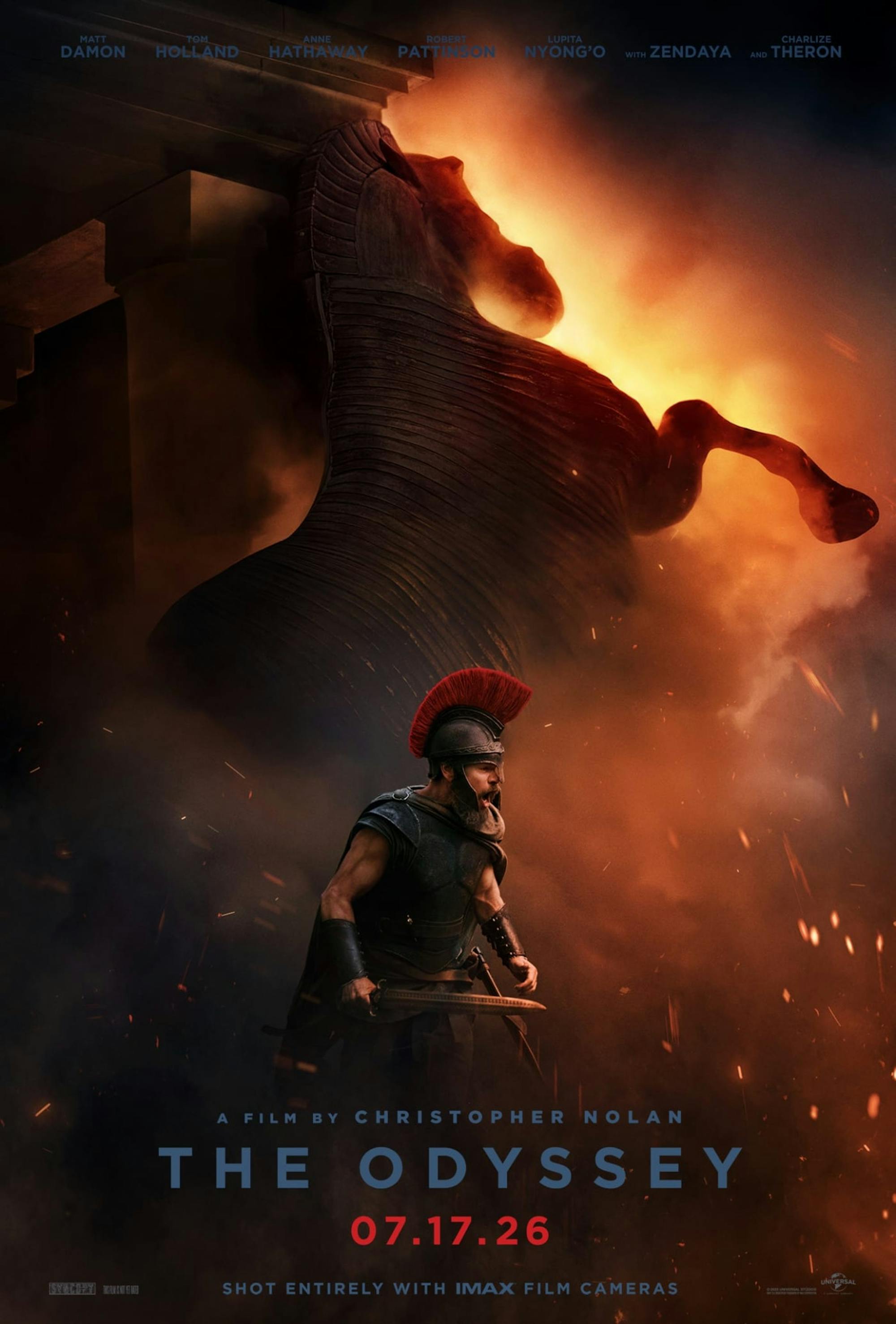
On July 17, Christopher Nolan released his film adaptation of the epic Greek poem “The Odyssey.”
“The Odyssey” recounts the tale of Odysseus (Matt Damon), the king of Ithaca and a general in the Trojan War. After fighting for 10 years against the people of the walled city of Troy, Odysseus devised a plan to win the war in one night. As everyone began their voyages home, Odysseus and his men decided to take a detour, one that would lead them down a dangerous path and come face-to-face with monsters and the wrath of the gods.
Around 10 years after the end of the Trojan War, Odysseus’ wife Penelope (Anne Hathaway) and son Telemachus (Tom Holland) are still waiting for Odysseus’ return. The rest of Ithaca has given up on the idea he will ever return and is pressuring Penelope to remarry one of her many potential suitors, so Ithaca may have a king again.
With a new looming threat on the horizon and a new clue of Odysseus’ whereabouts emerging, Telemachus decides to take matters into his own hands: either bring Odysseus home or ascend to the throne of Ithaca himself.
The film shifts mainly between the perspectives of Odysseus and Telemachus, telling the story of Odysseus’ journey home through tales Telemachus hears and Odysseus’ own memories. This type of non-linear narrative is a common storytelling tool Nolan uses in many of his films, going as far back as his first feature film “Following” in 1998. This method allows the film to keep Telemachus' story moving forward, while still maintaining the mystery surrounding Odysseus' 10-year journey.
“The Odyssey* shares many similarities with other films directed by Nolan, including minimal use of CGI, high-contrast visuals and a very self-serious tone. One of the most Nolan-esque decisions made was the choice of making the gods’ existence ambiguous.
In the original poem of “The Odyssey”* by Homer, the Greek pantheon of gods makes many direct appearances in the story to toy with Odysseus and his crew. In Nolan’s version, the gods appear through natural events such as bad tides and thunder in the middle of a clear day, causing the characters to read these events as signs of the gods' favor or fury. The uncertainty of what is real in the world is a common trope in Nolan’s works, with notable examples coming from his films “Inception” and “Memento.”
However, Nolan included elements of horror, different from any of his past works. In certain supernatural scenes in the story, Nolan mixes jump scares and body horror to bring an overwhelming sense of unease to the audience. Nolan has rarely dabbled in horror elements in his films, but its use in “The Odyssey” lands well in the scenes where it's included.
“The Odyssey” was also the first film in cinematic history to be entirely shot with IMAX cameras. IMAX cameras allow for a much larger film roll than traditional cameras, allowing the film to be projected onto a much larger screen without any negative space or losing any detail. “The Odyssey” took full advantage of the IMAX format, using the larger images to create a film that is both visually striking and deeply immersive.
Along with the IMAX cameras, “The Odyssey” takes full advantage of its legendary cast. Every actor delivers fantastic performances, elevating the story to a whole new level. A good example comes from Robert Pattinson, who plays Antinous, one of Penelope’s suitors. Despite having a relatively simple motivation, Pattinson plays Antinous in such a way that feels both confident and pathetic at the same time, making his performance stand out in an already stellar ensemble.
Despite following the overarching story of “The Odyssey," fans of the original story will quickly notice how much is cut out or altered in Nolan’s version. Many iconic scenes from the original text are either changed to match Nolan’s style or removed entirely.
It is understandable why they did not adapt the full story. Although the film is three hours long, to effectively include all aspects of the original story, the film would most likely have to be almost double that runtime. Despite skipping over much of the original text, Nolan’s version still hits enough beats of the overarching narrative.
Much of the whimsy of the original story is also taken away to fit Nolan’s self-serious style. Many scenes that had a subtle layer of joviality to them had that layer removed, such as the scene with the Cyclops, one of the most iconic parts of “The Odyssey.” While removing that layer works for the vision of “The Odyssey” Nolan has, it would have been nice to see at least some of the original whimsy make its way into this version.
Some of the characters also suffer from Nolan’s changes, most notably Calypso (Charlize Theron) and Odysseus. Calypso has much of her original complexity removed to serve as a vessel for Odysseus’ development. Odysseus, similarly, is a notably intelligent and witty character in the poem, but due to the removal of certain moments that highlight his intelligence, he never fully reads as witty.
Despite the issues with accuracy to the original story and character depth, Nolan’s version of “The Odyssey” is a spectacular film with a lot going for it. The cast, the visuals and the overarching narrative combine to make a film that is as impactful as it is stunning. “The Odyssey” is a truly epic film and one that can stand among Nolan’s best work.
Rating: 4.75/5