


Politics are like an investment, and your vote is the unfortunate collateral at the banking till. This system of contemporary political campaign buys advertising, floods the airwaves and claims victory before the race is over.
And with a limitless war chest, Democratic candidates for the United States Senate are being outspent by their Republican opponents. That spending scheme puts more pennies in the deep pockets of this country’s division while avoiding corrupt corporate donors right below the spending surface.
Election spending for Senate candidates has surpassed $2.8 billion during the 2026 election cycle, a 22% increase from the 2022 election cycle. At that rate, the Senate spending madness will not conclude under any circumstances, creating mountains of money for relatively no public gain.
The Ohio Senate race is a great example. The race between Sherrod Brown, a former United States Senator, and Senator Jon Husted shows how Republicans are increasingly outspending Democrats in the election cycle.
In Ohio, Republican Senate spending on aired media, such as broadcast TV, has outpaced Democratic Senate spending by $41 million. That creates a disjointed election strategy as dark money pours from unknown places, making it difficult to counteract Republicans’ fundraising.
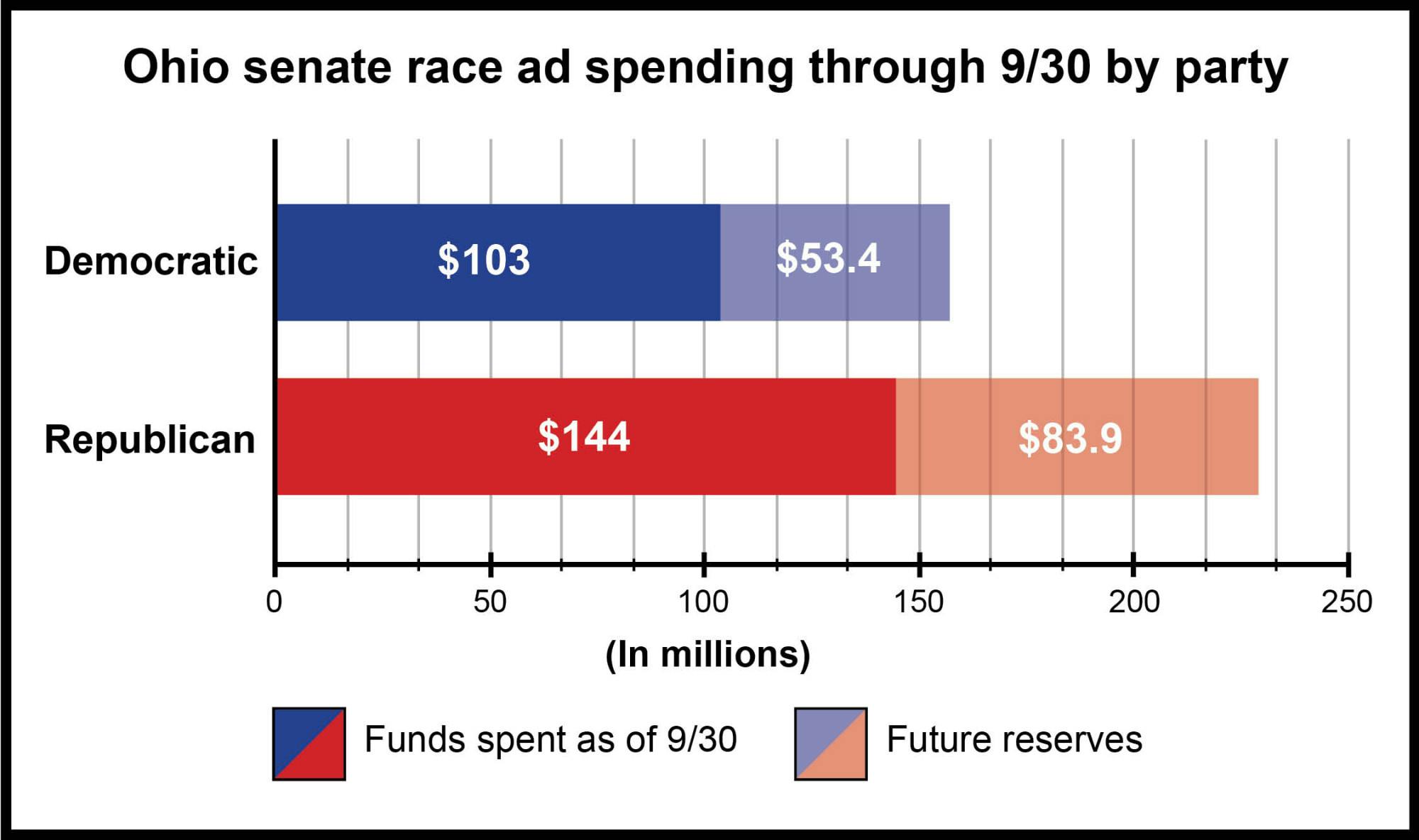
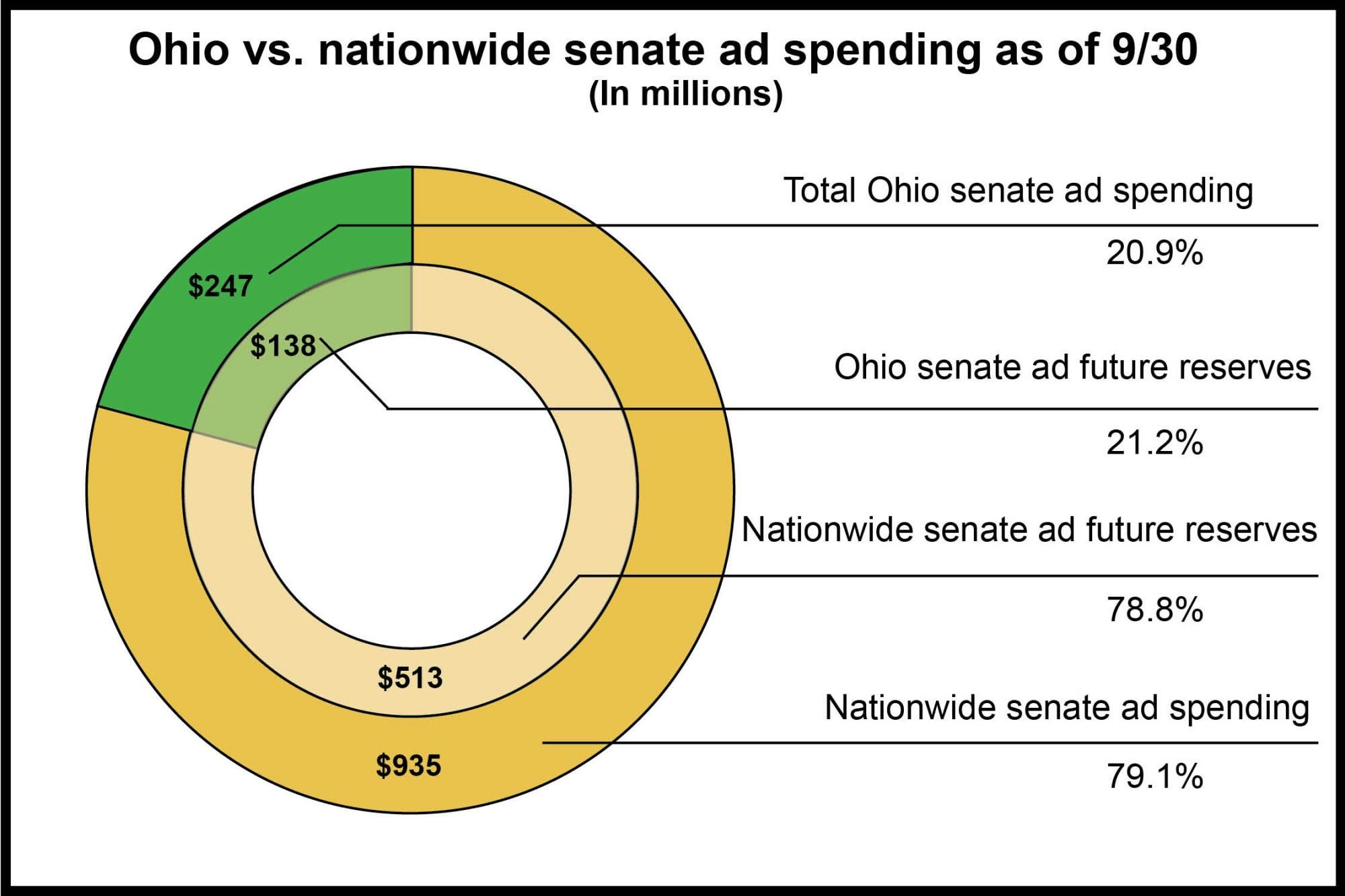
This cycle raises a serious question. Given rising prices at the gas pump and grocery store, it remains unclear whether Republicans’ spending advantage will be enough to propel them to victory.
One way to look at this is through presidential approval ratings. Support among core President Donald Trump voters from the 2024 election cycle has fallen dramatically according to the Pew Research Center. Among Trump voters in general, his presidential approval has fallen from 95% to 67%.
Key voter bases are quickly shirking the Trump agenda and going elsewhere, becoming receptive to Democratic messaging or not voting at all. Those same voters who voted for Trump in 2024 may not be as likely in 2026 to back his Republican colleagues running for congressional seats.
The problem with that is both major political parties generate millions of dollars during election season to cultivate coalitions of voters for electoral victory. Yet, once the election is over, little money is spent to keep those voters in the loop.
Once a campaign ends, any leftover money faces strict regulations. For example, a campaign can contribute unlimited amounts of money to state, local or national party committees such as the Democratic or Republican National Committees. Yet, most contributions are spent as they come in, especially to fuel frequent attacks on broadcast TV.
Voters are called to the polls but are rarely called to do anything else after they vote. It is an exchange, millions spent for media grabs and not enough spent on keeping the coalition that leads candidates to victory.
The solution is easier said than done: Get rid of the political action committees who contribute millions and leave no money trail. That money comes from corporations whose expenditures were deemed unlimited by the infamous 2010 U.S. Supreme Court case Citizens United v. FEC. The ruling allowed corporations and unions to act independently of political campaigns or committees, with limitless potential to donate money to a campaign.
Every voter should be concerned with PAC spending. After all, corporations are not the benevolent caretaker of our voting systems. They spend money to curry favor with their favorite candidates so they can pass legislation once the victor reaches the congressional voting floor.
This behavior is not emblematic of our constitution’s “We the People.” Every PAC dollar moves us closer to “I the Corporation.” If the corporate dollar has more power over the American’s vote, the fundamentals of American democracy are in serious danger.
In an increasingly partisan age, an alarmingly small group of challengers are reaching for votes among America’s small towns and suburbs, scrambling for scraps of independent voters who have been backed up into the corner and pressed against the gas pump due to unpopular Republican policies.
The 2026 election spending spree is about more than Democrats’ failure to make up for Republicans’ fundraising gains. This election begs multiple questions about how parties maintain voters when elections are not happening and the extent to which corporate money influences voting behavior.
Let this be clear: Campaign finance reform should not be a partisan issue. A corporation whose spending power is unrivaled by the average American is treated equal in the court’s eyes. That is a problem because it subverts our ability to make a difference as citizens.
Cast a vote on Nov. 3, and visit candidate profile pages to make informed voting decisions. No matter which candidate wins, let the decision rest squarely with the people of the state. Corporations cannot be trusted as caretakers of their cash and as tally-takers of our votes.
Aiden is a junior studying journalism at Ohio University. Please note the opinions expressed in this column do not represent those of The Post. Want to talk to Aiden about his column? Email him at ar260223@ohio.edu.


