

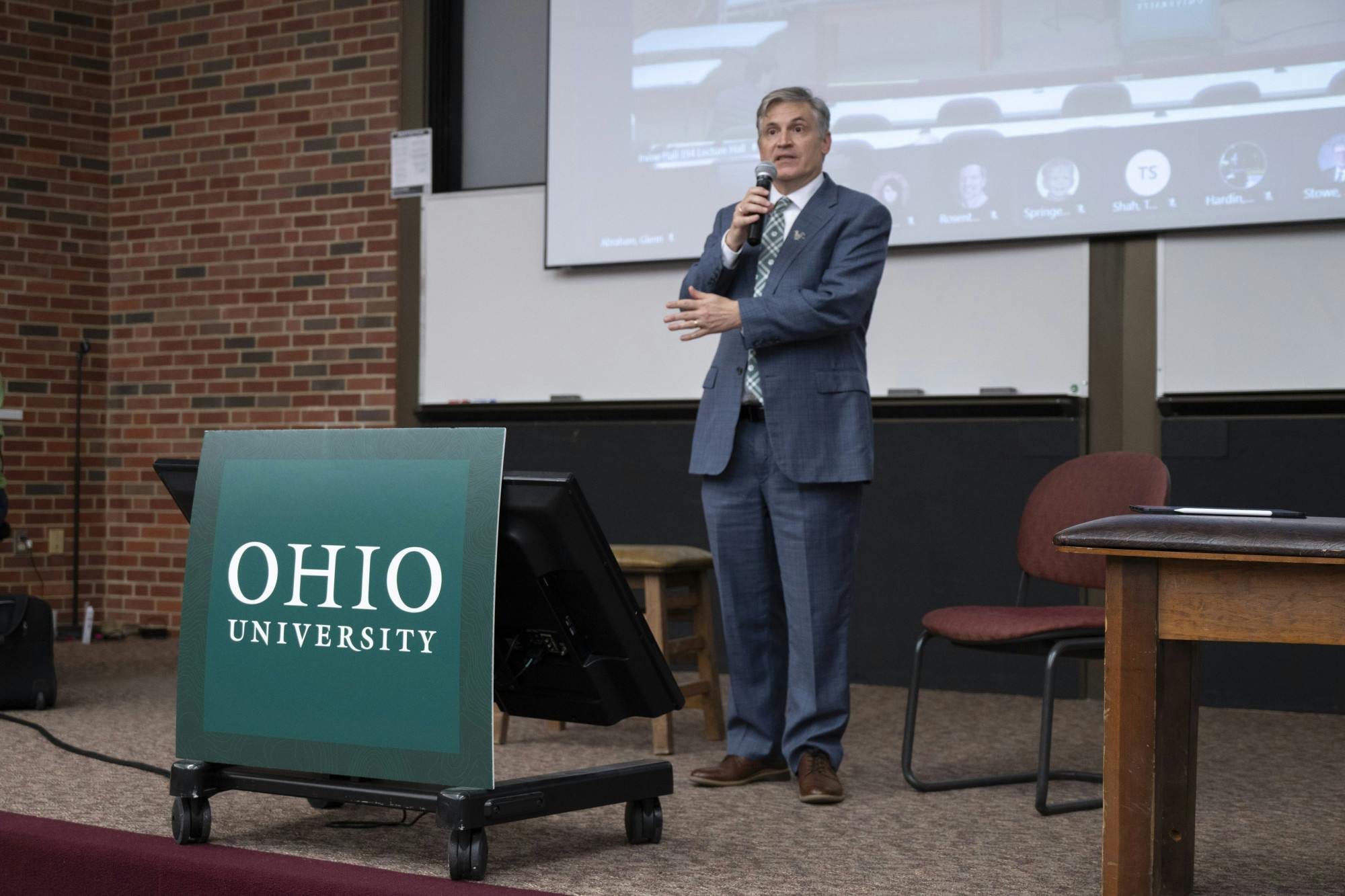
Ohio University Faculty Senate met Monday to discuss OU’s budget and research-related projects and grants. Both Provost John McCarthy and Dr. Eric Muth, the vice president for research and creative activity, spoke at the meeting.
McCarthy began the meeting by talking about how the university is trying to budget and what that means for departments, faculty and students.
McCarthy said there are many threats to higher education right now, including inflationary costs across the country, and it does not help that the cost of healthcare is high. He also added that state-capped tuition increases have not kept up with core inflation.
Tuition for OU students remains the same throughout the years as they earn their degree, which McCarthy said is great, but also limits the university’s ability to keep up with competing costs.
McCarthy said the university is currently determining how to model a response to deal with those threats.
However, the university is currently spending more money than it is receiving, according to McCarthy. In an October 2025 letter to faculty and staff, President Lori Stewart Gonzales told staff the university must either increase its revenue by 2% in fiscal year 2027 or cut its budget by 2%.
McCarthy asked units across the university, including deans, to model larger budget cuts, such as 7%, to understand what impact those cuts would have on their operations. McCarthy said those large cuts are unlikely, but it is a valuable exercise.
“I do want to highlight this is a modeling exercise that we have, so this will continue out through the spring,” McCarthy said. “At some point, as we go through and say, ‘All right, well, let's look at what are we projecting to take in next year as revenues. Now, what are we going to do? How are we going to manage our budgets?’ Those will be the times that we really will need to go back and talk to everybody.”
Deans are required to submit a first draft of their reduced budget Oct. 21. McCarthy said the budget for FY 2028 will be approved at the Board of Trustees meeting in June, so there have to be intense discussions in January regarding the cuts.
Regional campuses do not need to participate in the model, as they operate on a different revenue system. However, McCarthy said the Heritage College of Osteopathic Medicine also needs to model some level of reduction.
"And the bottom line is, we've got to save money in the short run,” McCarthy said.
Following McCarthy’s talk, Muth spoke about research-related projects and research grants for students.
Muth said when he came to the university two years ago, he was tasked with looking at the research ecosystem within the university and modernizing it.
When Muth opened the floor for questions, Matthew Cornish, a professor of theater arts, expressed concern about the student enhancement awards being cut, which were awards previously funded by the office of the vice president for research and creative activity.
Muth said his department looked into all things student-related in his division, including awards, and decided where to divest. He emphasized that his office divesting of something does not mean the university has, so projects can be picked up by other units within the university to be funded.
“We looked at all student awards, undergrad, grad, the student enhancement award being one of them and we divested of them,” Muth said.
Muth also said the research and creative activity department is trying to revamp all the awards, and he hopes to create an advisory committee to have comprehensive conversations about “which awards should be invested and which not.”
Jared DeForest, a professor of ecosystem ecology, said by getting rid of the student enhancement awards, the university was getting rid of something unique to OU.
“It’s the strong integration between faculty research, graduate research and undergraduate research,” DeForest said. “It’s this ecosystem that we have that all fed with each other. By taking that away, it seems like there’s this change in the paradigm where we had that integration again between faculty, graduate students, undergraduate students and you mentioned that you’re bothered by these things.”
Muth said taking away that integration was not the goal. He continued by saying the $100,000 dollars given out during the awards was spread so thin among students that the awards did not have the impact DeForest claimed they did.
However, Muth said his office should have had more conversation about divesting from the awards before doing so and promised more communication in the future.
The next Faculty Senate meeting will be Nov. 2 in Irvine Hall.


