

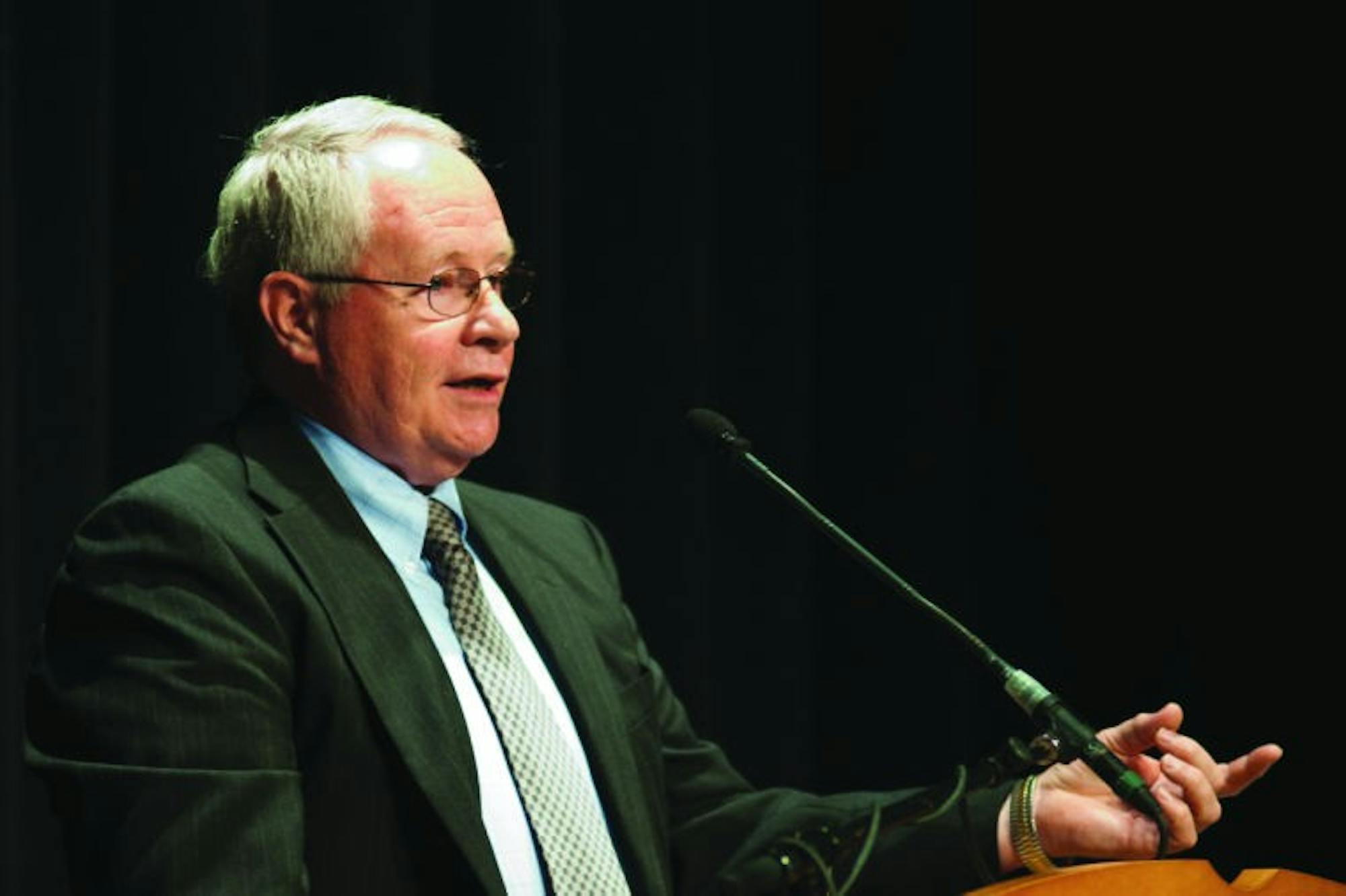
About 70 students, residents and city officials listened to six panelists discuss the potential benefits and risks of hydraulic fracturing in the Baker University Center Theatre Tuesday night.
The presentation was the last of a series of six forums held at each of Ohio University’s campuses to garner feedback about the possibility of “fracking” occurring in the area.
The President’s Advisory Council on Sustainability Planning and the Ecology and Energy Conservation Committee hosted the event and recorded feedback to present to the OU Board of Trustees during its April meeting.
The panelists discussed geological, environmental, health and safety and contamination issues, as well as economic opportunities that surround the controversial drilling technique.
The passage of Ohio House Bill 133, which facilitates the leasing of drilling rights on state- and public university-owned land, gave the discussion greater meaning, said Nikki Dioguardi, the opening panelist and associate director of legal affairs.
Dioguardi said the bill will create the state-run Oil and Gas Leasing Commission, which will be in operation by late June, to classify land based on its “frackability” — “one” being the highest level of potential. Fracking will be restricted from land classified with a “four” rating, which would indicate that it could be difficult to frack in the area.
“There is a lot of land that is class four in Athens County,” Dioguardi said. “House Bill 133 requires that whenever we can, we move those classifications up to one and two.”
But Greg Nadon, chair of geological sciences, said there is not a great deal of potential for fracking in Athens County.
“The amount (of natural gas) produced is much better further north,” Nadon said. “Drilling in Athens is an economic risk from (the oil and gas companies’) perspective.”
Although Athens has some breathing room in terms of time, fracking will inevitably move south once wells start running dry in the north, Nadon said.
If gas drilling does emerge in Athens County, Matt Warnock of Bickler and Eckler Attorneys said the region will see significant economic benefits.
“This has the potential to touch every business and company in Ohio,” Warnock said. “It’s jobs in both the energy industry and indirect jobs in other industries.”
Bernhard Debatin, a panelist and a journalism professor, said fracking is a sustainability issue and the environmental risks should be considered with the economic possibilities.
“This is a very short industry, with a lot of jobs going to out-of-state workers who are specifically skilled for those jobs,” Debatin said. “It is a dangerous journey and has a lot of risks that we should consider carefully.”
Debatin also said the short-term benefits don’t outweigh the long-term issues that could occur.
“It is difficult to put a dollar sign to environmental issues,” Debatin said. “A lot of the problems happen under normal circumstances.”
Joe Adams, associate vice president of Risk Management and Safety, said that a safe program is one that has no accidents.
“Typically oil rigs are very dangerous locations,” Adams said. “Can we live with this in Athens? Can we live with this at Ohio University?”
The Ohio Environmental Protection Agency has said in a statement that there is a possibility of contamination of drinking water from damaged well casings, but the possibility remains small after thousands of oil and gas wells have been drilled in Ohio without significant negative effects.
Others argue that it is not worth the risk to Athens and Ohio University.
“There is a responsibility as an institution of higher education to provide a learning environment,” said Eden Kinkaid, a junior studying plant biology who attended the event. “If there’s fracking on campus, it’s going to discourage prospective students from attending OU.”
ls114509@ohiou.edu


