

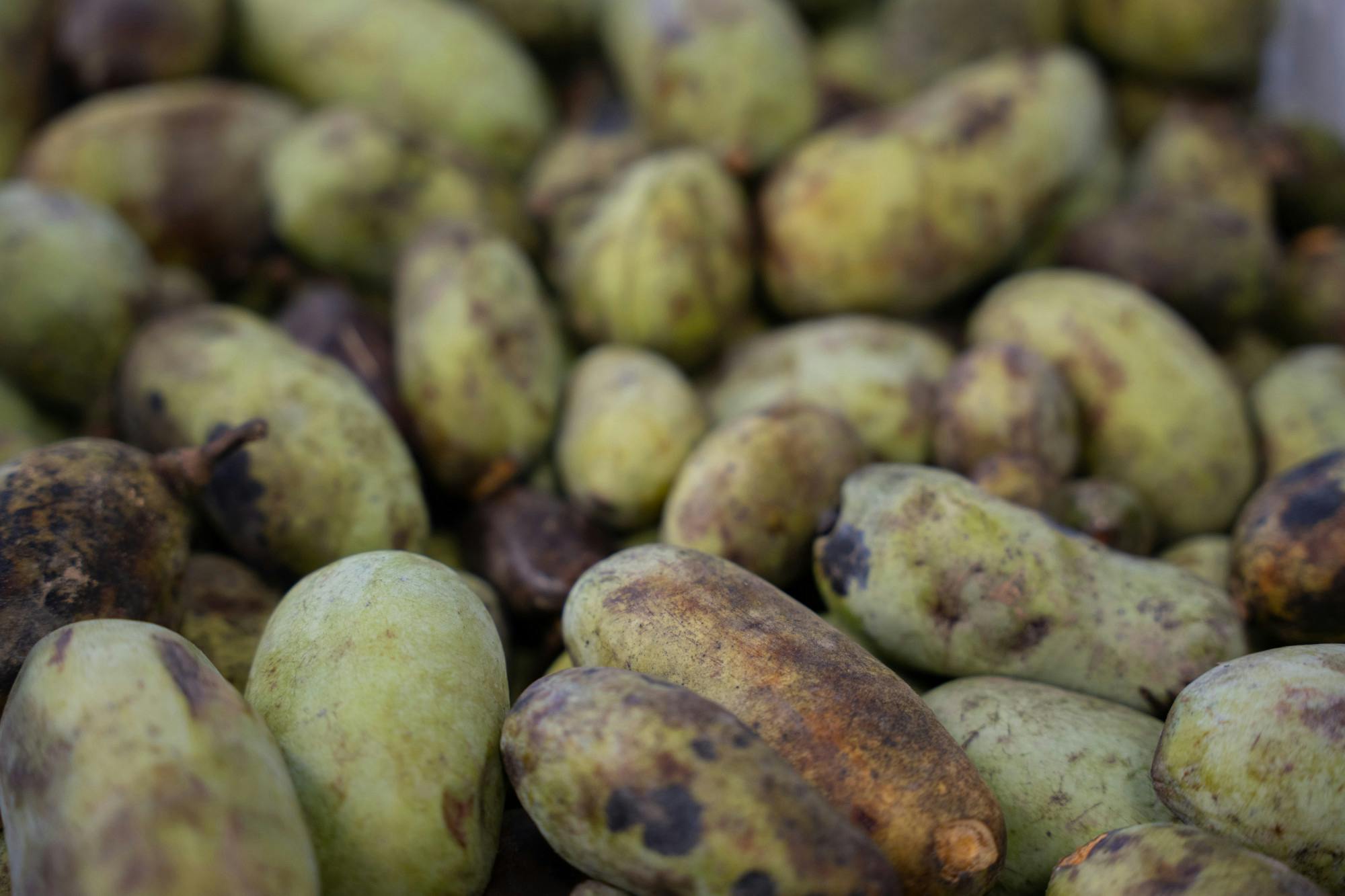
The invasive Ambrosia beetle species continues to harm fruit trees across Ohio and has affected local farmers for years, taking a specific toll on the native pawpaw.
The pawpaw tree, a vital part of Southeast Ohio culture, produces the largest edible fruit native to North America, according to the National Park Service.
Chris Chmiel, co-owner of Integration Acres, said he has been suffering the results of this invasive insect for around 5 years, claiming 70% of the trees in his orchard have died.
Chmiel said when a tree’s roots are flooded with water following extreme rain events, it will produce ethyl alcohol, which attracts the beetle.
“(Ambrosia beetles) drill holes into the tree, and wherever they drill holes, this fungus that lives in them and with them starts to take over the interior part of the tree,” Chmiel said. “The xylem phloem, which is kind of like the veins and the arteries of the tree which is pumping the energy through the tree, it gums that up, and it stops the tree's ability to transmit the energy that keeps them alive.”
After discovering an infected tree, Chmiel cuts it down and burns it, which he has found to be the best solution.
Chmiel also mentioned some farmers use preventative measures, such as spraying chemicals on the trees or setting up traps. However, he said he was not knowledgeable enough on either to use them yet.
According to the Department of Entomology at the University of Kentucky, traps baited with ethanol are effective in attracting and trapping adult Ambrosia beetles. The method is to be combined with removing and burning all infested trees, as well as ensuring planted trees stay healthy.
Farmer Cliff England works on England’s Orchard in Kentucky and has struggled with Ambrosia beetles for around 33 years. England said 50-170 trees in his wife's orchard have been killed as a result of infestations.
England worked with the University of Kentucky and discovered a preventative measure that has worked well on his trees. He uses a mixture of an insecticide called Talstar and a natural pesticide called neem oil. England sprays this on his trees in March to prevent any Ambrosia beetle infestations.
“It is a synthetic para-retroid, and you mix it and I'm spraying at the rate of 150 gallons per one and a point five gallons of trilogy,” England said. “Trilogy is a neem oil that has been emulsified.”
Chmiel said he is planning on replanting his trees next year with increased drainage, stating he wanted to better understand the conditions before doing so. He is also considering using pesticides and traps in the future to deter the beetles.
Chmiel claims the climate is partly responsible for this growing concern, noting extremely high precipitation in the area to be a cause of the infestations.
According to the University of Kentucky, flooding, drought, freeze damage and poor management practices are all factors that can make a tree release the ethanol that attracts Ambrosia beetles.
The annual Ohio Pawpaw Festival, a treasured local event that celebrates the pawpaw, took place Friday-Sunday. The event invites people from all across the state to come celebrate the native fruit. Valerie Libbey, owner of Libbey Farm, looks forward to the event every year.
Libbey said she has not had problems with Ambrosia beetles in her trees, but is familiar with the issue. She said research into pawpaws is far behind other commercial crops such as apples and oranges, partly contributing to the lack of knowledge about dealing with Ambrosia beetle infestations.
Libbey expressed her gratitude to surrounding universities, such as Kentucky State University, Ohio University and the Ohio State University, for their ongoing research, and noted the Pawpaw Festival as a chance to communicate and learn from other farmers.
“(The universities) are doing work on pawpaws, but we are far behind in terms of funding the kind of research we'd like to see on controlling pests and diseases that affect pawpaws,” Libbey said. “Connecting with other growers is probably one of the more important reasons why the festival is so important to me as a grower.”


