

An Ohio University student is taking the institution to court, claiming officials here infringed on his free speech rights.
An Ohio University student is taking the institution to court, claiming officials here infringed on his free speech rights.
Isaac Smith, an OU senior studying political science and Spanish and a member of Students Defending Students, a student organization that helps OU students navigate the university’s judicial processes, filed suit July 1 against three OU administrators.
He claimed they violated his first and fourteenth amendment rights by using what he called an overly broad Student Code of Conduct.
The federal court case is brought against OU President Roderick McDavis, Dean of Students Jenny Hall-Jones and Director of Community Standards and Student Responsibility Martha Compton for reportedly preventing the group’s members from wearing their club T-shirts that read “We get you off for free.”
Smith, in conjunction with international law firm Davis Wright Tremaine and the Foundation for Individual Rights in Education (FIRE), claims the wording in the OU Student Code of Conduct is unconstitutionally vague. Consequently, he argues the court should bar OU from enforcing that code.
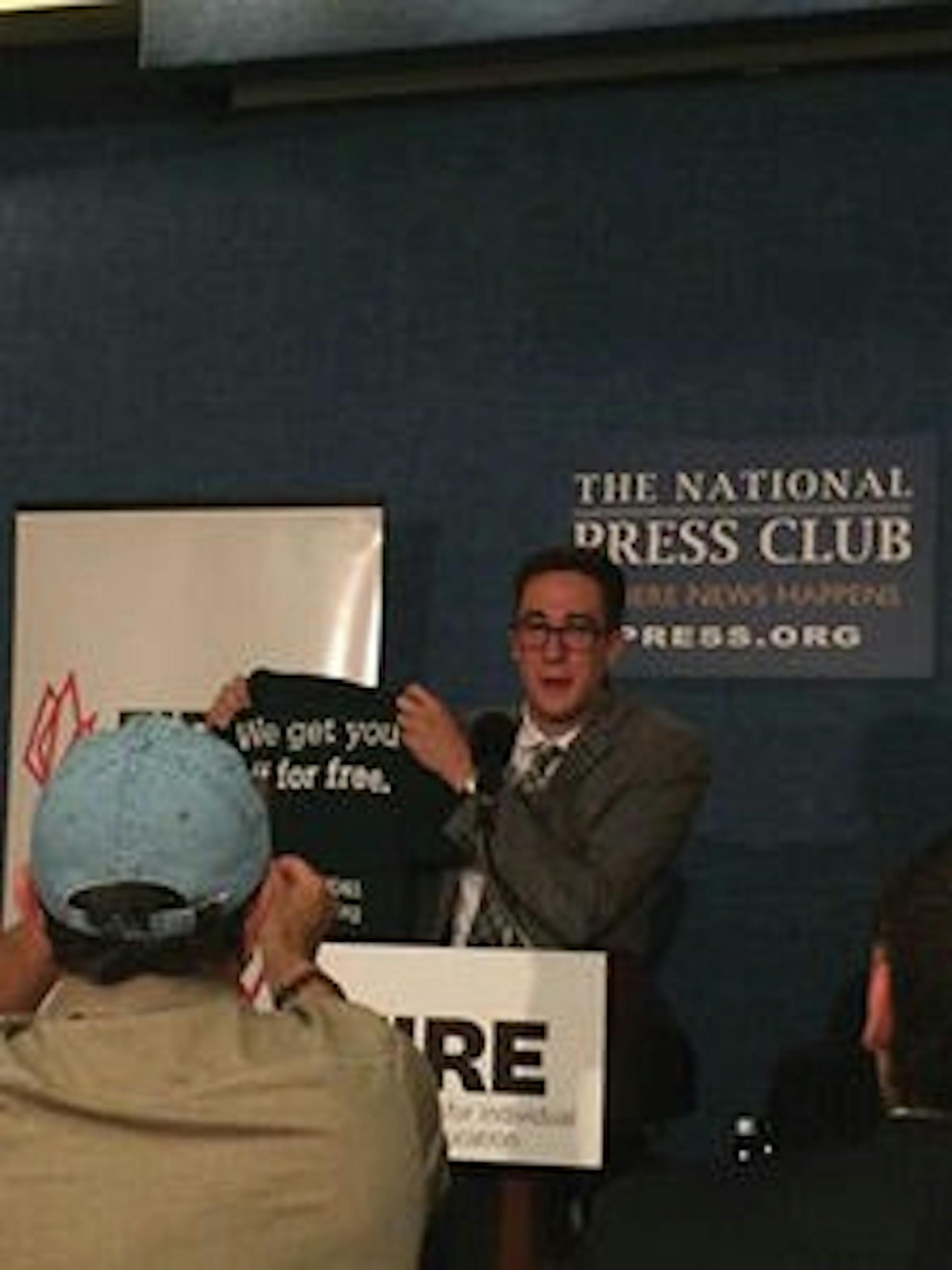
Smith and his lawyers announced the case in a news conference on July 1 to the National Press Club in Washington as a part of the Stand Up for Speech Litigation Project, a collaboration between FIRE and Davis Wright Tremaine targeting unconstitutional public university speech codes.
Administrators never told students not to wear the T-shirts nor threatened to punish students for wearing them, said OU Spokeswoman Katie Quaranta, in an email.
“As educators, we respect freedom of speech and expression as core values at Ohio University,” Quaranta said. “We also believe that an important part of the educational process is to hold discussions and present other points of view. Such a discussion occurred when administrators suggested to the student organization that the T-shirts might inhibit their efforts to serve other students.”
OU, Smith and his lawyers declined to comment while the lawsuit is pending.
The conflict began during the 2013-14 Campus Involvement Fair, where leaders of Students Defending Students, including Smith, showed up to pass out information while wearing the controversial T-shirts.
The slogan had been used by the group since the 1970s, and OU Student Senate approved its use on the recent T-shirt design for the club, Smith said in the claim.
During the event, Smith tweeted a picture of group leaders wearing their T-shirts, and according to the suit, after seeing the picture on Twitter, Compton sent a screenshot of the picture to Hall-Jones.
According to the suit, Hall-Jones told Smith that she did not want to see group wearing the shirts again because they were unprofessional and “contained inappropriate sexual innuendo.”
Former Director of Students Defending Students Katlyn Patton met with Compton in early September to discuss the shirts, and Compton advised group members not to wear the shirts. The organization’s members kept their shirts at home for the rest of the academic year to avoid punishment, according to the suit.
“I started paying attention to what the university does and what its administrators say, and I realized that we live in a climate that’s very unfriendly for expressing a contrary opinion,” Smith said at the National Press Club.
Following the incident, Smith spoke with an employee of the pro-student rights’ organization FIRE. That employee presented Smith’s case to FIRE’s Litigation Coordinator Catherine Sevcenko and other attorneys.
Sevcenko said she and other FIRE employees felt Smith’s case had merit because of the vague wording in OU’s speech code.
“Certainly this is something that we discussed and looked at the various options over several months,” she said. “No one goes into litigation lightly.”
Smith is challenging three policies in the OU Student Code of Conduct that, as a student litigator, he said he thinks administrators could use against the group’s T-shirts.
The sections of the code up for judicial consideration are Section A-4(f), prohibiting “any act which demeans, degrades, disgraces any person,” Section A-4(c), prohibiting “taking any reckless, but not accidental, action from which mental or bodily harm could result to another person;” and Section B-4, requiring students to obey any “legitimate directive” by a university official.
Compared to other universities, Sevcenko said the vagueness of OU’s Student Code of Conduct is not uncommon, but does not diminish what she called a lack of constitutionality in the speech code.
“It’s important to know that these kinds of speech code litigations have been going on since the 1980s, and almost uniformly the speech codes are struck down,” Sevcenko said. “It’s important to remind universities that these laws are there and they need to comply with it.”
@DanielleRose84
dk123111@ohio.edu


