

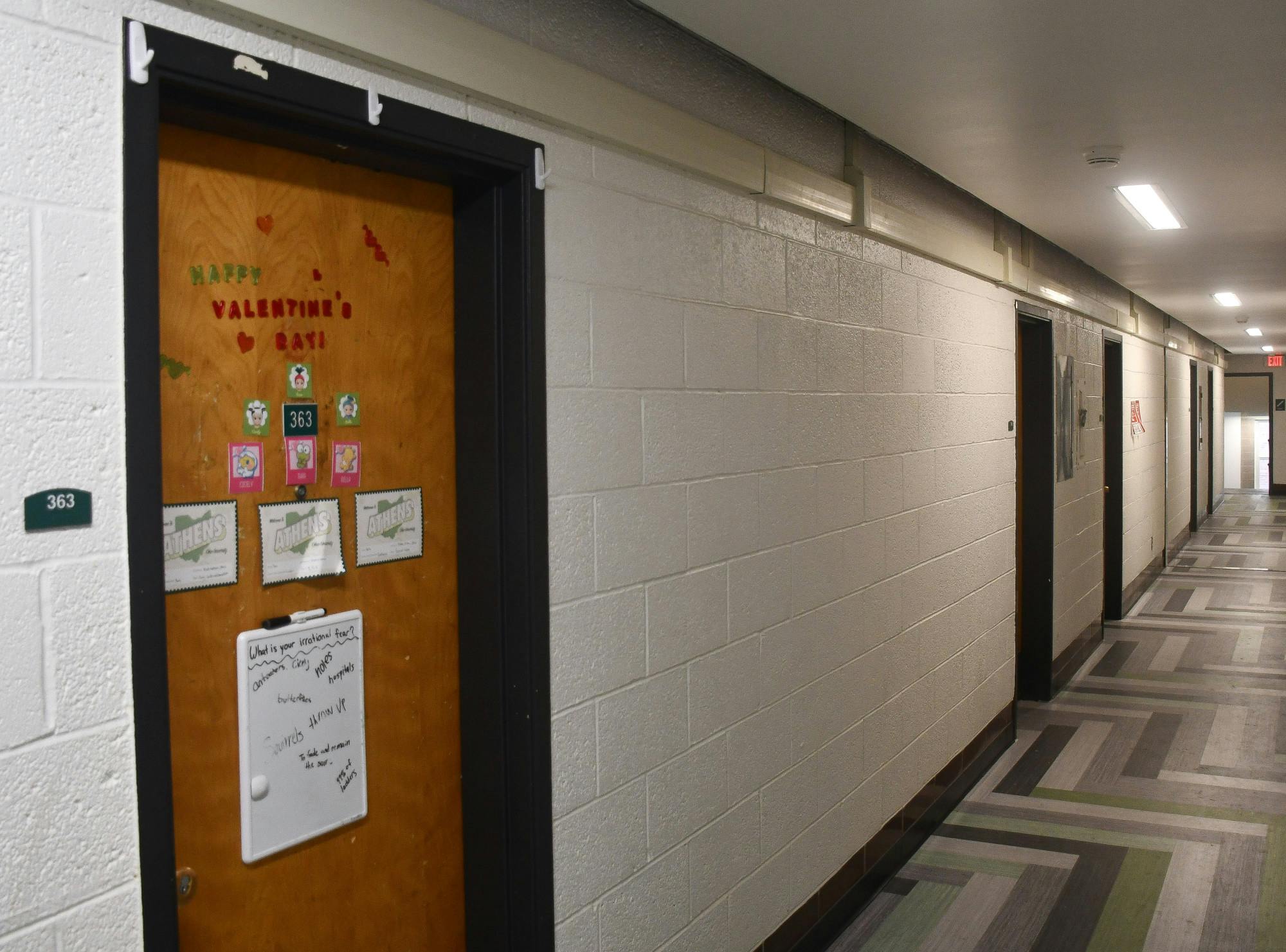
Ohio University has 36 operational dorms that house approximately 8,000 undergraduate students, with another dorm, McDavis Hall, set to open at the start of the 2026-27 academic year. The buildings contain a total of 3,751 rooms with the capactiy to house a maximum of 7,493 students.
As enrollment continues to grow, some students say dorm rooms originally designed for fewer occupants have been converted into triples, creating crowded living conditions.
The university requires students to live on campus for their first two years. Students can choose from single, double, triple or quad rooms available in traditional, renovated, suite-style or apartment-style residence halls.
Addie Kearns, a sophomore studying journalism, said dorm rooms in Adams Hall were previously doubles but have since been converted into triples.
“When we first got assigned to that dorm, it was kind of devastating,” Kearns said. “We weren't super excited about it just because we knew that it was built as a double. They renovated (the hall) into triples, but really they just added more furniture into the rooms.”
Each dorm room is furnished according to capacity, with a bed, desk, chair, closet and set of drawers for each resident. The university also provides a refrigerator and microwave unit in each room.
Lily George, a sophomore studying marketing, said the triple room she lived in last year in Treudley Hall lacked sufficient space. She currently lives in a double, which she said better fits her belongings.
“We had a whole wall of closets, we had a bunk bed and a lofted bed, and three desks,” George said. “One of the desks was under the lofted bed, and the other two were squeezed in between the bunk and the lofted bed. Everything was touching in that room. There wasn't really an ounce of open space.”
George said the limited space made it difficult to complete everyday tasks indoors.
“It was even hard to have friends in our room,” George said. “We'd be touching, sitting on the floor. It’s hard to play games. It's hard to do lots of stuff because of limited space.”
Alesha Morrison, a sophomore studying biology, said her first-year triple dorm room provided just enough space for essentials, in part because she shared a bunk bed and had no space underneath for storage.
“The way it was laid out was our bunk bed was against the wall (then it was my roommate’s) desk and my desk, so there was no ladder,” Morrison said. “I would have to climb up my desk to get onto my bed. As the year went on, my desk became more and more full because that's the only storage space I had. It was really hard to get into my bed … That was tedious.”
Jneanne Hacker, the executive director of Housing and Residence Life, said average dorm sizes vary by location and building type.
On West Green, the average dorm size varies by type, ranging from approximately 125.38 to 194.67 square feet. Dorms located in The Convo are somewhat larger, averaging around 326.29 square feet.
A non-suite style single room on South Green typically measures around 78.51 square feet, while doubles average about 176.54 square feet.
In the front four halls, Crawford, Brown, Mackinnon and Pickering, quads have an average size of 367.19 square feet. Suites provide more space, with singles averaging 144.79 square feet and doubles averaging 273.17 square feet.
“The size of a single and the size of a double in a mod style facility it's pretty consistent across all five of those halls,” Hacker said. “Now there's some nuances here and there, where a room might be a little bit bigger, or a room might be a little bit smaller, but it doesn't necessarily impact the experience of the student living in the space.”
The dorms on East Green vary in size, typically ranging from 196.88 to 229.63 square feet. The doubles are the smallest option, averaging 196.88 square feet, making them 32.75 square feet smaller than the average East Green triple.
Students can visit the OU website to access the floor plan and select individual rooms to see their dimensions. Hacker said the measurements provided online are generally reliable.
Hacker said since OU administrators do not reside in the dorms, they have students assess the dorms and share their views on what size they should be classified as. The custodial staff also helps make the decisions because they are directly supporting students in those spaces.
“There have been times, perhaps, that we convert a double to a triple because we feel that it can accommodate three people,” Hacker said.
Morrison said she wishes the university did not charge students living in smaller dorms as much as students living in larger dorms with more amenities and space.
“I think if you're forced to live in a triple in those that used to be doubles with terrible conditions, you should get significantly less in housing fees,” Morrison said.
OU’s enrollment increased by 3.6% this academic year, according to a previous report by The Post. Kearns said she believes the university is over-admitting students while continuing to require two years of on-campus living.
"Interest in OHIO has been at an all-time high in recent years, but we wouldn’t expect recent growth trends to continue in perpetuity,” Vice President for Enrollment Management Candace Boeninger said in an email. “OHIO’s integrated planning processes allow the institution to take into account student interest, programmatic and residential capacities and available resources to support an excellent Ohio University experience."
Hacker said Housing and Residence Life continues to collect student feedback as it plans for future housing needs.
“We will continue to build towards the future to meet the students' needs and their wants, and do so in such a way that it's once again continuing to ensure the success for our students required to stay on campus for two years for all the value that contributes toward, quite honestly, student retention and student success,” Hacker said.


