

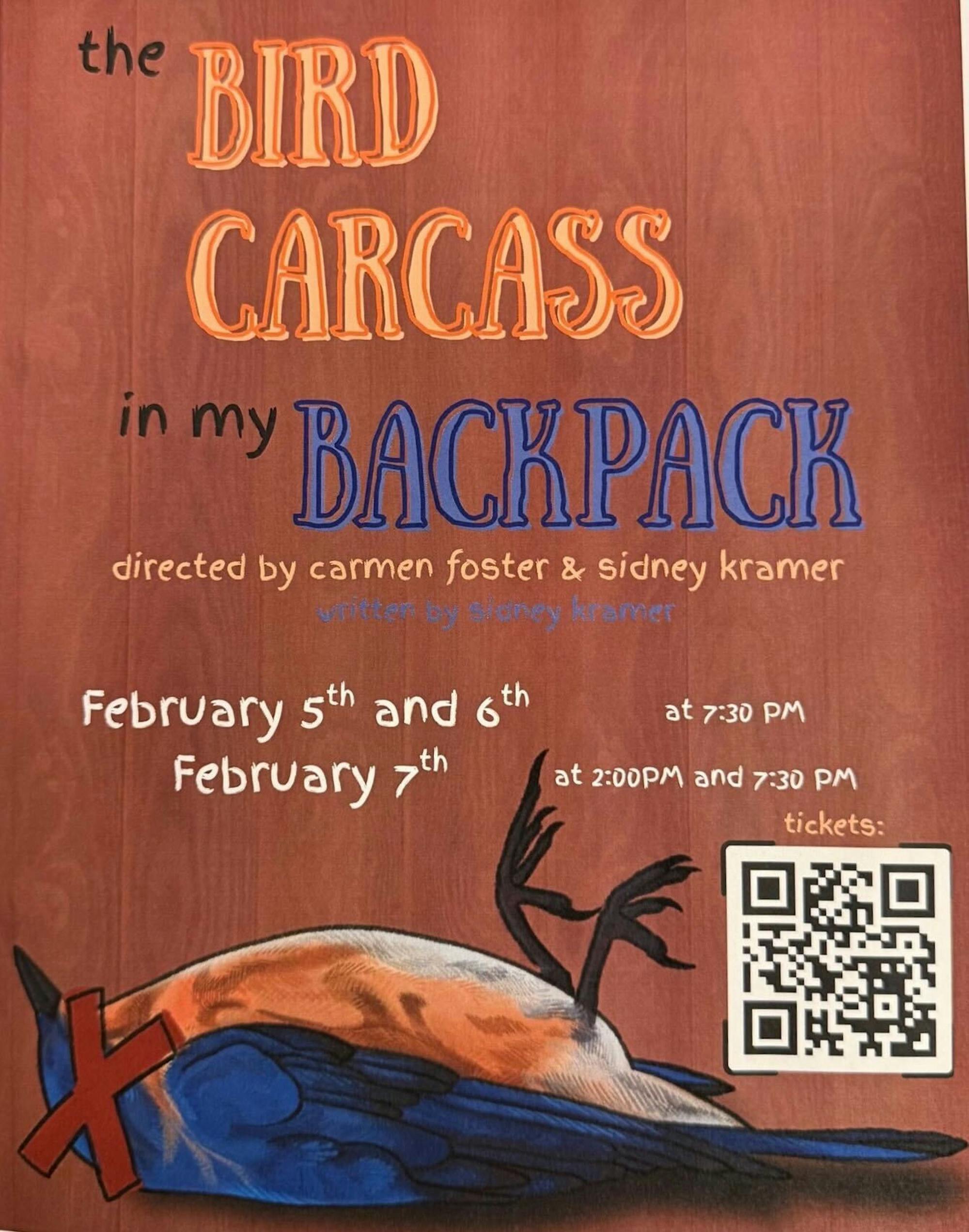
Sidney Kramer, a sophomore studying acting at Ohio University, made her playwriting and directing debut with the show “The Bird Carcass in My Backpack”.
Kramer said her background in poetry helped spark the play’s central image.
“This is…the first play I’ve ever written,” she said. “I’m a poet, predominantly.”
She explained her creative process often begins with a vivid image, and for this piece, that image came from an experience with a friend: a bird carcass tucked inside a backpack. She initially tried to shape it into a poem, but quickly realized the idea demanded more space than a poem could hold.
“I immediately was like, ‘This can’t be a poem,’” Kramer said. “‘There’s too much I want to put into this, and I can’t do it in a poem.’”
After jotting down the initial idea, Kramer set it aside. She didn’t return to it until her freshman year at OU, when a class assignment required her to write a one‑page play. She revived the bird‑carcass concept and began shaping it into the piece it has become today.
“The Bird Carcass in My Backpack” was co‑directed by Kramer and her friend Carmen Foster. Foster studies playwriting, and her past works include “All Playwrights Aren’t Dead” and “Three, Two, One.”
“I give a lot of credit to Carmen Foster,” Kramer said. “I’ve never directed anything before in my entire life, and Carmen is a big reason why all the technical stuff got done.”
The show follows Child, an 11‑year‑old boy with autism, played by Isabella Campi. Child is selectively nonverbal, and throughout the play, Kramer confronts the stigma surrounding nonverbal autistic children. Sarah Comer, a senior, plays Teacher, who repeatedly pushes Child out of his comfort zone by forcing interactions with other students. In one scene, when Child has a meltdown, Teacher restrains him in an attempt to make him stop.
“[Campi] has been so dedicated to really taking the time to, like, care for representing an autistic person in a way that’s … genuine and real,” Kramer said. “It’s just really amazing to see everyone fully understand and begin to embody their characters … It’s really amazing to be with people that clearly care about this show as much as I care about this show.”
Kramer said she wanted the play to highlight real‑world issues that often go unnoticed until it’s too late. The production was staged in OU’s Putnam Hall, room 227 — a small space with limited seating. Kramer said the intimate setting makes the show feel more immediate, placing the audience directly inside the classroom alongside the characters.
Kramer doesn’t plan to stop writing with this show, nor does she plan to stop shining a light on injustice. She already has two new ideas she hopes to carve out time to explore. One would center on consent and feature a cast of only three actors. The other would approach race from a white perspective.
“I know I’m a white person,” Kramer said. “And I obviously cannot explore that in the exact same way, but I very much want to present it as, like, you’re following this white main character as she becomes the antagonist in everyone else’s story without her necessarily, like … doing anything wrong.”
Even as her work tackles heavy, real‑world topics, Kramer draws much of her inspiration and grounding from her parents.
“[My parents] have always been very supportive of me being an art kid,” she said. “I was always a very big writer. And I remember being 11 years old, and my dad gave me an old journal he had that was full of his poetry.”
Her father’s screenwriting background has shaped her, but she turns to both parents when she needs to talk through ideas, whether she’s working on an essay, a poem or a script.
“I think that, without my parents…” Kramer said. “I don’t think I would’ve gotten to the point I’ve gotten to with my writing.”
Although the run of “The Bird Carcass in My Backpack” has ended, Kramer remains grateful for everything she learned from writing and directing it. More than anything, she hopes the message she built into the play lingers with the audience long after they leave the room.
“I hope that this play helps people really be like, ‘oh, we need to be listening,’” Kramer said. “Take the time to listen, take the time to care about things that matter to you.”


