

Somali community in Columbus is underserved by the media, but a new app called NewsRain is trying to fix that.
It wasn’t Ayleen Cabas Mijares’ idea to get involved in the Scripps Innovation Challenge.
Mijares met Kingsley Antwi-Boasiako in an international journalism course at Ohio University and as they became friends, she jokes her involvement is “his fault.”
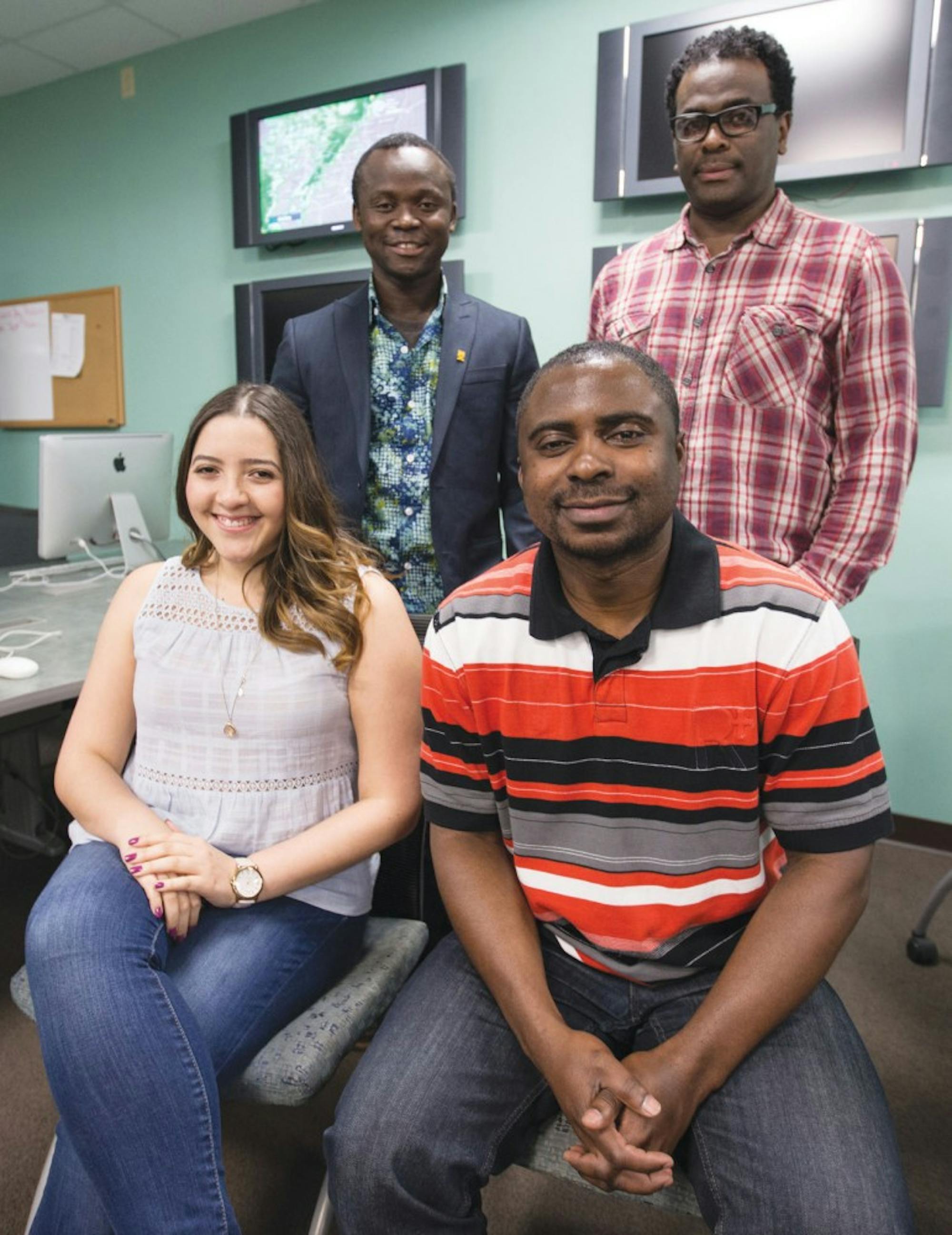
But whatever the reason may be, their group, Team Ubuntu, went on to win first place in the challenge, alongside other team members Samuel Antwi and Goitom Negash. The team won $10,000 for their pitch of the app, NewsRain, according to a previous Post report.
“Once we were all agreed that we would get into this, we started working together and thank god it worked in the end,” Mijares, a graduate student studying journalism, said. “It was a lot of work.”
The Scripps Innovation Challenge is a competition that allows students to create innovative solutions to problems in media and communication. This year, 13 teams submitted final proposals for the chance to win from an overall pool of $25,000 — $10,000 for first place, $5,000 for second, as well as several other prizes, including one regarding diversity.
NewsRain is a website and app that aims to fix the media desert facing the Somali community in Columbus by facilitating mobile journalism through simple story tutorials and photography lessons.
“This is for them to represent themselves fairly,” Mijares said.
A media desert is a geographic area that lacks local news, Mijares said. The concept was one originally from Michelle Ferrier, the associate dean for innovation of the Scripps College of Communication who studied areas that may not be serving all residents of a particular community.
“We started doing research and actually kind of expanded the concept that Michelle had created in the beginning,” Mijares said. “We had to support that with other scholarly work so it was, like, serious research from level one so we could justify that we were serving this community.”
Mijares said once they confirmed the Somali community in Columbus was a media desert, the team was able to find ways in which they could serve them best by talking to them and seeing what they needed most.
Negash, a graduate student studying African studies and media arts, said he had pre-existing relationships within the Somali community in Columbus, so it allowed them to communicate more efficiently.
Mijares said two of the biggest problems in the Somali community are the lack of coverage and misrepresentation within the media.
“These are, like, two different communities, like one is in the media and one is in reality,” Mijares said. “That’s what’s viable about our solution that we are trying to implement, because we have to close that gap. The news media is not really reflecting what these people are doing and what these people are about.”
According to the American Immigration Council, central Ohio has the second largest Somali population in the United States, behind Minneapolis, Minnesota.
{{tncms-asset app="editorial" id="9d5297ee-fb6f-11e5-aa91-0fb1cb95b472"}}
“What we sought to do … is to create an avenue where we can have a platform that the news will emanate from the Somalis themselves so that Americans can get information from this platform and then the Somalis themselves can also share information on that platform,” Antwi-Boasiako, a PhD student studying media arts, said. “Empowering them to tell their own story to have a peaceful coexistence between the host country which is America and the refugee communities, in this case.”
Negash added that the team wants to expand to other communities facing media deserts in the world as well.
“It doesn’t end here,” Antwi-Boasiako said.
@mmhicks19
mh912314@ohio.edu


