Ohio University might face less daunting budget cuts than it originally projected next fiscal year.
The university has changed its estimated budget gap from $32 million to $19.7 million based on the governor’s biennial budget proposal, which was released Tuesday afternoon.
"We did not take an approach of just cutting," Gov. John Kasich said at a press conference Tuesday, adding that basic state aid to higher education increases.
University officials originally projected OU would have a $32 million hole in its budget next year, caused by a projected $27 million reduction in state funding, $5 million increase in health care costs and $600,000 increase in utility spending.
Now that Kasich has released a budget draft that contains an increase in State Share of Instruction funding, OU is estimating it will only see a $16.2 million total decline in state support, according to an e-mail sent to OU students and employees from President Roderick McDavis. State Share of Instruction funding helps keep the cost of tuition down at Ohio’s public colleges and universities.
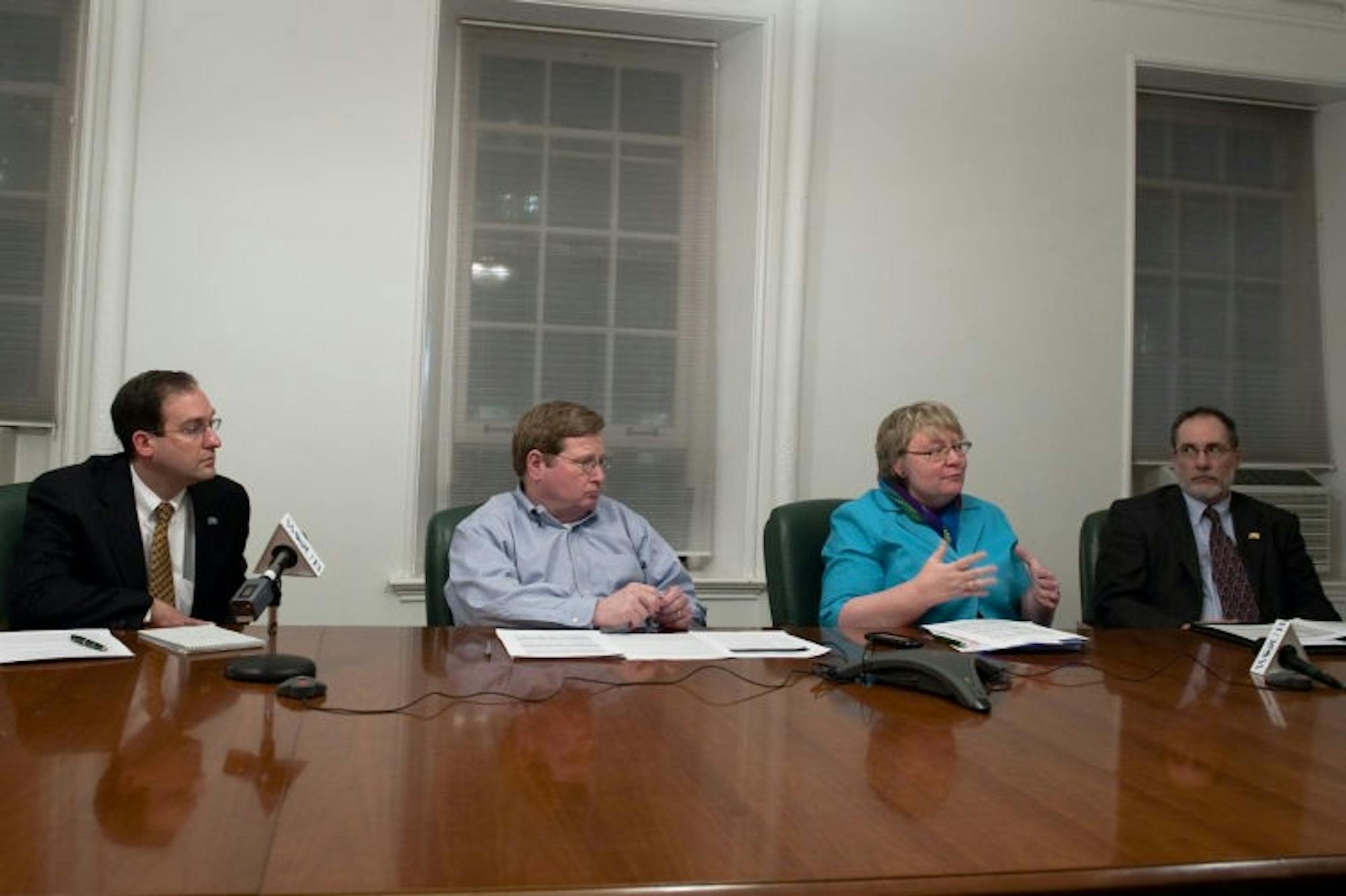
“We could say that (this budget) is better than we anticipated,” said Executive Vice President and Provost Pam Benoit.
Despite the possible increase in State Share of Instruction funding, OU is still expecting a decrease in total state support next fiscal year because of the loss of federal stimulus money. OU received $15 million in federal stimulus money during the past two year.
“As we had anticipated, there will be no continuation or state replacement of the federal economic stimulus funding we received in the current biennium,” McDavis said in the e-mail. “However, there will be a 2.7 percent increase in State Share of Instruction funding largely through the reallocation of line items.”
OU’s Athens campus received $98 million in State Share of Instruction funding this fiscal year, and next year’s reduction to the Athens campus is expected to be $11.8 million. State Share of Instruction funding for OU’s regional campuses is also expected to decline by $2.9 million next fiscal year.
The university is still hoping to receive a lapsed payment of $9.2 million from the state this July.
“The governor’s proposal also provides some assurance that universities will receive the lapsed (State Share of Instruction) payment, if the state’s economy remains stable and in balance,” McDavis said in the e-mail.
OU officials previously feared that, because of state budget cuts, the university might never receive that payment.
“While the news today is better than originally projected, we still must make difficult choices,” McDavis said in the e-mail. “The state budget process has just begun and there are many aspects of the proposed budget that require study and research to understand the potential implications for our students, faculty and staff.”
OU officials are still examining certain line items of the governor’s budget that could affect faculty, staff and students, Benoit said.
“We’re working our best on looking through the (budget) material,” Benoit said. “There are a number of details that we still need to look into further.”
The budget also continues a 3.5 percent cap on tuition increases that former Gov. Ted Strickland first implemented. OU has not yet decided if there will be a tuition increase for next school year.
“Tuition has got to be constrained if we are to retain affordability,” said Stephen Golding, vice president for Finance and Administration. “…We have to stay focused on those types of issues.”
In the e-mail, McDavis also said OU’s health care consultant has “reduced its original projection for increased health care costs for the Athens campus to $2.9 million in the coming year.” The cost was previously estimated to be $5 million.
Kasich’s biennial budget draft must now be approved by the state’s legislature before it can go into effect.
The draft also includes reductions to funding for OU’s Voinovich School of Leadership and Public Affairs and the clinical teaching for the College of Osteopathic Medicine. The College of Osteopathic medicine would see a $1.5 million funding reduction if Kasich’s budget proposal is approved. The budget also eliminated a $326,000 line item for the Voinovich School, which makes up 12 percent of the school’s total budget.
“When there is a zeroing out of a line like that … what the university has to do is determine how best to continue to support that particular program or college as part of the state funding the university receives in total,” said Becky Watts, McDavis’ chief of staff.
Despite the lower-than-expected cuts to state higher education funding, OU officials said faculty and staff buyouts and early retirement plans will still be necessary.
“There are several things … we would have done no matter what the budget cut would have been,” Benoit said, adding that OU is planning ahead for future years by using a multi-year budgeting strategy.
OU might also save money on future construction projects with changes in state-imposed prevailing-wage, or union, requirements for universities.
“The movement away from having multiple primes could be extremely beneficial in terms of cost and then there is the question of prevailing wage, but we would have to analyze what that means … in terms of commitments we’ve already made,” Golding said.
pe219007@ohiou.edu
@ThePostCampus