For years, dermatologists have been warning the public about the dangers associated with tanning.
The UV rays encountered in tanning beds put people at risk for skin cancer, sunburns and eye damage, but college students continue to spend their time and money at tanning salons.
More than 30 percent of 421 college students showed signs of dependence and addiction to indoor tanning, according to a study by the Archives of Dermatology.
A major factor sparking addiction is the confidence boost people feel being tan.
“I have seen girls get addicted, and I can definitely see it being addictive,” said Megan Kennedy, a sophomore studying speech pathology. “Society creates this tan image, and once you get it, you feel good and don’t want to lose it.”
Sarah Kinnear, an employee at Outer Glow, 14 S. Court St., said she sees some customers become dependent.
“I definitely think addiction does happen,” Kinnear said. “I think they just like the way they look so they keep going more and more.”
Many regular tanners feel more self-confident after a session in the tanning bed, when their skin is as dark as possible. Kennedy, for instance, started tanning this quarter after going through a breakup.
“You want to look the best you can,” Kennedy said. “Tanning makes you feel better and hides all of your imperfections.”
Molly Maloney, a freshman studying retail merchandising, also experiences a boost in self-esteem after tanning.
“I don’t like to be pale,” she said. “I feel so much better about myself when I’m tan.”
Maloney said that while she is aware of the risks of tanning, she still visits a salon four to five times a week.
“I want to look good,” Maloney said. “I feel like other than tanning, I’m a pretty healthy person, so I’m just weighing my risks.”
In addition to increased self-confidence, regular tanners find other benefits in the activity as well, said Candice Chiwalkowski a sophomore studying communication studies.
“Tanning makes you feel happy, and it can clear up your acne, too,” Chwialkowski said. “People do it for other reasons than just to be tan.”
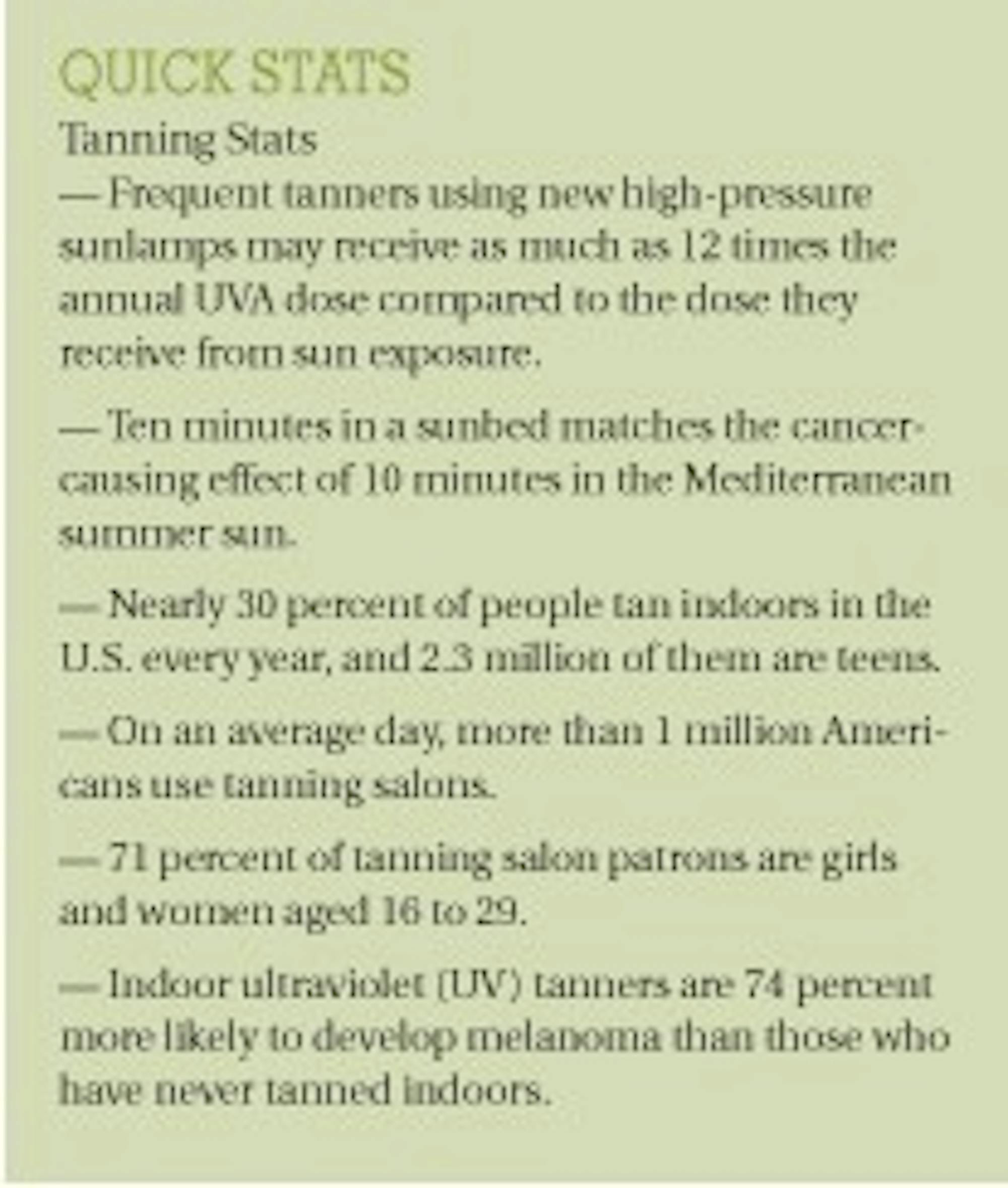
Regardless of the reason people choose to utilize tanning beds, they put themselves at a higher risk of developing skin cancer. According to the National Cancer Institute, women who artificially tan more than once a month are 55 percent more likely to contract malignant melanoma, the deadliest form of skin cancer.
For people who want to avoid skin cancer but still tan, Kinnear suggests doing so in moderation.
“With the aging and cancer nowadays I definitely think people should go less,” she said.
Non-melanoma skin cancer is increasingly common. According to the National Cancer Institute, 40 to 50 percent of Americans who live at least 65 years will experience non-melanoma skin cancer at least once in their lives.
“It can be really bad for your skin to expose it to all those UV rays,” said Barbara Jewell, a freshman studying art history. “Skin cancer is a huge problem, so tanning just seems silly.”
In addition to skin cancer, other risks like eye damage can arise from artificial tanning. Kennedy takes all the precautions she can to prevent her eyes from being burnt, although she does not take any steps to protect her skin from UV rays.
“I make sure I wear my goggles, and sometimes I cover my face with a towel,” Kennedy said. “But I don’t really take any precautions other than that.”
Although she does not go to the tanning beds, Jewell said she has noticed the practice being talked about positively among Ohio University students.
“I feel comfortable with the way I look,” Jewell said. “But sometimes I hear people talking about someone saying, ‘She’s so tan, she’s so fit.’ It seems like an ideal around campus. ... I think people easily get addicted to it.”
bm257008@ohiou.edu
@ThePostCulture