

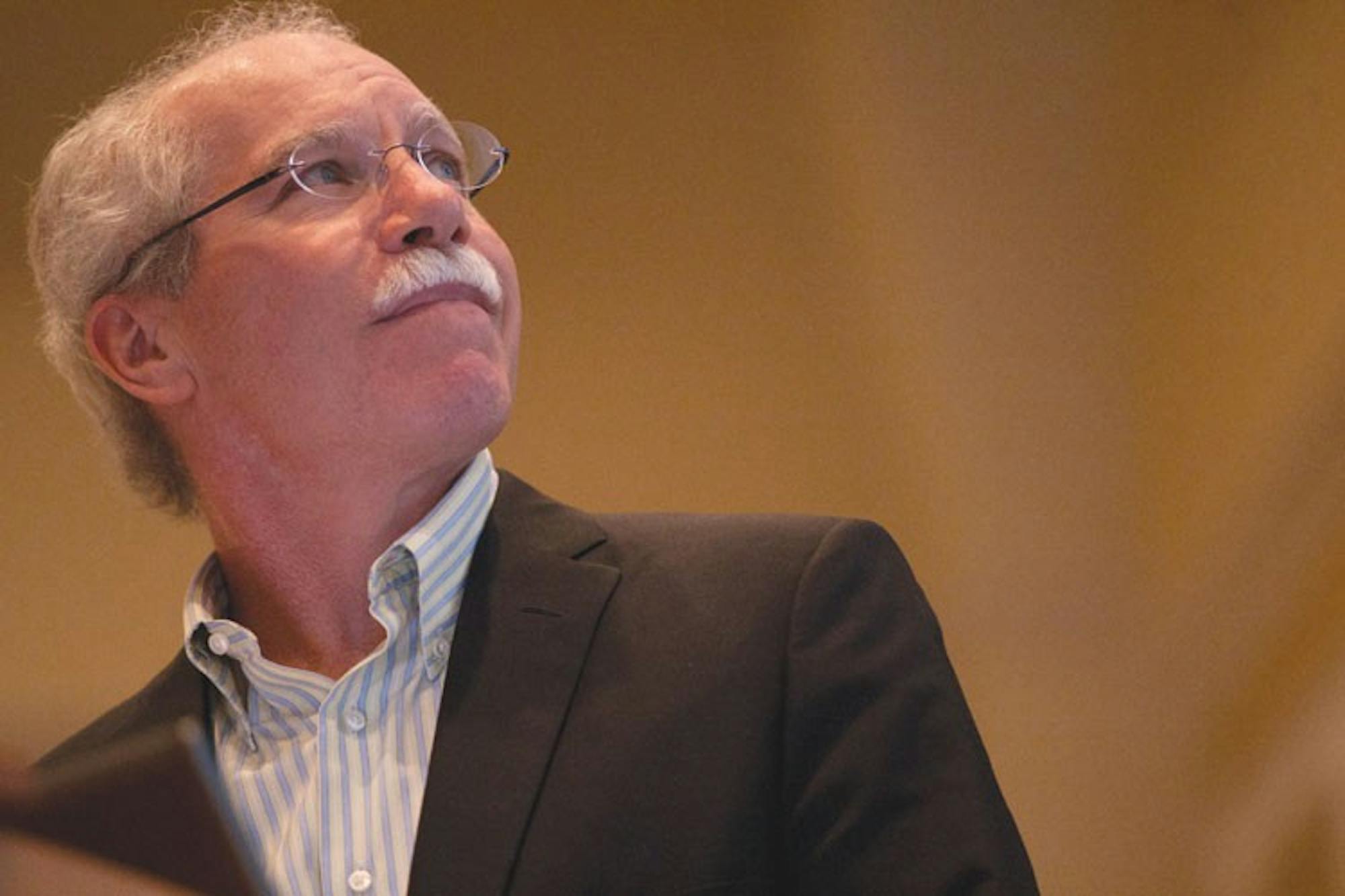
Those in attendance at Ohio University’s digital-media conference yesterday received a lecture on a seemingly unrelated topic — evolution.
The conference, titled “Creating the Future: Managing Media in the Digital Age,” was hosted by the Scripps College of Communication and focused on how media can adapt to a continually changing industry landscape.
Speakers and panelists included Margaret E. Buchanan, president and publisher of Enquirer Media and vice president of the Gannett Interstate Group; Bray Cary, president and chief executive officer of West Virginia Media; and Frank E. Deaner, former executive director of the Ohio Newspaper Association.
Throughout the 10-hour conference in Baker, media professionals spoke about management research, adapting to changing markets, and entrepreneurialism in media markets.
The keynote speaker, Richard Boehne, president and chief executive officer of the E.W. Scripps Company, spoke about the history and future of journalism, noting that now is both a scary and exciting time for journalism professionals.
“Give light, and the people will find their own way,” Boehne said.
Because the market continues to change, it is necessary to either keep up with the times or be left behind, Boehne said. He expressed concern for those who are not able to keep up with today’s technology.
Although journalists used to view online communication in a negative light, the Internet is both a good and bad source of news and advertising material, Boehne said. Though valuable information is available at the fingertips of those in need, there is also dishonest information that dilutes the value of what is already out there, he said.
Boehne said the journalists who lose in today’s Internet era are information gatekeepers and editors, traditional media companies, and mediocre journalists and stenographers.
He urged the many college professors in attendance to pass this message along to their students: There is no longer room in the industry for stenographers of world events. There will be cuts in the field, and those left will be paid higher salaries and have much better skills than their predecessors.
Boehne stated the journalists who win in today’s era are talented story-telling journalists — those interested in free speech and diversity — consumers and advertisers. The consumers and advertisers will find success in the Internet era because of the economic efficiency of the Web, he said.
With sites such as eBay and Craigslist, there is no longer a need to run “a $100 ad for an $80 bike,” Boehne said.
He also encouraged all journalists to become great storytellers. He said there are enormous opportunities at OU for professionals to build their own career and create a personal brand.
To indicate where journalism is going in the future, Boehne outlined a projected timeline from 2005 to 2015. In 2005, journalism was still a profitable business. Convergence was typical in most media outlets. The same news story would be produced and then “shot out” through one or two different media, he said.
During the economic collapse, newspaper and TV revenue was down and many media outlets, including the Scripps Company, were forced to make cuts. Today, although television has much recovered, the newspaper economy is still considered weak compared to its former status.
The solution, Boehne said, is found in divergence. Today, there are many different ways to get information other than from a newspaper or website. The iPad was first introduced to the public in January 2010, and 4 percent of the nation’s population is now using that as their source of information, he said.
The Scripps Company is developing a paid tablet application for a newspaper in Memphis. If there is enough demand for this product and the launch is successful, it is likely that many similar products will appear on the market, Boehne said.
Boehne said he believes there is still a demand for the newspaper industry in our nation. The key to keeping this industry alive is to create compelling consumer products. Journalism professionals must listen to what the public wants and change with the new era, he said.
Zainab Kandeh, a freshman studying journalism, said Boehne’s presentation was “exciting and necessary.”
“It makes me want to work harder to prepare myself to compete,” she said. “I need to learn to be a one-man band.”
A video of the conference will be available at scrippsconference.org.
bl171210@ohiou.edu


