When the Athens Mental Health Center opened its doors Jan. 9, 1874, it was ill-prepared for patients who died during their stays.
The facility broke ground for a cemetery for unclaimed bodies on Tower Drive a few years after its opening. That cemetery expanded into three separate ones over time that now contain 1,700 bodies.
The unembalmed corpses were wrapped in shrouds, placed in wooden caskets, and buried in shallow graves in rows according to gender. Numbered, state-issued stones marked the patients’ final resting place.
In the time since, the corners of once-squared stones have rounded, and many of the numbers have been obscured moss and dirt. Some stones have been replaced with more contemporary tombstones; others have been removed entirely, leaving evenly spaced depressions where the wooden caskets have decomposed underground.
“The cemetery, it tells a story,” said Trudy Sharp, the communications director for the Ohio Department of Mental Health, which still has jurisdiction over the cemeteries.
However, disagreement has arisen about exactly what story the cemeteries should tell.
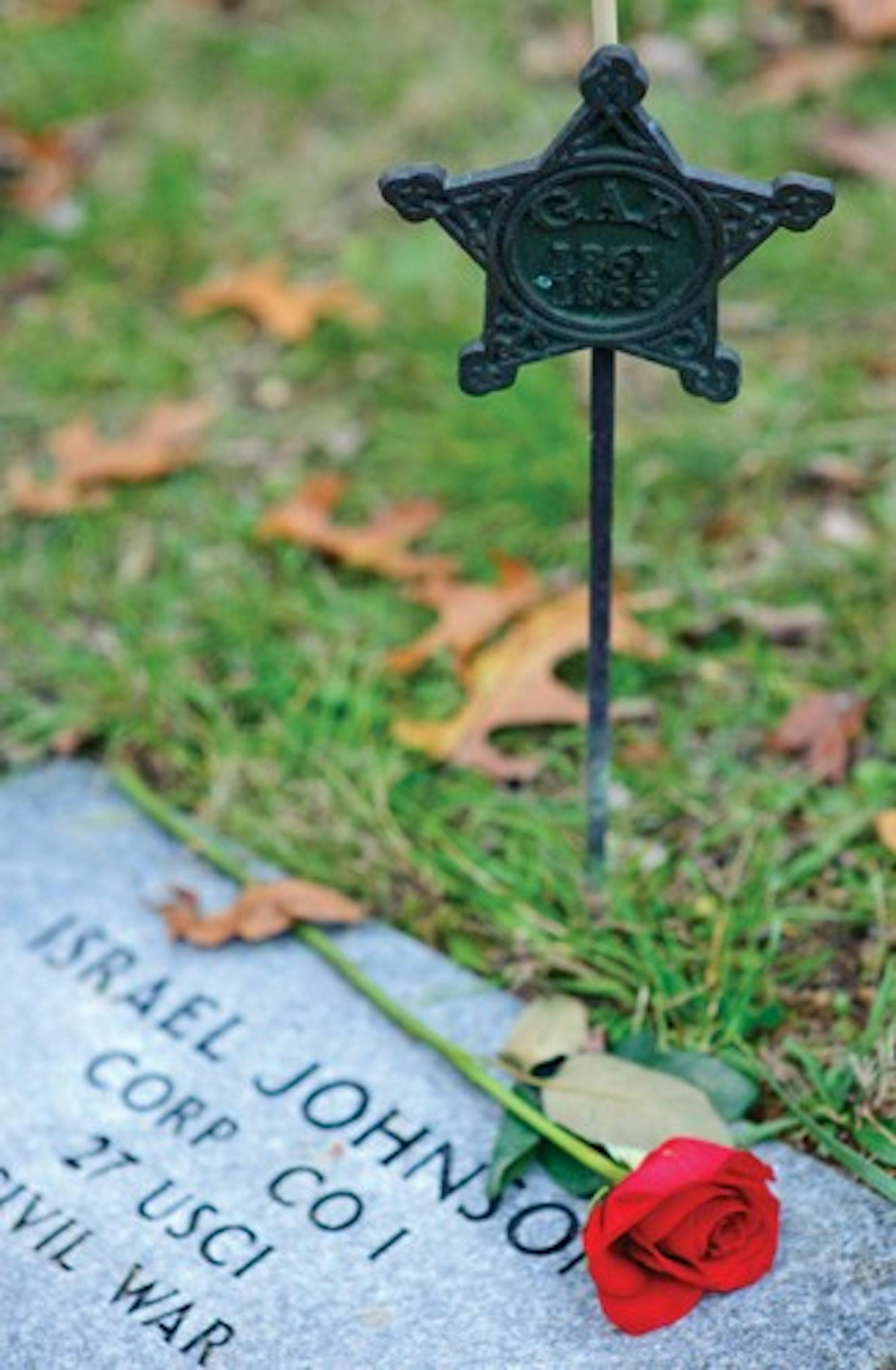
Granite stones engraved with names and vital dates of Civil War soldiers were approved for placement at The Ridges. So far, 43 of the 89 known veterans have received a stone.
The markers were fixed flush to the ground in front of the state-issued ones. Volunteers, including 25 ROTC members, helped dig and secure the nameplates Saturday.
Sharp said the Department of Veterans Affairs supported the project and that, because it was proposed by a government entity, the mental-health department supported it as well.
Only families who can prove lineage are allowed to place new headstones, Sharp said.
She added that descendants’ documented research to find their family members provides a warm resolution to the purported storyline. The unmarked plots serve as a reminder that people were forgotten.
Local group, Friends of Athens Asylum Cemeteries, said it believes that placing markers for everyone is a moral obligation and estimated the project’s minimum cost at $300,000 — all it needs is approval from the Ohio Department of Mental Health.
The group plans to continue placing the understated granite stones on the plots. It maintains that the historical integrity will not be interrupted because the original stones would remain in place and more prominent.
“For them to perpetuate this abuse doesn’t make sense,” said Doug Lockhart, a Logan blacksmith and member of the Friends of Athens Asylum Cemeteries.
“It would say: ‘This should have never happened, and we rectified it not: ‘This should have never happened, and we did nothing about it,’ ” Lockhart said.
But Sharp said the Ohio Department of Mental Health believes a cemetery full of new stones would affect the historical integrity. She also added that all names are public record, so if people want to find a particular person, they will. She said it’s not the state’s place to mark all the graves — it should be the families’ choice.
In addition to the veterans’ graves, two stones were also placed to honor relatives of Melba Linn of Logan. Linn discovered that she had two family members, both named William Tatman, buried in the cemetery.
The Friends of Athens Asylum Cemeteries has periodically printed lists of names in the native towns of deceased patients in an effort to find living family members.
“I would have never found them if it weren’t for these people,” Linn said.
Last Saturday, she rested a rose on the new name stones for plot 445 and 455.
“Another two pieces to my puzzle have been solved,” she said.
Both sides agree that veterans should be honored, but volunteers, including Tom Collins of Logan, said everyone buried at the site should have a name stone.
“We need to realize that everybody in America makes a contribution. And when we stop doing that, when we don’t make them known, we forget our future because we forget our past,” Collins said.
Former residents from 45 of Ohio’s 88 counties are buried in The Ridges’ cemeteries.
“This is not an Athens issue; it’s a state issue,” said Berta Lockhart, member of the Friends of Athens Asylum Cemeteries.
“We will not rest. We will not stop. If we need to find every family for all 1,700 people buried up there, even if it takes 30 years, we’ll do it,” Berta said.
Sharp maintains that it’s not the state’s place to lay stones for everyone.
“Some of it is just lost to history,” Sharp said.
mh317008@ohiou.edu