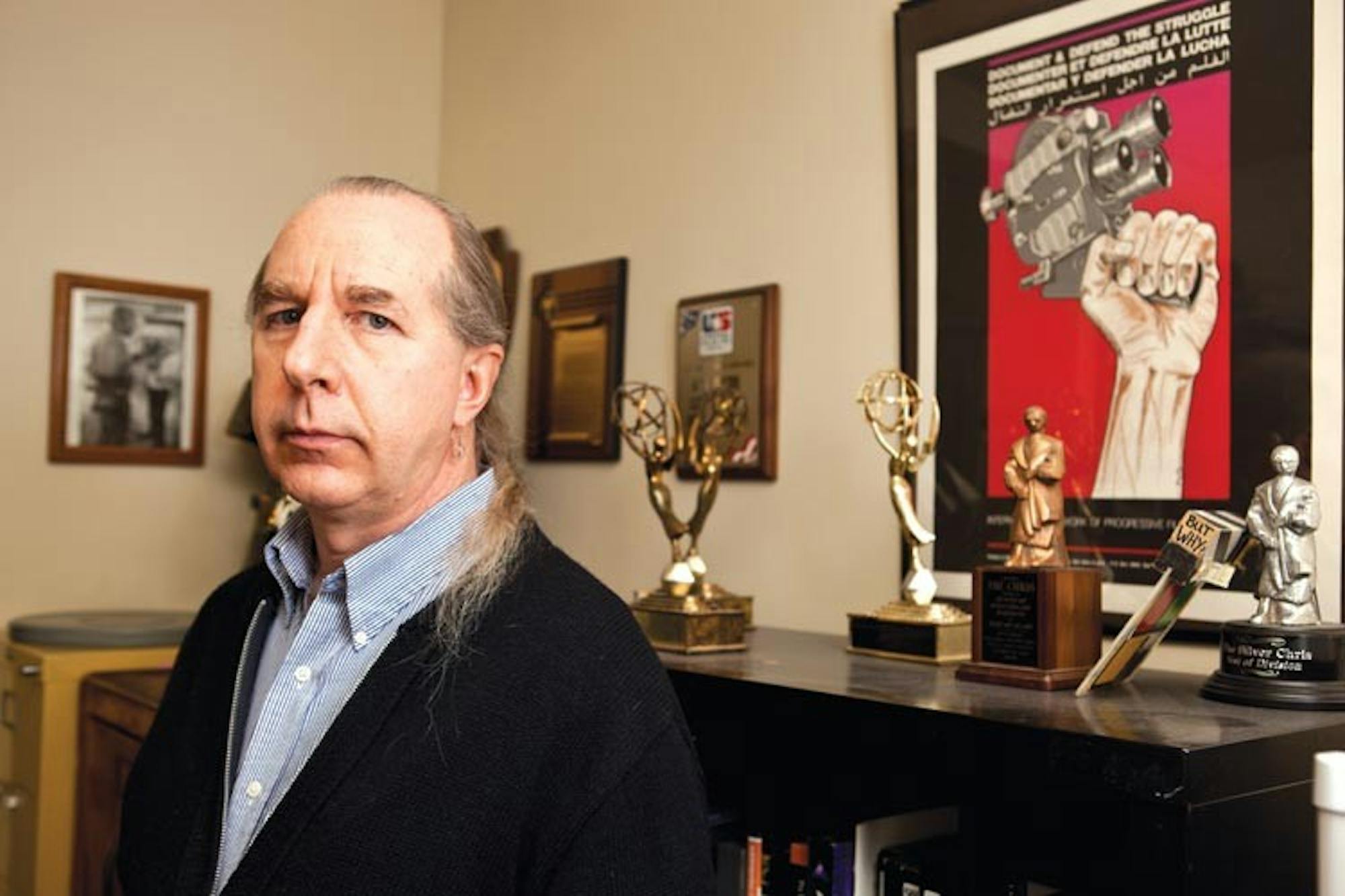
Ohio University film professor Tom Hayes traveled to his first impoverished country while working as a deck hand more than three decades ago.
Since then, Hayes has used his career as a documentarian to focus on disorder around the world.
“The essence of the process is a chaotic interaction with a chaotic world,” Hayes said. “If it isn’t (chaotic), you may as well do scripted work.”
Since graduating from OU in 1977, Hayes has been running his own production company, through which he produces long-form documentaries, three of which are about the Middle East.
Native Sons: Palestinians in Exile, his first film, was an examination of the lives of three Palestinian refugee families in Lebanon. The second, People and the Land, focused on U.S. foreign policy and the effect of tax dollars going to Israel.
His newest documentary, which is unfinished, is Two Blue Lines. The film explores Israeli policy through the eyes of Israeli Jews who are angered by their country’s treatment of Palestinians.
Despite making multiple films about the Middle East, familiarity with the area has not made shooting there any easier, Hayes said.
“Working in areas under Israeli control has become progressively more difficult for me over the years,” Hayes said. “The Israeli military has not allowed me to enter Gaza since 1994 and has obstructed my work in creative ways. For example, despite providing the Government Press Office with appropriate paperwork from WOUB, they refuse to issue me and my crew press cards.”
Hayes began making films as a child and, at age 15, won the Kentucky Educational Television Young Peoples Film Competition. Today, he still garners praise within the film industry.
“Tom and his films are the perfect mixture of brilliant, crazy talent and insistent witness that allows a vision of the truth to explode out of the screen and crawl under your skin,” said Susan Halpern, executive director of the Columbus International Film and Video Festival, in a Columbus Monthly article on Hayes.
Hayes said he expects Two Blue Lines to be released later this spring or in early summer, although the film is not completely finished and he still needs to find distribution rights.
“The film addresses deeply problematic questions and issues,” he said. “It is not the kind of work that hits pop-culture nerves like talking dog videos, so distribution is going to require some creative strategies.”
wa054010@ohiou.edu