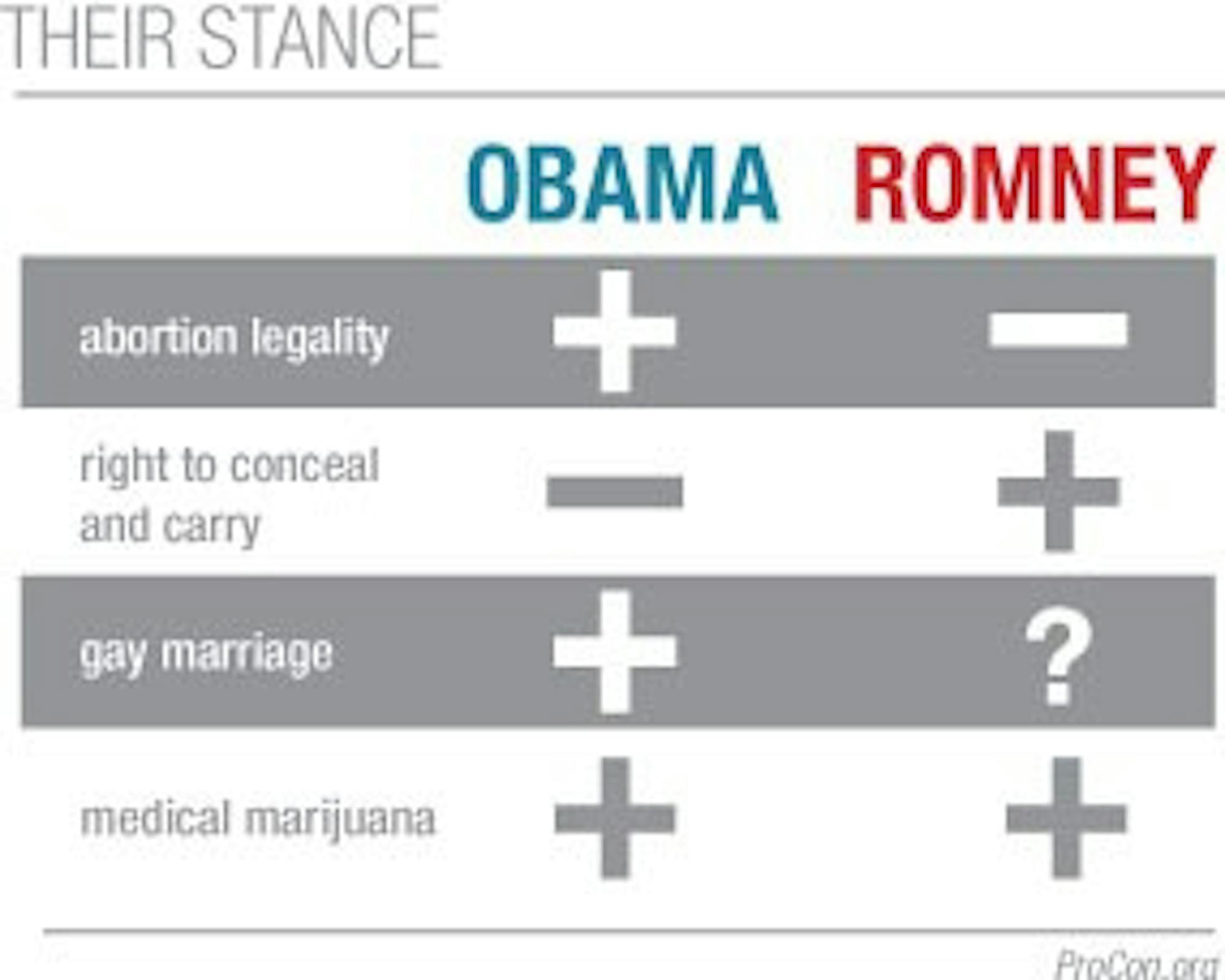
Campaign ads that traditionally targeted the economy and job creation are now taking a different trajectory, attacking views on social issues such as abortion and gay marriage.
With ads reflecting the growing importance of social issues in political debates, some might wonder whether these topics can make or break a candidate’s chance for election.
Each election cycle is different based on what is happening, and this year, social issues will be a concern, but not the driving issue, said Ryan Dilworth, president of Ohio University College Republicans and a senior studying aviation management.
“This year is mostly going to be about the economy and jobs,” Dilworth said. “Social issues are being used as an attack on the candidates more than anything else and getting people motivated to vote.”
Although social issues are important, the media is making them out to be bigger than they really are, said Nathan Kelly, campus coordinator for OU Students for Liberty and a senior studying political science.
“If you look at polls, the economy and job situation are still the most important,” he said.
According to the Pew Research Center for the People and the Press, as of April 17, 2012, 86 percent of voters said the economy is a very important factor for votes, while 28 percent said that gay marriage is.
The media intensifies the importance of having an opinion on social issues and makes it difficult on candidates, Dilworth added.
“There is no gray area in the media,” he said. “Part of the problem is that candidates cater to whatever group they are speaking to that day, and they send mixed messages.”
There is a voting base that the presidential candidates have to cater to, said Chase Peterson-Withorn, executive board member of OU Students for Liberty and a junior studying economics and political science.
“Everybody has values or has a debate over certain issues,” Peterson-Withorn said. “The candidates have to pay lip service to it.”
Social issues have always played a role in elections, said Shannon Welch, president of OU Democrats and a senior studying political science.
“In the past, the Jim Crow laws were seen as social issues, and obviously people voted based on those issues,” she said. “I think social issues can be really important issues, so I think they should be discussed, but they are used as distractions from the economy.”
Some people might vote solely on a social issue, and that could be a problem, Welch said.
“I think redirecting the dialogue back to issues such as health care and the economy can help the candidates,” she said.
A shift in values has made social issues more important to the younger generation, Peterson-Withorn said.
“You find baby boomers who are more concerned with budgets and social security and Medicaid,” he said. “Our generation is pushing social issues like legalizing marijuana and gay marriage.”
The best time to focus on social issues is when the economy is doing well, Kelly said.
“There are certain people who will always be concerned, but there is a greater number this year who are saying social issues are most important,” he said. “Let’s focus on that after we focus on the economy.”
ao007510@ohiou.edu