

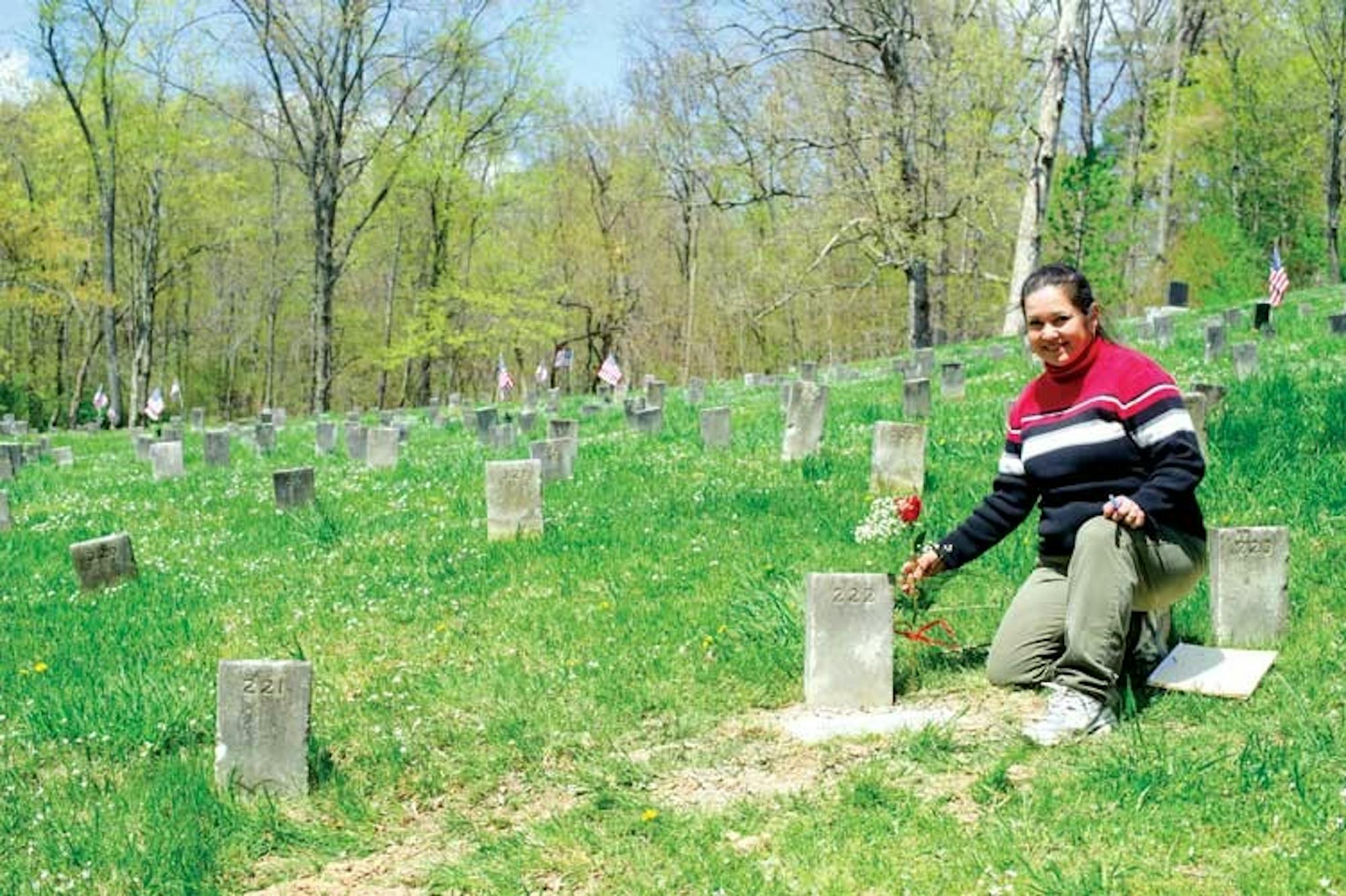
Gravestone 174 now has an identity.
Maud King passed away at the Athens Lunatic Asylum in 1900, but it was not until Saturday — 113 years later — that she was given a proper burial.
King’s second cousin, Leroy King of New Straitsville, had been working on his family’s genealogy when he was contacted about a missing member of his family tree.
“I couldn’t find out … what had happened to (Maud),” Leroy said. “I (am) pleased that now other family members can find out where she is at … because no one could before.”
Prior to 1943, Athens Lunatic Asylum did not place names on graves in the cemetery. The Friends of Athens Asylum Cemeteries has partnered with Ohio University’s Army ROTC in the hopes of giving all unnamed graves a personalized tombstone — even if the names are lost to history.
“(We) feel that every person that’s laid to rest should have their name on their final resting place,” said Berta Lockhart, president of the Friends of Athens Asylum Cemeteries. “We are doing it one stone at a time if that is what we have to do.”
Cadets from the Bobcat Battalion are familiar with the layout of the Ridges and frequently train there. More than 15 cadets from the Bobcat Battalion helped lay 11 new stones in the cemetery and place flags near veterans’ graves.
“It is important to respect those that have come before us,” said Cadet Alyssa Bush, a junior studying early childhood education. “(I want) to help out a place that we come to every other day.”
In order to place the stones, though, family members must first give their approval, unless the deceased was a veteran, Lockhart said. Since 2009, individuals from around the country have volunteered to help contact family members whose relatives are buried in the cemetery without a marker.
“This is not just an Athens thing,” Lockhart said. “This is a state issue.”
Because 45 counties in Ohio are represented in the cemetery, not all relatives are able to witness the laying of the engraved tombstone, but, regardless, red roses are placed by each new stone.
The engraved tombstones are laid in front of the historic, state-issued markers, which contain only a number. Though each number represents an individual, members of the community including Sharon Grossman, vice president of the Friends of Athens Asylum Cemeteries, do not see this as enough.
“I think this is … a moral issue,” Grossman said. “In our society today we do not leave people like this. These are unclaimed people from all walks of life … (who) we need to do right by.”
oh271711@ohiou.edu


