

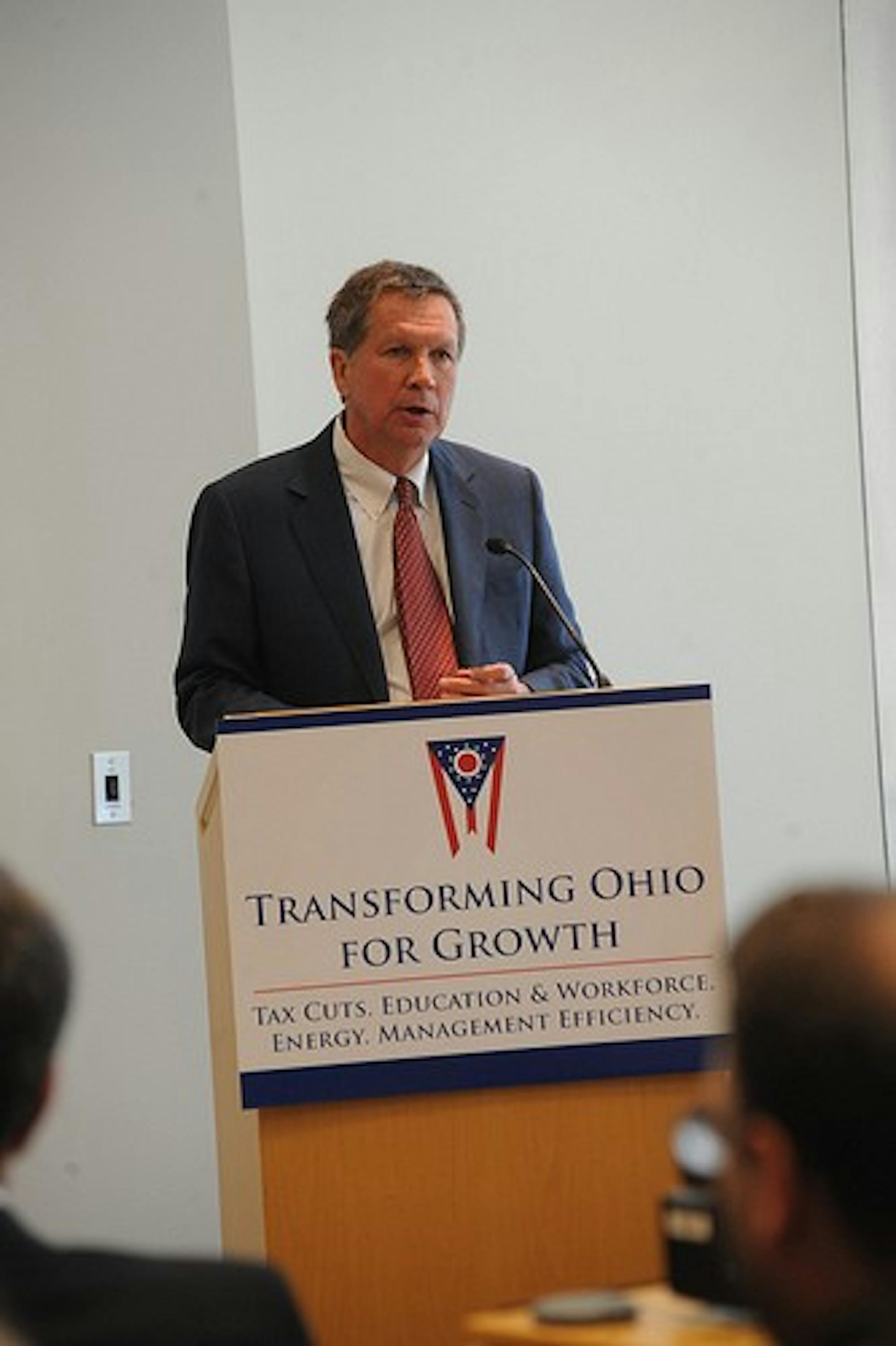
Gov. John Kasich signed the state’s two-year, $62 billion budget into law Sunday evening and touted it on social media as legislation that would benefit all Ohioans.
But Athens’ state lawmakers — soon after the legislature finalized the budget Thursday — said this budget is mostly a bad deal for Southeast Ohio.
Some major parts of the recently-signed budget bill: a major overhaul of Ohio’s tax code, which includes a 50 percent tax cut to small business owners and a 0.25 percent increase of the state sales tax; language that gives Ohio University more control of its property at The Ridges; new rules for public universities that tie graduation rates to state funding; increasing the speed limit to 70 mph in some rural areas; and giving universities the go-ahead to implement a “guaranteed-tuition model," which was adopted last week by Ohio University’s Board of Trustees.
Big changes coming to OU
The new guaranteed tuition model — which OU expects to offer in fall 2015 — promises future incoming students a flat tuition rate for four consecutive years at the university. It also increases the state-mandated tuition increase cap, according to a previous Post article.
Sen. Lou Gentile, D-Steubenville, stopped short of explaining whether the new guaranteed tuition model was good public policy, but did say: “Anytime we can cap tuition at a reasonable rate, I think we should do that.”
The Ridges amendment, introduced by state Sen. Chris Widener, R-Springfield, whose district does not include Athens, gives more power to Ohio University officials over its own property at The Ridges by reducing the number of local representatives who have a say in decisions regarding the property, critics argue.
Previous language specified OU’s president “shall” appoint the committee; the new law replaces the word with “may.” The old description included an Athens township trustee, but the position was eliminated; however, an Athens trustee could be appointed in one of the three resident positions — fewer positions than the original committee.
Gentile and some Athens residents have said they were displeased with the university’s outreach.
Some changes for how you get taxed
The budget includes several regressive tax measures such as an increase in sales and property taxes and a decrease in state income taxes. The state’s new tax policy will give Ohioans a net $2.7 billion tax cut overall, according to information from the Governor’s Office.
State Rep. Debbie Phillips, D-Albany, called tax changes, including a 50 percent tax cut on the first $250,000 of income for small business owners, a “massive tax shift that favors the wealthiest people in the state.”
“Essentially it raises taxes on homeowners, farmers and the elderly to fund the tax breaks for the rich.”
The state's sales tax will go up to 5.75 percent from the current 5.5 percent rate.
No Medicaid expansion ... for now
Kasich wanted to accept federal money under a provision of President Barack Obama’s Patient Protection and Affordable Care Act that would have expanded Medicaid coverage to some of the state’s poorest residents. The legislature stripped that from the budget and included line items that would bar Ohio from accepting that money in the future.
Kasich vetoed those line items Sunday night, effectively putting the possibility of a Medicaid expansion back on the table but in separate legislation.
“There is still an opportunity to do this, it’s just a matter of whether leaders have the political will to get this done,” Gentile said, alluding to the fact that some GOP lawmakers fear that supporting the expansion would be seen as supporting an Obama policy.
Phillips said the Medicaid expansion would have brought jobs into the state and been a benefit to small business owners and hospitals.
“The failure to expand Medicaid is a terrible failure of leadership,” Phillips said. “It is incredibly shortsighted by Republicans who are afraid of a primary challenge by the tea party.”
Abortion regulation passes
Other non-fiscal measures were passed in Ohio’s budget, such as a new abortion law that would require doctors to test if the fetus has a heartbeat and inform the mother before the procedure.
Phillips called the abortion provisions “invasive.”
“I think that’s a cowardly way to conduct business, to hide something in the budget," she said. “And that’s from people who claim to believe in small government.”
Gentile also said he felt the budget was an inappropriate place to pass abortion laws.
K-12 schools in Athens to take a hit, lawmakers say
The budget increases Ohio’s spending on K-12 education but does so by giving more money to charter and private schools.
“Many of the schools in Southeastern Ohio don’t receive additional funding,” Phillips said. “They really are getting hit from several directions at once here.”
Strong feelings, little sway
Fact of the matter is: Phillips and Gentile are Democrats in a Statehouse dominated by Republicans. The budget was finalized in the legislature mostly along party lines and sent to a GOP governor for passage.
Kasich, seemingly satisfied with changes made by Republican lawmakers, tweeted shortly before 9 p.m. Sunday: “Our new budget is now law, and it puts more pro-growth policies to work for us all.”
A link attached to that tweet directs to a YouTube video with the governor praising the budget, which he considers to be in a similar vein as his first state budget passed two years ago.
“Now isn’t the time to ease up on the gas,” Kasich said. “We’ve got to keep the pedal down and keep Ohio moving forward.”
The new budget law takes effect Monday, the first day of the new fiscal year. Some provisions, such as the 70 mph speed limit increase, are immediate. Others, such as the sales tax increase, will be phased in over time.
ld311710@ohiou.edu


