

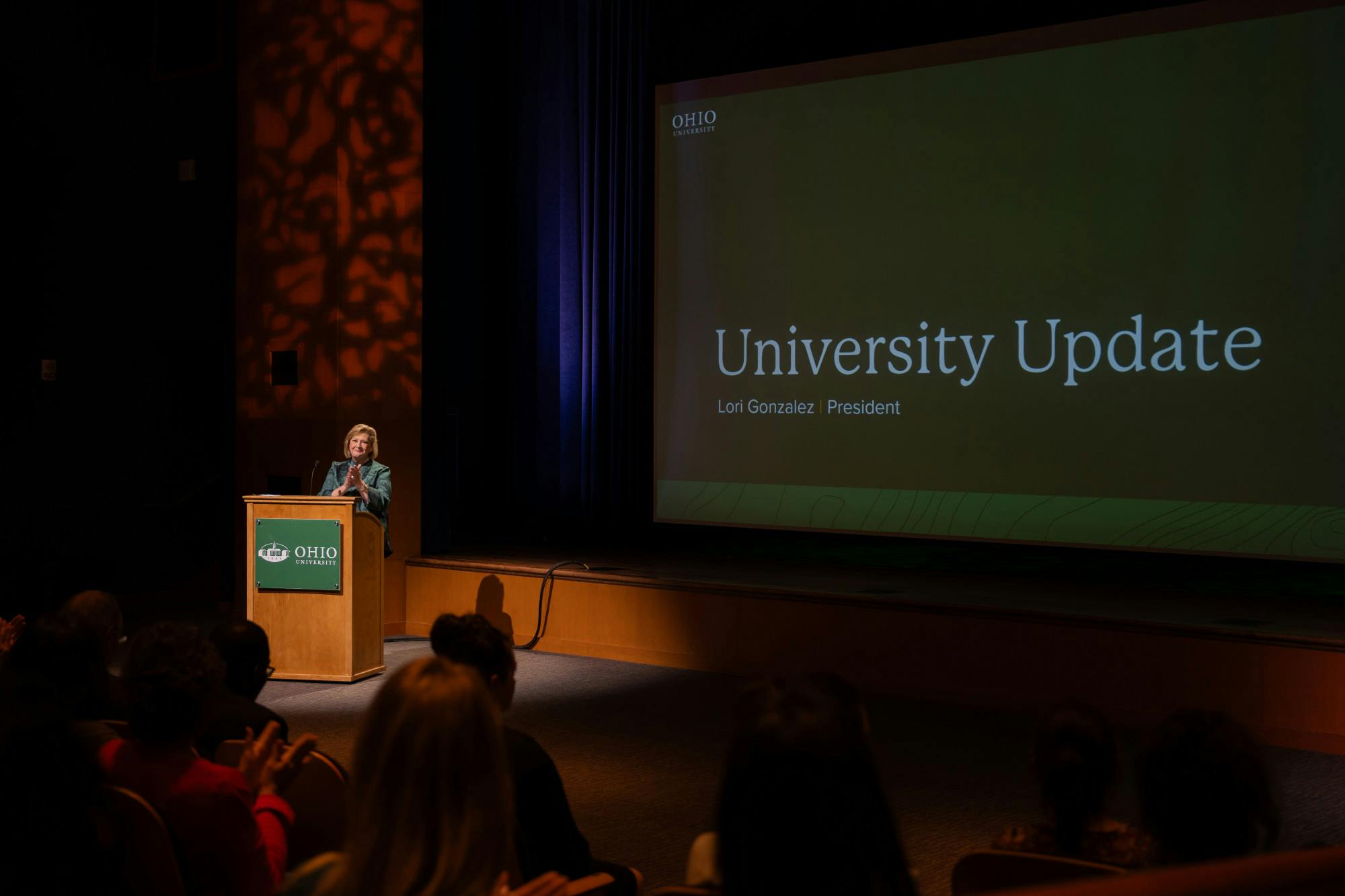
Ohio University hosted its university updates Wednesday at 1 p.m. in Walter Rotunda. The university updates is a series of events detailing the strategic priorities, progress and important topics affecting the university.
The first topic on the agenda was the Dynamic Strategy, which was presented by Donald Leo, the executive vice president and provost of OU.
Created in 2023, the Dynamic Strategy is a road map of ideas the university is following to continue to build its founding purpose and embrace existing excellence, according to the OU website.
The Dynamic Strategy is built on four pillars: learn, discover, engage, and work. Robin Oliver, the vice president for university communications and marketing, collaborated with Leo and others across campus to implement the strategies.
Leo said to ensure appropriate engagement across leadership and gather feedback on the Dynamic Strategies, they created multiple groups for the implementations. The groups consist of members from the university’s President’s Cabinet and Dean's Council.
Leo followed up on a comment OU President Lori Stewart Gonzalez made at the State of University Address, noting an implementation advisory committee had been established for the Dynamic Strategy. The implementation advisory committee has 30 members from across main and regional campuses.
“The purpose of this group is to help us define metrics, assess the progress and over time, give us feedback on the initiatives on how well they're working,” Leo said. “In the future, perhaps also suggest new initiatives align with the future strategy and the implementation of the dynamic strategy.”
The new initiatives announced at the State of University Address for the learning pillar of the Dynamic Strategy are being moved forward, according to Leo. The first investment, drawn from $500,000 allocated over three years from the original Dynamic Strategy, has been implemented. Funding for the skill-based program has also been approved and will be available to faculty in the summer. Finally, a student success working group has been put together to look at data metrics of university data to see how to improve the initiatives in the coming years.
As part of the implementation of the discover pillar, a hiring initiative has been enacted. 15 new faculty members were hired and placed into positions relating to the initiative.
“I think we're going to see a very interdisciplinary group of faculty join us in the fall to move these initiatives forward with also the people with existing strength in here to help with energy, environment and then in the emerging area of artificial intelligence,” Leo said.
To work toward the engage pillar, the team is collecting data to identify the center of community impact. In addition, a program is being implemented to mentor students through the engagement of alumni.
Leo also announced the Campus Climate Survey administered through ModernThink will be administered next month. Additionally, the Center for Employee Excellence is currently in development, and further investments and adjustments to the Dynamic Strategy are planned for the middle of next year.
Next, Gonzalez discussed this year’s required evaluation by the Higher Learning Commission which has accredited the university for over a hundred years. The review team will visit the Athens campus March 24 and March 25 and the Eastern and Lancaster campuses March 25.
“We certify that we meet established standards for quality, ensure that our students have access to federal financial aid, demonstrate our commitment to institutional effectiveness and continuous quality improvement, and we also enhance our reputation and credibility with our stakeholders,” Gonzalez said. “This promotes stakeholder confidence.”
The evaluation will include an assurance or self-study, a look at the documentary evidence file, a federal compliance report, a multicampus report and an HLC survey. The evaluation will be conducted by reviewers from other universities who have broad experience with the differences between higher education institutes.
“Their visit is an opportunity for us to tell them how Ohio fulfills its mission and how we serve our students and provide a quality education,” Gonzalez said. “It's an opportunity for us to tell the story of Ohio, why we believe in Ohio University and what makes Ohio University unique.”
From Jan. 27 to Feb. 5, students can help with the evaluation by filling out the HLC survey that will be sent to their emails.
Open forums will be held both online and in-person March 24 at 1:30 p.m. for the Dynamic Strategy. They will cover criteria one, the university’s mission; criteria two, integrity and ethics; criteria three, teaching and learning; and criteria four, assessment and improvement. Any questions students and faculty have can be answered during the open office hours held March 17.
Following this, Mary Elizabeth Miles, the vice president of human resources, spoke about the role of human resources at the university.
“You are our priority and that hasn't changed,” Miles said. “We spent some time as a team really refining our mission and reaffirming the values that we have. Through this process, we recognize that your well-being is really at the heart of everything that we do.”
Miles said the university has been working hard to go green. To do this, the university has switched to paperless W-2s through ADP, launched a transition to direct deposit pay and begun scanning and digitizing documents.
In addition, the university changed the onboarding process to reflect the changes and be more welcoming, as well as revised the performance management cycle to include multiple check-ins.
Miles shared the university's accomplishments regarding compliance. The university launched the Supervisor Foundation Series, had over 10,000 employees participate in fraud training, trained 300 employees and supervisors on changes to the Fair Labor Standards Act and launched the #HRexcellence campaign.
Finally, Miles ended her section by discussing the services the university is reviewing to improve financial wellness for retirement with a private consultant. The services being reviewed are creating budgets, retirement planning, retirement preparation, debt, home ownership, college savings, pensions, social security options, 403D plans and 457D plans.
The last speaker at University Update was Chris Ament, chief information officer of OIT, who spoke about the role of information technologies at the university.
“One of the things I really like about my role in the field of technology is that it's ever-changing,” Ament said. “In the early 2000s, technologies like smartphones disrupted the technology landscape. Similarly, in late 2022, generative AI emerged, promising another large-scale disruption for technology.”
Ament discussed the roles and teams at the university IT department. He said currently at the university IT department, women hold about 45% of the administrative roles, which is double the industry standard. In addition, a third of the IT team is integrated with funded academic-industry agreements, and 60 workers are students.
The IT department also achieved several milestones over the past year, including moving 83% of courses to Canvas, saving $90,000 from the Adobe contract, relocating the tech help desk to the fourth floor of Alden Library and implementing an information security governance structure. Additionally, 40 IT workers have completed a professional degree development program since 2022.
Lastly, Ament talked about the future plans of the IT department. He said the department is looking to modernize telephone infrastructure, evaluate artificial intelligence tools, increase awareness and proactiveness of security, establish a data strategy and framework and modernize the enterprise resource planning software.
The next University Updates will be March 8 at 11 a.m. in Baker University Center theater.


