

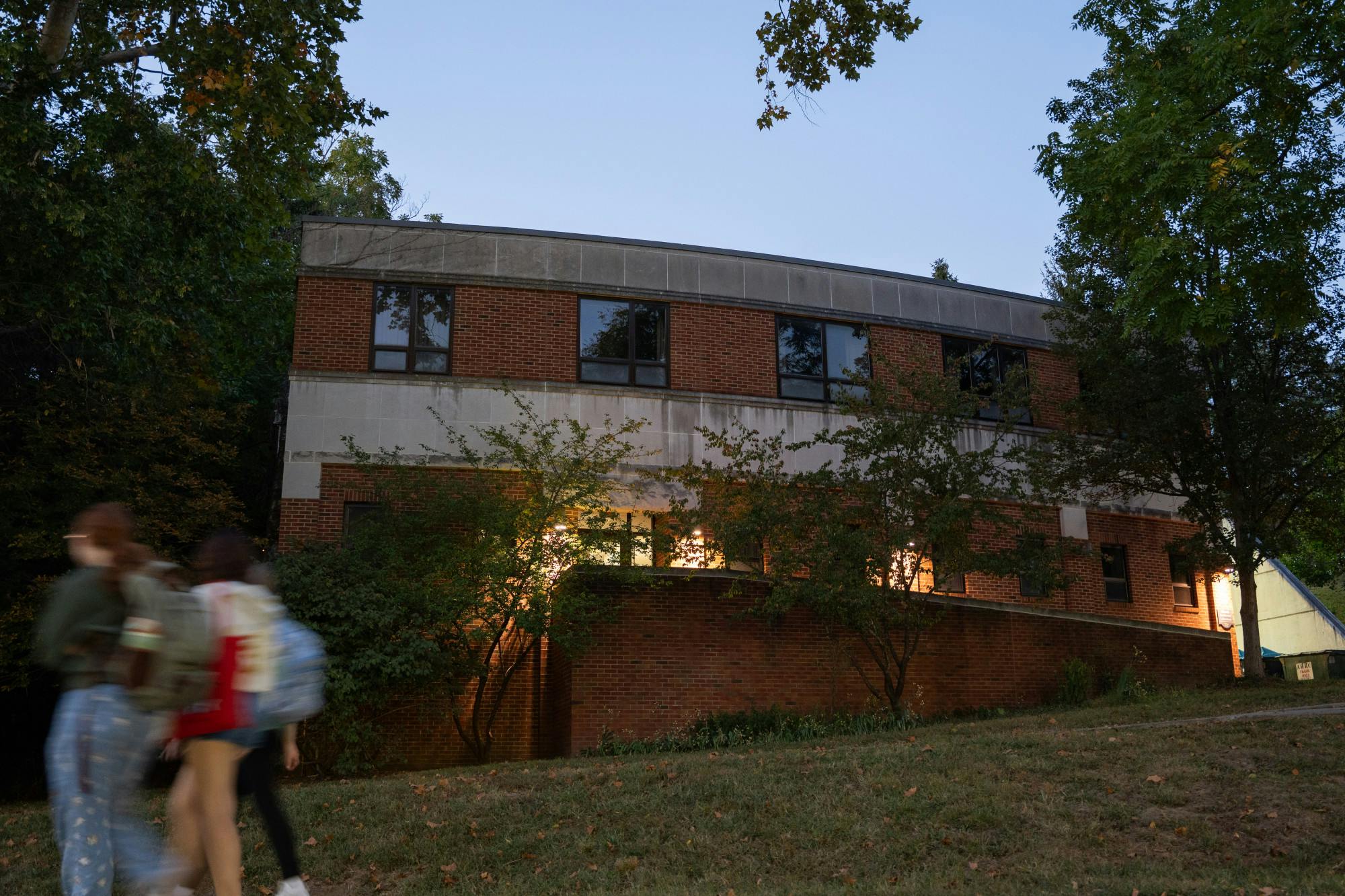
Ohio University provides a rare opportunity for undergraduate, graduate and Ph.D. students to work hands-on with a particle accelerator — the only one at a university in Ohio.
OU’s Department of Physics and Astronomy has operated a particle accelerator in the John E. Edwards Accelerator Laboratory for more than 50 years. Construction began in 1965 and was completed in 1967, with the first experiment taking place in 1971.
The 4.5-MV tandem accelerator was funded through a $1 million grant awarded to OU by the U.S. Atomic Energy Commission in 1967.
Noah Smith, a graduate student and teaching assistant in physics and astronomy, explained the purpose of a particle accelerator.
“You choose whatever particle you want, you send it through a really strong electric field, and that accelerates the particle,” Smith said. “Then you use magnets on the other side to kind of steer the particle to the target you want. It hits the target, and then a bunch of stuff comes out. You set up detectors to detect everything that comes out on the other side.”
A particle accelerator typically consists of six main elements: the particle source, electromagnets, electric fields, targets, beam pipe and detectors.
Cade Saugier, a graduate student of physics and astronomy, described the intricacies of how the accelerator works.
“We have this nucleus, and physics tells us if we have something we can ram into it, we can get different possible results that can happen, we can then measure those results,” Saugier said.
Particle accelerators allow nuclear physicists to probe the smallest components of matter and gain deeper insight into the structure of atoms.
“The reason that we do this, if you think about the atom as a whole, you’re talking about something that is so incredibly small … the only way we can learn things about it is to actually do interactions with things of the same size, we call that probing,” Saugier said.
Students at OU benefit from access to this technology, with undergraduate students able to become certified to operate the accelerator themselves.
“We do have some undergraduate students who are partially trained … you have the keyholder training, which is level 0 if you will, then level 1 and level 2,” Saugier said. “For example, I’m a level 2 operator, I can run the accelerator by myself.”
Chirag Rathi, a Ph.D. student, said the particle accelerator was necessary for his research.
“If the particle accelerator were not on campus, I couldn’t have imagined my Ph.D. project without it,” Rathi said.
Rathi added that direct experience is critical to mastering nuclear physics.
“Working with the particle accelerator on campus, with a hands-on experience, gave me a very in-depth understanding and a detailed understanding of my project,” Rathi said. “It’s more of a need if you want to really intricately understand what goes into physics.”
The accelerator’s reach extends beyond physics. Smith said an undergraduate student in plant biology recently used the facility for research.
“He is a plant biology major, but he’s doing an experiment studying the effects of bombarding a certain plant with radiation, and they can do that in the accelerator, so even undergrads can have their experiments done in our accelerator,” Smith said.
Though the accelerator is relatively unknown to many students on campus, Smith emphasized its unique value.
“I think it’s just nice to get the word out, because I think physics is fun, and I would like to share that fun with everyone else,” Smith said.


