

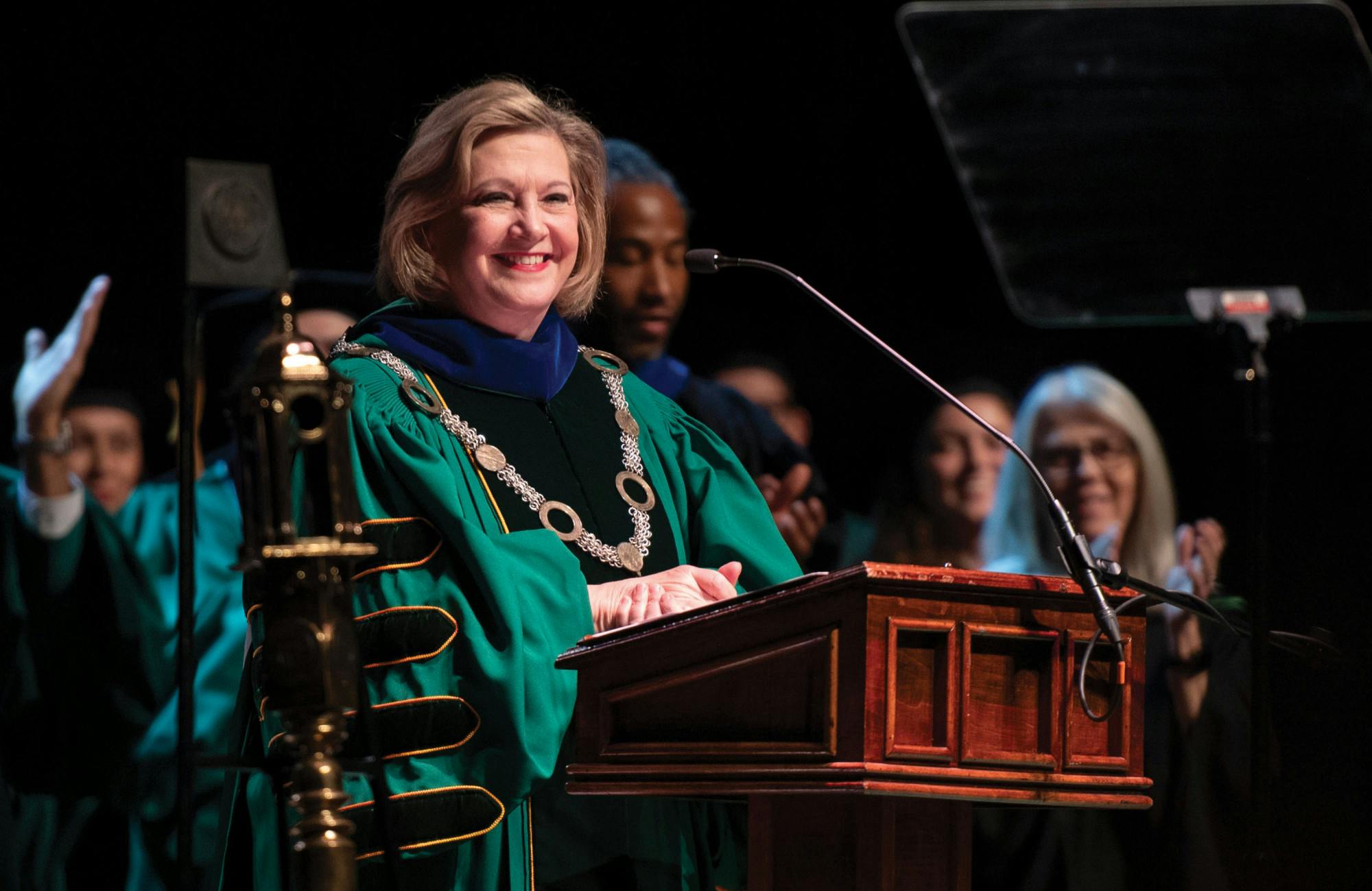
Ohio University President Lori Stewart Gonzalez hosted a State of the University Address on Wednesday morning and welcomed over 8,000 new students across all campuses, as well as 261 new faculty members.
She recognized Roxanne Schroeder-Arce as the new dean of Chaddock + Morrow College of Fine Arts, as well as Slade Larscheid as the new director of athletics.
Gonzalez called attention to the new residence hall currently being built on South Green, the Roderick J. McDavis Hall. This Friday, there will be a cornerstone dedication welcoming President Emeritus Roderick J. McDavis and First Lady Emerita Deborah McDavis at the Paw Print Park to celebrate the construction of their new building, which is set to open to students in August 2026.
Gonzalez also announced the Heritage Translational Science Research Facility has undergone “major progress,” and will be open late 2026, providing space for communal effort to support clinical and translational research.
U.S. News and World Report published its annual rankings Sept. 23, and for the sixth consecutive year, named OU the best value public university in Ohio and 39th overall in the nation.
In addition, Gonzalez said the latest Carnegie Classifications named OU as an R1 institution.
Gonzalez went on to address some concerns regarding the university, including the Advance Ohio Higher Education Act, Senate Bill 1and the state budget bill.
Gonzalez said she understands how difficult these changes may be for students and faculty alike, but said OU is doing everything it can to comply with these new laws while staying committed to students and education.
“Senate Bill 1 required us to make some changes that have been difficult for all of us, particularly those changes that resulted in the elimination of people and positions held by valued colleagues and friends,” Gonzalez said. “Change is even more difficult when you don't choose it, and in its way, we all need to ask ourselves how we will continue to meet the needs of every student in Ohio.”
Regarding the new state budget bill, Gonzalez reiterated what David B. Moore, vice president for finance and administration, released last week. She said the budget limits in-state tuition increases to 3% under the guarantee for the next biennium.
With this, tuition costs will increase only for incoming students. Updates to Pell eligibility, new program-level accountability metrics and changes to the Federal Direct Loan Program will likely create challenges for families.
Gonzalez reported the financial aid teams at OU are currently working on “clear and timely guidance” for families and students to help them understand these new adjustments.
Inflation has taken a toll on OU, with energy costs increased by 19%, software now costs 23% more and healthcare expenses have risen $14 million in the past three years.
With this, Gonzalez said over the past three years, OU has dedicated $18 million to annual compensation increases for its employees. She also said the university has made the decision, for the second consecutive year, to keep health insurance premiums flat for faculty.
In the future, the university plans to partner with donors to expand scholarship and opportunities for students, as well as continue to be transparent about university concerns. Gonzalez also said freshman learning communities will be extended into the spring semester, focusing on group mentorship opportunities.
Gonzalez ended her speech saying OU has always moved forward amid challenges, and that is exactly what the university intends to do now. She also encouraged people to celebrate the accomplishments of students and staff at OU and remember the mission of the university.
“Here's to another year of work that matters, work that makes a lasting difference in the lives of those we serve together,” Gonzalez said. “Together, we'll ensure our work continues for generations to come.”


