

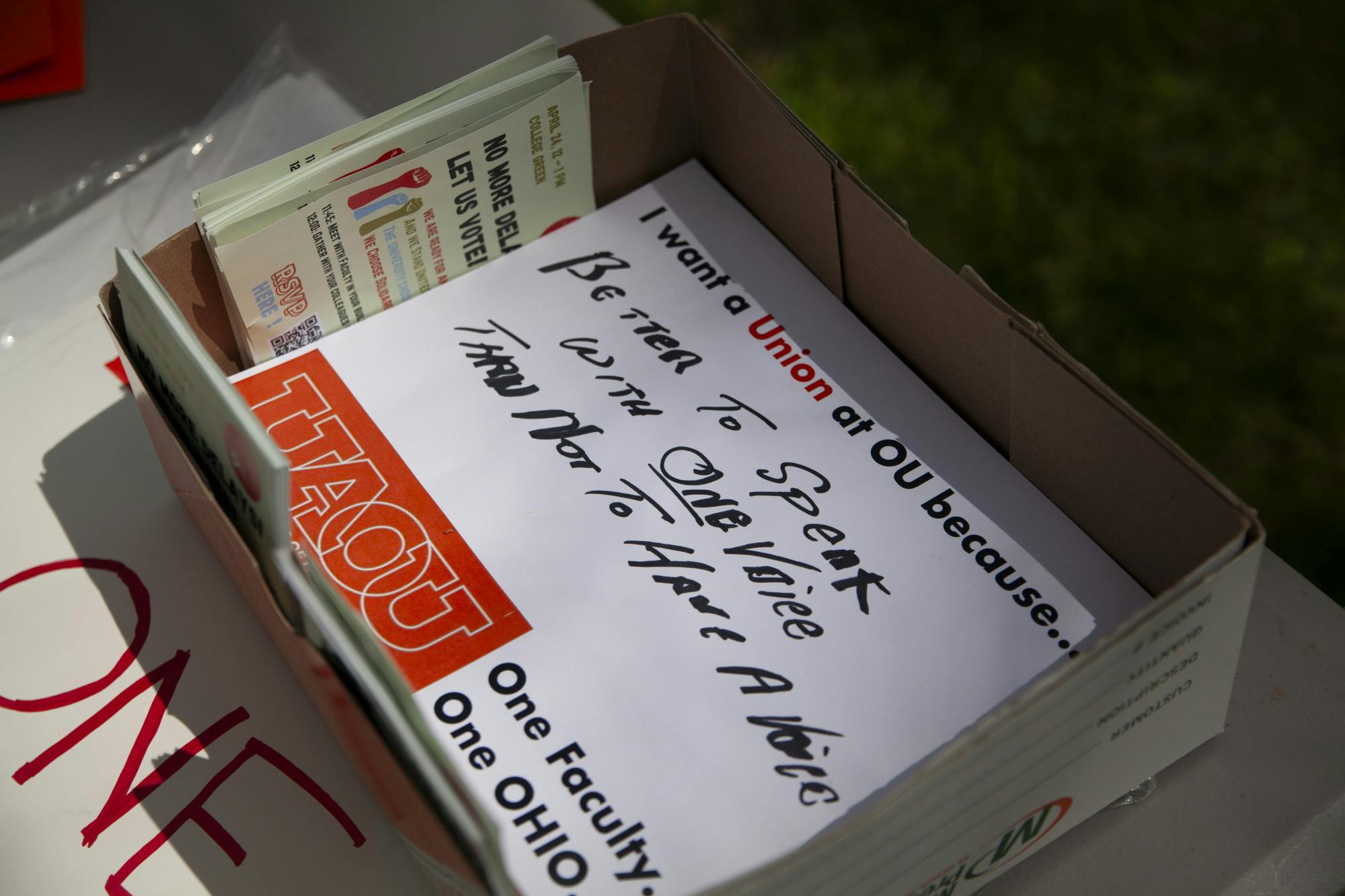
Nearly 18 months after filing to unionize and six months after securing a decisive vote, the United Academics of Ohio University has officially begun contract negotiations with the university’s administration.
Following a 453-189 vote in favor of unionization March 24, UAOU has formed a panel of 10 faculty members to represent the union at the bargaining table. However, early scheduling struggles have slowed the start of talks.
After two scheduled negotiation sessions were canceled by the university, UAOU held a “cheer-in” Wednesday in Baker University Center to rally support and call attention to the delays.
Joe McLaughlin, an associate professor of English and a member of the bargaining team, said the process has been frustrating.
“We knew at the beginning of the summer that we were going to negotiate,” McLaughlin said. “We proposed a lot of dates to them. It was a good time for faculty because we didn’t have all our teaching commitments to meet over the summer, and they weren’t willing or able to meet before Aug. 4.”
According to McLaughlin, of the three meetings originally planned for the summer, the university canceled two, one Aug. 4 and the other Aug. 22. The only session took place on Aug. 8.
Although the meetings have been sparse, McLaughlin said UAOU is determined to get a working contract.
“This is a process that’s likely to take some time,” McLaughlin said. “Things that are going to be negotiated in the contract are certainly issues like salaries and health benefits, but also issues surrounding our working conditions.”
John O’Keefe, UAOU director of communications, said although there is no way of knowing a projected timeline, he is optimistic they can reach a contract by January 2026.
“Once again, we’re confronting the strategy of denial by delay,” O’Keefe said. “I think you know if the university is prepared to negotiate seriously, I think we could easily get a contract by January.”
McLaughlin said the effort is not just about improving faculty working conditions. It is also about enhancing student learning conditions.
“At the end of the day, we’re doing this for students,” McLaughlin said. “Having competitive compensation at the university is not just about you knowing our own individual economic well-being … It can recruit better faculty. It can retain faculty.”
McLaughlin said OU faculty and staff used to be one of the most fairly compensated teaching staff in Ohio. However, through the years, this top-tier rank has decreased.
“When I started teaching at OU in the mid-1990s, a few years before that, the Board of Trustees had passed a resolution directing the administration to get OU faculty salaries into the top three in the state in all categories,” McLaughlin said.
At one point in the 1994-95 academic year, OU ranked second among public universities in average salary. By 2017-18, the university had dropped to eighth.
Along with better compensation, O’Keefe said improved working conditions will reinvigorate professors in their teaching.
“We love the work that we do,” O’Keefe said. “We really care about research, we care about teaching and students and we care about the service to the campus and to the community, so we want to be able to do that under better conditions.”
Dan Pittman, a university spokesperson, said the university will continue to work with UAOU toward a contract.
“As this bargaining process moves forward, the University remains focused on working in good faith to negotiate legally mandated terms and conditions of employment as determined by state law,” Pittman said via email.
Pittman said the university administration cannot release any further information to the public at this moment, but will continue to update ohio.edu/uaou as negotiations continue.
“We have our act together,” McLaughlin said. “We’re ready to go. Let’s get serious about negotiating and stop dragging your feet.”


