

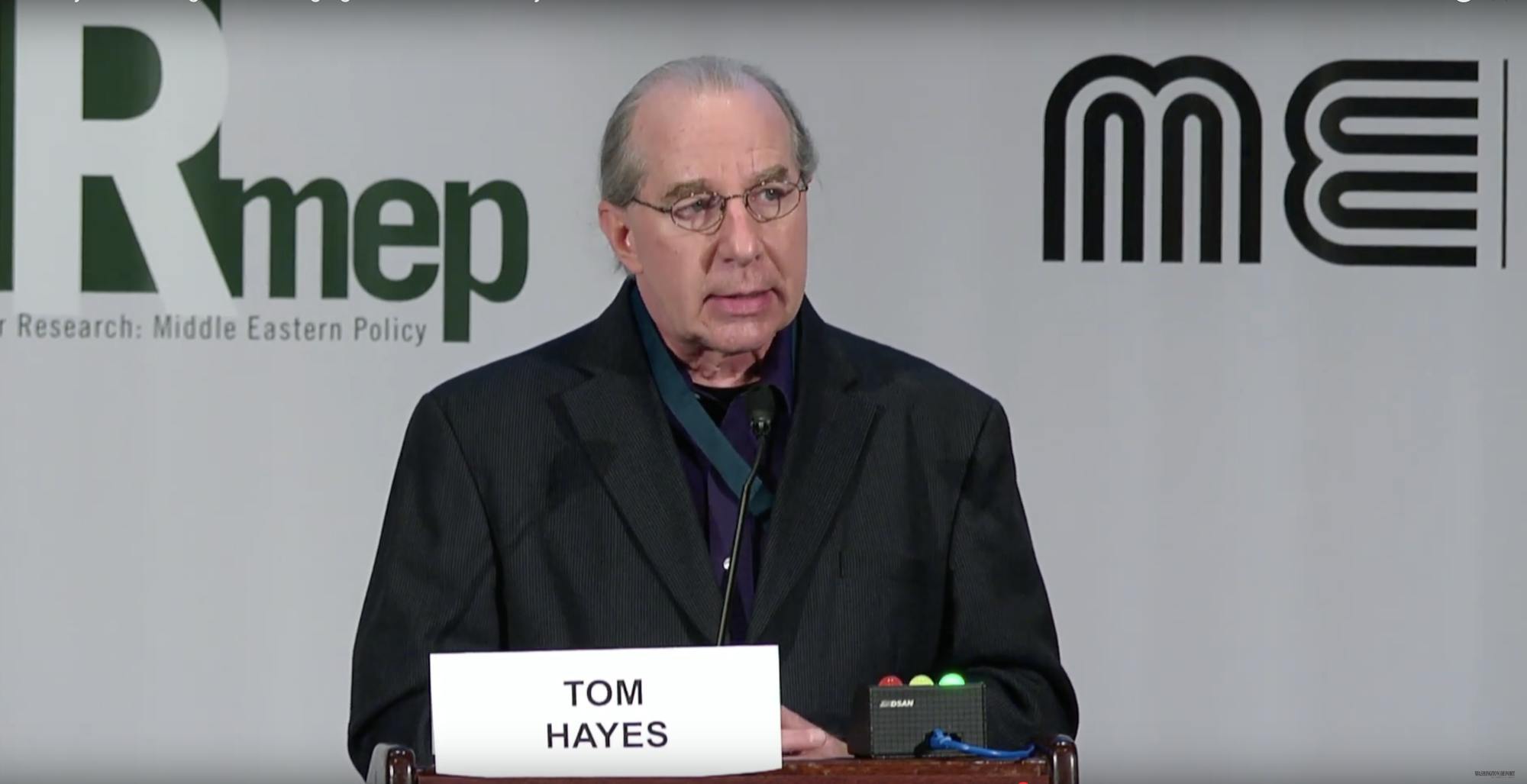
“I’m active, I’m not an activist,” Tom Hayes said.
And active he is. Hayes was jailed for protesting the Vietnam War, participated in the anti-nuclear movement and has sailed twice with the Freedom Flotilla Coalition to Gaza.
He said the phrase, “What then must we do?” runs through his mind often, a question that pushes him to act.
Hayes, who has been with Ohio University since 2002, serves as an associate professor in the School of Film. Following his kidnapping and imprisonment in Israel, he was removed from teaching his only in-person course, the art of editing, with a replacement instructor taking over for the remainder of the semester.
It was already on record that Hayes planned to retire from full-time teaching at the end of the Fall 2025 semester.
Dan Pittman, a university spokesperson, said in an email Hayes violated the faculty handbook by providing virtual instruction for his students while abroad. The university said his course was listed as strictly in-person, not mixed in-person and virtual.
Cait Rowe, a second-year MFA film production student in Hayes’ course, said the class was “shocked” by the news. On Oct. 12, they were told Hayes would return to Ohio and resume classes Oct. 14. The next day, they learned he had been removed as their instructor, with assistant professor Jordan Spayd taking over the course.
In response, the students organized and sent a letter to Dean Roxanne Schroeder-Arce demanding Hayes’ reinstatement.
“We listed the reasons why, professionally and academically, Professor Hayes, as an instructor, has no equal here,” Rowe wrote in an email. “With over 50 years of filmmaking under his belt, he is the most qualified person to teach the Art of Editing course and the person we most want to learn from.” On Tuesday, Oct. 14, Hayes’ students walked out of Spayd’s class in protest.
“It's unfortunate that we were left out of the conversations completely when our information and experiences of the course in his physical absence could have potentially made a difference,” Rowe said in an email. “There were failures of communication at every level.”
Beyond the classroom, Hayes has long been vocal about issues of global justice. In 2024, he staged a solo protest against the United Nations’ veto of a ceasefire resolution by blocking traffic for about 30 minutes at the intersection of Court and Union Streets in Athens before being stopped by police.
“I thought that business as usual really has to stop in the face of genocide,” Hayes said.
Last summer, Hayes joined the Freedom Flotilla’s mission to deliver aid to the children of Gaza, so when the opportunity arose to sail again this year, he did not hesitate. The trip included media and medical workers aiming to provide aid to as many people in Gaza as possible.
A documentary filmmaker, Hayes has spent decades documenting life in Palestine. In the 1980s, he filmed in Palestinian refugee camps and has produced three long-form documentaries on the denial of Palestinians’ rights.
Of his documentaries, Hayes’ 2015 film “Two Blue Lines” explores the impact of Jewish settlements on Palestinians, while his 1985 documentary “Native Sons: Palestinians In Exile,” narrated by Martin Sheen, follows the lives of three refugee families living in Lebanon’s camps.
Hayes most recently co-directed “Voyage of the Handala,” an independent documentary about the Freedom Flotilla Coalition, which is premiering Oct. 27 at Evolution Mallorca International Film Festival in Spain.
“I guess that's why I kind of hitch at the term activist because it's not about some political position or something like that,” Hayes said. “This is a community of human beings I came to know over time, and in some cases, have protected my life from the IDF.”
Hayes’ latest journey began Sept. 24, when he received a call informing him the Conscience, a Freedom Flotilla vessel delivering aid to Gaza, would soon depart from Italy. Two days later, he was in Otranto, a port town on the Italian coast. On Oct. 8, the ship was hijacked by the Israeli military, and Hayes and his shipmates were taken captive.
Before the mission, the crew had practiced drills to prepare for a potential hijacking and even had a chant prepared if the Israeli army invaded the ship: “We are journalists, we are medics.”
Hayes said the Conscience was closer to Egyptian territorial waters than Israeli ones, so when the call came through that the Israeli military was on the way, “nobody was really ready for it,” Hayes said.
Once onboard, Hayes said Israeli soldiers confiscated anything of value. Hayes said his books, Palestine T-shirts and even his hairbrush were thrown away, while his H4n audio recorder, DJI gimbal and other hard drives and cables were seized by the military.
The crew was detained on the boat, some zip-tied and forced to kneel on the concrete with their heads down for 45-90 minutes. When one of the coalition members spoke up about being in pain, Israeli soldiers laughed and zip-tied him, Hayes said.
The Freedom Flotilla members were then taken to Israel against their will at gunpoint, where they were processed and imprisoned.
Hayes described the processing: their bags were X-rayed, belongings taken or discarded, and they were lightly strip-searched and interrogated. For every question he was asked, Hayes said he told the Israeli army he requested to see his lawyer and contact his consulate.
“The only question that I responded to in any way was when they asked me if I was a journalist,“ Hayes said. "I said yes."
Hayes and his comrades were then taken to another holding room where they were blindfolded and zip-tied. They were shoved onto a bus that, hours later, dropped them at Ketziot Prison in the Negev Desert.
They spent at least two full days in prison before being released the morning of the third day.
“I think it was the morning of the third (day) that they showed up and just marched us out and then put us on a bus,” Hayes said. “This time, they didn't blindfold us and zip-tie us, and we're on a bus for about three hours, and then we were in at Ramon Airport … There was a Turkish Airlines plane waiting for us there.”
Hayes said throughout the detention, they were verbally abused by Israeli soldiers, border guards and the Israel Prison Service.
At one point, IPS officers shouted that Hayes and the other flotilla members were “f---ing terrorists.”
“(We were) people trying to deliver humanitarian aid to an area that has been adjudged by the International Society of Genocide Scholars to be under a genocide,“ Hayes said. "If that’s what a terrorist is, then we really need to rethink this word."
He said he could recount everything that happened to him step by step, but that was not what mattered. Hayes said what happened to him and the others was terrible. It was unpleasant, but there was a bigger issue.
“The mission was what counted,“ Hayes said. "Our effort to try to open a maritime humanitarian corridor to people who are being starved to death, denied medical care, that's what really matters to me. Really, the most unpleasant thing about it is that we were stymied in our effort.”


