

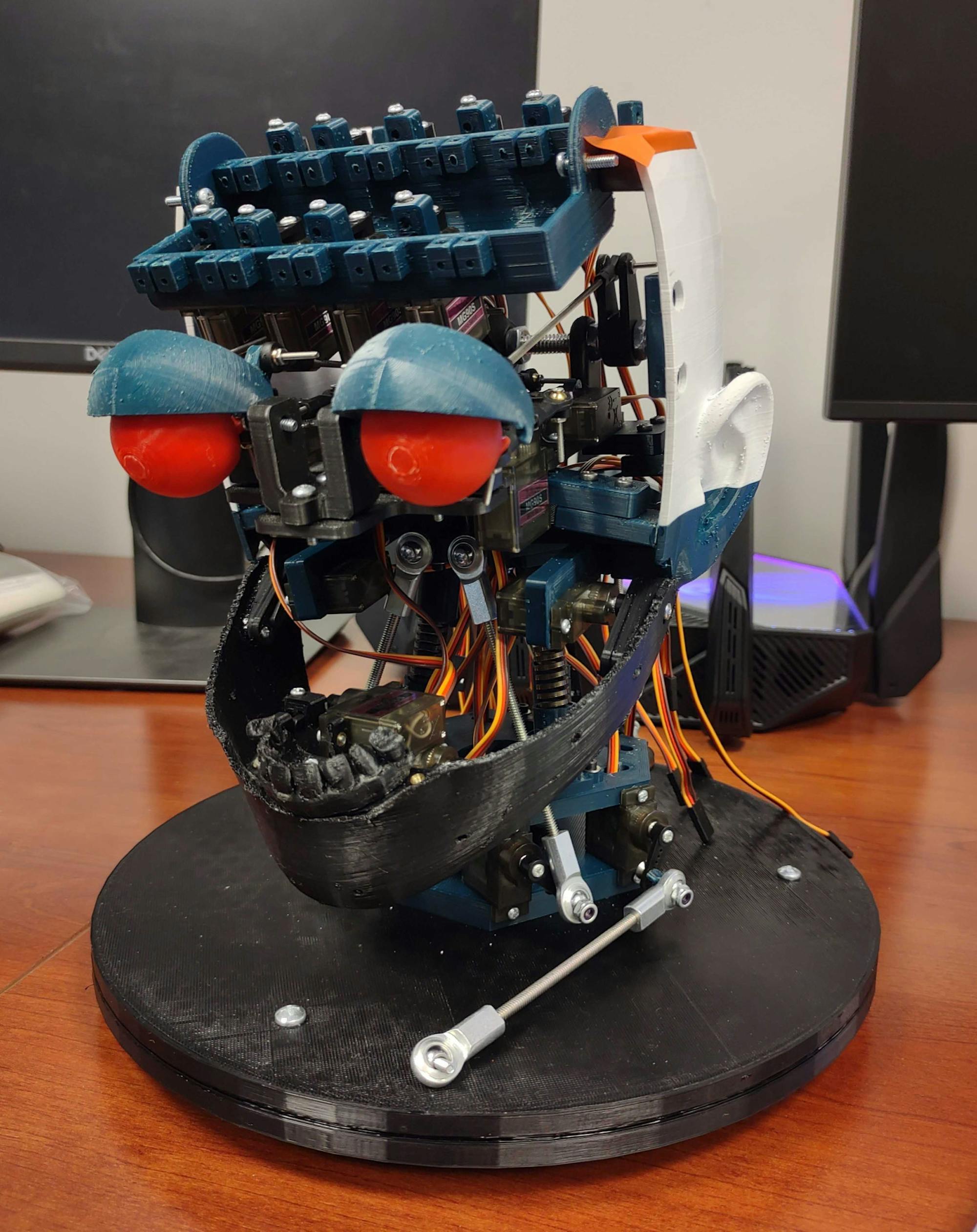
Brock Klamfoth, a senior at Ohio University studying computer science, co-founded the Animatronic Digital Engineering Initiative, which allows students to build physical and digital animatronics.
When Klamfoth had the idea for the initiative, he talked to Kouree Chesser, the faculty member supervising the club BattleCats, who connected him with Scott Miller and Neil Littell, faculty members for the Russ College of Engineering and Technology, who helped bring it to life.
“There are a vast majority of ways you can go with computer science,” Klamfoth said. “You can do cyber security, Internet of Things and robotics. However, it's kind of hard to have courses that cover all that. This kind of covers as a way to really go into what I want to do as a career.”
The team currently consists of eight people, with four students and four faculty members. Klamfoth said he is interested in seeing the team grow and urged anyone interested to join.
Klamfoth became interested in creating animatronics from science fiction works, particularly Star Wars, and his visits to Disney World. He said he was curious about the mechanics behind various attractions, such as the robotic ghosts on the Haunted Mansion ride.
“I just kind of went off to find my own, and I just kind of learned I like programming these things the most,” Klamfoth said. “That's why I was like, ‘OK, I want to do computer science.’”
The Animatronic Digital Engineering Initiative has successfully completed two projects, EVE-AI and Maxwell. They are currently in the process of developing another project called Gizmo.
A research team at Columbia University first developed EVA, a robotic head engineered to mimic human emotions, eye contact and engage in speech to allow people to interact with it. To put his own spin on the project, Klamfoth added artificial intelligence to EVA to allow it to have unscripted conversations with people.
The next project, Maxwell, consists of a parrot constructed from a Bottango robot kit. The team enhanced the robot's features by programming it to sing, move and imitate conversations. Additionally, a second bird was created to allow for two-person conversations to be mimicked.
Currently, the team is developing Gizmo, a robotic incarnation of the character Gizmo from the film "Gremlins.” The robot will function similarly to Maxwell and EVA, but it will also have the ability to move.
Klamfoth said he makes an effort to avoid duplicating existing work and often checks the internet to see if someone else has already created it.
“I might use some of these mechanisms if they're open-sourced and they are allowed to be used by others,” Klamfoth said. “If they are not, then we'll just make our own, either inspired by those things or just completely independent of those things.”
In his spare time, Klamfoth is also engaged in various personal animatronic projects. To date, he has recreated the bomb used by the character Jinx from the video game “League of Legends” and has made a mask that resembles Springtrap from “Five Nights at Freddy’s.”
Klamfoth said he donned the Springtrap mask for the December release of the "Five Nights at Freddy's 2" movie.
“That's the type of thing I like to see in my creations: not only satisfying my needs and being like, ‘OK, I made something really cool,’ but other people coming up to me and saying this is really cool,” Klamfoth said.
The initiative is funded through the National Institute of Standards and Technology funding stream, the Air Force Research Lab grant and matching funds provided by the university.
Currently, the Animatronic Digital Engineering Initiative is housed in the Digital Enterprise Collaboratory, which is located in Stocker Center, room 195.
The space was formerly a computer lab but has since been renovated and equipped with tools, giving students the ability to complete all elements of engineering to help make the manufacturing process smoother, including virtual and augmented reality headsets, a light detection and ranging scanner and a variety of digital programs.
“Initiatives (in the DEC) broadly provide Ohio University students with unparalleled hands-on experiential learning that bridges the gap between classroom theory and industry standard competencies,” Christopher Quolke, the project manager for the DEC, said. “Students gain proficiency and digital thread tools ... which are critical for high wage careers in the microelectronics, gaming, emulation, simulation and defense sectors.”
Quolke said Klamfoth is an example of a student who made the move to pursue his dream career after college.
“Brock has been a fantastic student on this project," Quolke said. “He bubbles with passion around his project from EVA to Maxwell to Gizmo. He has a very unique perspective from the engineering college on these things, these projects and these tools as we will envision them in the future.”


