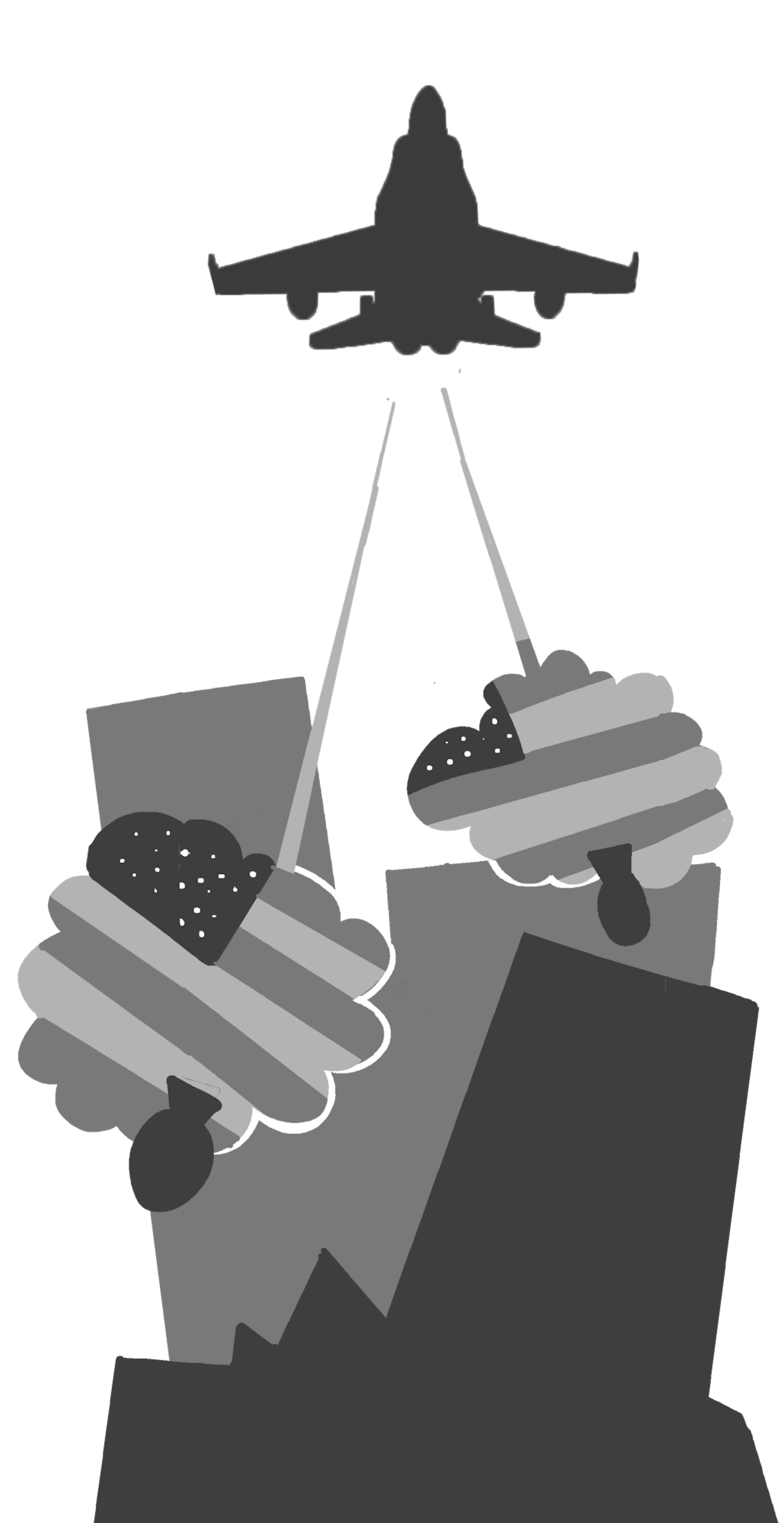
The conflict between the U.S. and Iran continues to escalate as both Washington and Tehran volley consistent threats and attacks in the Middle East.
The war began Feb. 28 when Israeli and U.S. strikes, conducted under President Donald Trump's Operation Epic Fury, killed Iranian Supreme Leader Ayatollah Ali Khamenei, according to The Associated Press.
Since the initial missile strikes, Iran retaliated, launching attacks on both U.S. and Israeli military bases, including Diego Garcia island, a U.K.-U.S. military base located in the Indian Ocean, according to the AP. Iranian strikes also hit Israel as well as Qatar energy facilities and the American Embassy in Saudi Arabia, the AP also reported.
The Strait of Hormuz, a waterway that connects the Persian Gulf with the Gulf of Oman and the Arabian Sea, has become an integral part of the current conflict. The strait is bordered by Iran and is used to transport around 20% of global petroleum, according to the U.S. Energy Information Administration.
Christopher Nichols, the Wayne Woodrow Hayes chair in national security studies and professor of history at Ohio State University, discussed the nature of the strait.
“If you look at the Strait of Hormuz on a map, it's a very narrow channel which is pretty easily obstructed by military means … virtually any kind of vessel can lay mines in that area,” Nichols said. “And so it makes it a relatively simple military task to make the strait virtually impassable.”
Iran has practically closed the Strait, but threatened to shut it down completely after Trump mentioned the possibility of attacking Iran’s power plants. That would deal a significant blow to the U.S. and its allies, as the strait is integral to their energy supply.
The Trump administration promised a swift response.
"If Iran doesn’t FULLY OPEN, WITHOUT THREAT, the Strait of Hormuz, within 48 HOURS from this exact point in time, the United States of America will hit and obliterate their various POWER PLANTS, STARTING WITH THE BIGGEST ONE FIRST!” Trump posted on Truth Social on Saturday night.
Trump also hinted at invading or attacking Kharg Island, a stronghold near the Strait of Hormuz. Nichols described the island, and the political advantage of taking it over would give Trump.
“Kharg Island is where a lot of the oil exports coming out of Iran come from,” Nichols said. “It's a refining area. It's only like five miles of land, but that's where Iran's oil exports pass through, so the U.S. attacking it or taking it over, destroying it, and all of which are apparently on the table, are ways to stop Iran's one major export from getting out, so it would put a sort of stranglehold on the Iranian economy.”
The Trump administration’s decision to engage in a military offensive against Iran came shortly after Trump expressed disappointment with the way nuclear talks were going with the nation, the AP reported. The issue of Iran's nuclear capabilities has been a conflict for years, with the U.S. attacking Iranian nuclear sites in June.
Aiden Fox, president of the OU Republicans and a senior majoring in political science, agreed with the attacks on Iran.
“I think the United States essentially needs to stick to its stated goals so far,” Fox said. “I think at this point, that's probably regime change … I really think the broader foreign strategy that Trump has been showing here has actually been China-focused. Believe it or not, Venezuela represented a large portion of China's oil imports, same thing with Iran.”
U.S. relations with Iran span back to post-World War II, Nichols said, when the CIA intervened in 1954 to help stage a coup d’état.
“One thing that historians think about a lot … is the sort of longer history of the way the US has meddled with Iranians in the country of Iran since World War II,” Nichols said. “And the most obvious and notable one that people who are knowledgeable about this know is the CIA intervention in 1954 to overthrow the lawfully elected leader, Mohammed Mosaddegh, and in helping institute the Shah after that.”
Nichols argued Trump’s intent to initiate regime change will be more difficult than he thinks. He said regime change typically occurs from within and requires a viable movement from the nation's people, which is not present in Iran.
A majority of Americans do not favor the war with Iran. According to a Reuters/Ipsos poll conducted from Feb. 28-March 1, only 27% of 1,282 respondents approved of U.S. strikes on Iran, while 43% disapproved and 29% were not sure.
As of Fall 2024, Ohio University has a total of 40 Iranian students, with 38 being graduate students and two being undergraduate students, according to an international student enrollment chart.
The OU Iranian Students Society was unable to provide an interview with The Post.
Samantha Pelham, a university spokesperson, provided a statement of support for OU’s international students.
“OHIO's Office of International Student and Scholar Services (ISSS) is committed to providing our entire international student community with the individual support and resources they need to succeed during their time at OHIO,” Pelham wrote in an email. “We encourage our international students who have specific questions or concerns to reach out directly to the ISSS team via phone (740.593.4330), via email or online.”