Trigger warning: this article details experiences of gun violence and trauma. Please exercise caution if you believe the words below may be triggering or hard to read.
We, Ohio University students, members of The Post and White House Correspondents Scholars, are not only victims, but survivors of the most recent attempted assassination of President Donald Trump.
April 25 will go down as one of the craziest days in our lives. In a place of celebration, where we were being honored for our contributions as collegiate journalists with an award given to 30 recipients a year, quickly turned into a “Do or Die” situation.
What will stick with us is the clanking dishes, the pops of distant gunfire, images of Secret Service agents pointing firearms, both politicians and journalists alike, confused by the closeness of an increasingly common reality of political violence in America.
It can happen to anyone, even a group of students visiting Washington, D.C., from their liberal arts university in Appalachian Ohio. This is our story told in our own words, along with our real reflections. Our stories will not be a headline. Instead, we offer our honest reflections in this letter on a particularly challenging moment in our careers.
Sensationalism, Sauvignon Blanc and Shots Fired
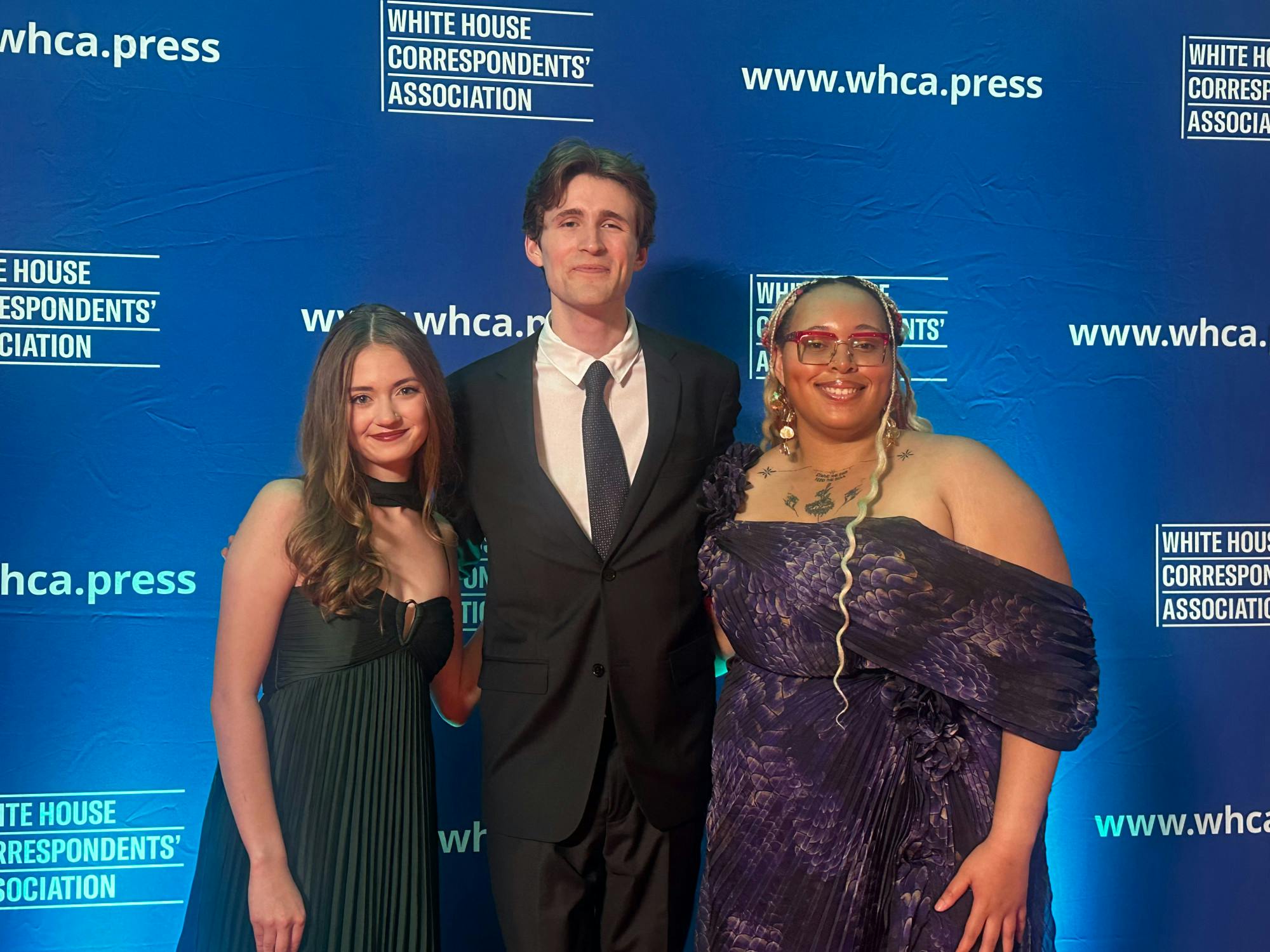
The White House Correspondents Association is a highly respected organization in the journalism industry. Students from OU apply each year for one of three spots to attend high-level networking opportunities.
Then, they are whisked away to a night of glitz and glam, dressing up and networking with politicians and big-name journalists, at journalism’s biggest night, the White House Correspondents' Dinner. One night of the year, politicians and journalists can mingle without working.
The dinner annually recognizes student scholarship winners, who receive funding from their university and the association.
Thus far, the weekend had been one of great success. Including visiting the White House, meeting White House press staff, walking on the lawn, visiting the press briefing room and then meeting with WHCA mentors at the Watergate Hotel.
At 7:00 p.m., guests started to filter into the ballroom, packed with tables tightly placed next to one another. Students had the longest way to go, up to the front and just right of the vice president’s table, offstage, in the mezzanine.
This table would become our home base, our shield of protection and our escape from a flurry of activity later that night.
Sitting about 20 feet from the head tables with Vice President JD Vance, with an almost direct view of Trump’s seat, we had just been rearranging our seats to look around the column that separated us from the Secret Service agents posted at the exits.
One minute, we were talking, laughing about the event, the people we saw and the next, we heard a burst of gunfire. Five pops turned the dinner upside down.
The gunfire was muffled from outside the door; we had mistaken it for the drums of the marching Howard University band members that had been seen entering and exiting the room with their instruments earlier in the evening. Reactions were mixed among the audience of well-seasoned professionals, but much more amongst students.
As we turned our heads to the main door, a tidal wave of bodies pushed away from it in an abrasive, synchronized movement. For a split second, the consideration of it being a bomb passed through one of our minds, as the doors slammed shut and reporters dove for cover.
In the sardine can of reporters and political affiliates, we rushed to the ground as Secret Service and National Guard swarmed into the room, leaping over tables to get to the President and Vice President, yelling, “Get on the ground! Get down!” From the table where we sat, we could see various agents with rifles peeking from the nearest door, trained on the main aisle.
We all dove to the ground, confused and panicked, even contemplating if this would be it for us. Then, the journalistic experience of everyone in the room kicked in.
We witnessed the mathematical, well-trained and calculated movements of Secret Service agents. Behind our table, a journalist in a bow tie tried to get a video of the stage as Vice President Vance exited. The Secret Service agent then pointed his firearm at the man, urging him to back up, considering “Would we see the blood of the man behind us instead of the President’s?”
The enduring and albeit dangerous work of journalists was highlighted that night, despite dire circumstances. Although we all dropped to the ground, hundreds of journalists in the room quickly stood up, reporting live on various social media platforms.
Despite the confusion, it was a rapid moment of information-sharing. As reporters across the room moved to share what happened, the dinner became a reminder: journalism continues to thrive when threatened.
“Journalism is a public service because when there is an emergency, we run to the crisis, not away from it,” Weijia Jiang, president of the White House Correspondents’ Association, said.
Sitting Across the Table: Becoming the Source
Across the table from us, journalists filled the whole room immediately after the attack. They leapt up with livestreams, phone calls and more, trying to get information from the outside and to the public.
Weijia Jiang was right to say that journalists run toward danger, but it proposes a key question for journalists: safety and mental health. How far do we put ourselves in the line of fire? And further, how good are we at informing the public if we are not alive to do so?
All three of us are student journalists, reporters, editors and directors. We are dedicated to our respective beats during our college careers and interviewed sources from various backgrounds.
The morning after the attack, our social media profiles, personal and public, were found by media outlets. From messages on LinkedIn, Instagram and other platforms, we found ourselves becoming the subject of the conversation instead of moving it forward.
While we give credit to those who sent a kind message or words of support, the underlying intention was still there: get the scoop.
We learn at the E.W. Scripps School of Journalism to care for our sources and be mindful of how we approach sensitive subjects. Yet, being in the hot seat is dangerously more vulnerable than we even anticipated.
Even that night, some of us were the subject of invasive inquiries, having had reporters who wanted to record the incident, kicking those on the floor to get their bodies away for better coverage, then pointing cameras in our faces to ask, “Did you see what happened?”
There is an undertone of invalidation to everything, invasiveness in every inquiry. Those inquiries represented age-old questions about our ethical obligations as professionals. Trust and safety are already things lost for survivors of violence, and being asked to interview and retell an especially violent encounter the night after it occurred disturbed us.
In returning home from the attack, we lost normalcy, sleep and direction. Media requests kept pouring in as we struggled to reckon with what we witnessed. The immortal comfort of our 20-somethings was gone in a second.
As journalists, there is a sentiment of obligation and responsibility to speak up. The feeling that you must participate in the media, no matter the cost. But at the same time, we felt frustrated, hurt and overwhelmed. The field we so dearly love may also reduce our experiences to a quick story.
In part, this is why we wanted to tell our own story, through our own words. We didn’t want to be the student faces on morning television, telling our account of the attack. We wanted to be empowered to talk not only about what we witnessed, but also about what we learned about ourselves and others in the aftermath.
Political Violence and the Atmosphere of Threat
After peeking out from the fresh linen tablecloth, Erika Kirk ran by the table we shared with other scholars. Her face echoed the trauma of her husband, Charlie Kirk, who was assassinated last fall.
We met Erika Kirk earlier in the evening, more out of awe that she was there than a political affiliation. After speaking with her and taking photos, she held students’ hands in hers, saying, “God bless you.”
At the time, it seemed a bit intense, regardless of the religious affiliation between students. However, now, it serves as a prominent, ominous warning, knowing the moments that were about to come. Although we may not associate ourselves with her political stance or affiliations, the humanity in her words offered a moment of compassion.
As a society that has become so divided and polarized, we often lose the element of human connection. We begin to see sides, aisles and frustration over companionship and emotional links bringing us together.
In this moment of fear and terror, and although we were surrounded by some of the most controversial public figures and administration our nation has seen, their walls were removed. Their fear was that of any common person, and although they had very different lives than us students, politics did not reign while the bullets flew.
Following the shooting, numerous conspiracy theories emerged, suggesting that this assassination attempt was another hoax or that what happened was not “real.”
But as survivors of this attack and students of the world, what we lived through was not fake. The risk to the attendees of witnessing an assassination was real and terrifying.
The split-second decisions we made in that moment were very real. The bodily awareness that comes with the split-second closure, that “this may be it,” was real. After what we saw, it becomes clear political violence is no remedy to our disagreements as a nation.
Shortly after the shots were fired, a guest shouted, “God Bless America, U.S.A, U.S.A.” Our reactions were not that of national patriotism, but rather fear of another gunman, more shots and more danger.
When you are outside of a situation like this, it is so easy to gloss over the details, people and aftermath. Being in the center of a moment like what happened that Saturday night puts things in perspective. There are everyday people, citizens, voters and students who are the ones witnessing this violence.
Rumors online and harsh comments about the success of an assassination attempt don’t hurt Trump or high members of government. Instead, they accomplish the same outcome of political violence: everyday people get hurt in the process.
Corey Comperatore was killed in Butler, Pennsylvania, in 2024. David Dutch and James Copenhaver were also shot. Those people, their families and the other attendees at the rally were the ones who suffered.
In those moments, political violence doesn’t choose sides. As Americans, we run the risk of being in the wrong place at the wrong time. We experienced how no one can ever know when they will be next.
Love those around you, and tell your friends and family you love them. Life is short and unpredictable. You never know where you’ll end up.
If you or someone you know is struggling with mental health or suicide, you can call, text or chat 24/7 with the 988 lifeline by dialing 988.
Ohio University students can also reach out to Counseling and Psychological Services by calling (740)-593-1616 to schedule or talk after hours.
Journalists and professionals alike can also utilize resources from the Global Center for Journalism & Trauma to learn more about Trauma-Informed Journalism.
Nyla Gilbert and Emily Stokes are seniors studying journalism and Aiden Ryan is a junior studying journalism at Ohio University. The views of these editors reflect the opinions of the majority of The Post. You can contact the Editors via editor@thepostathens.com.