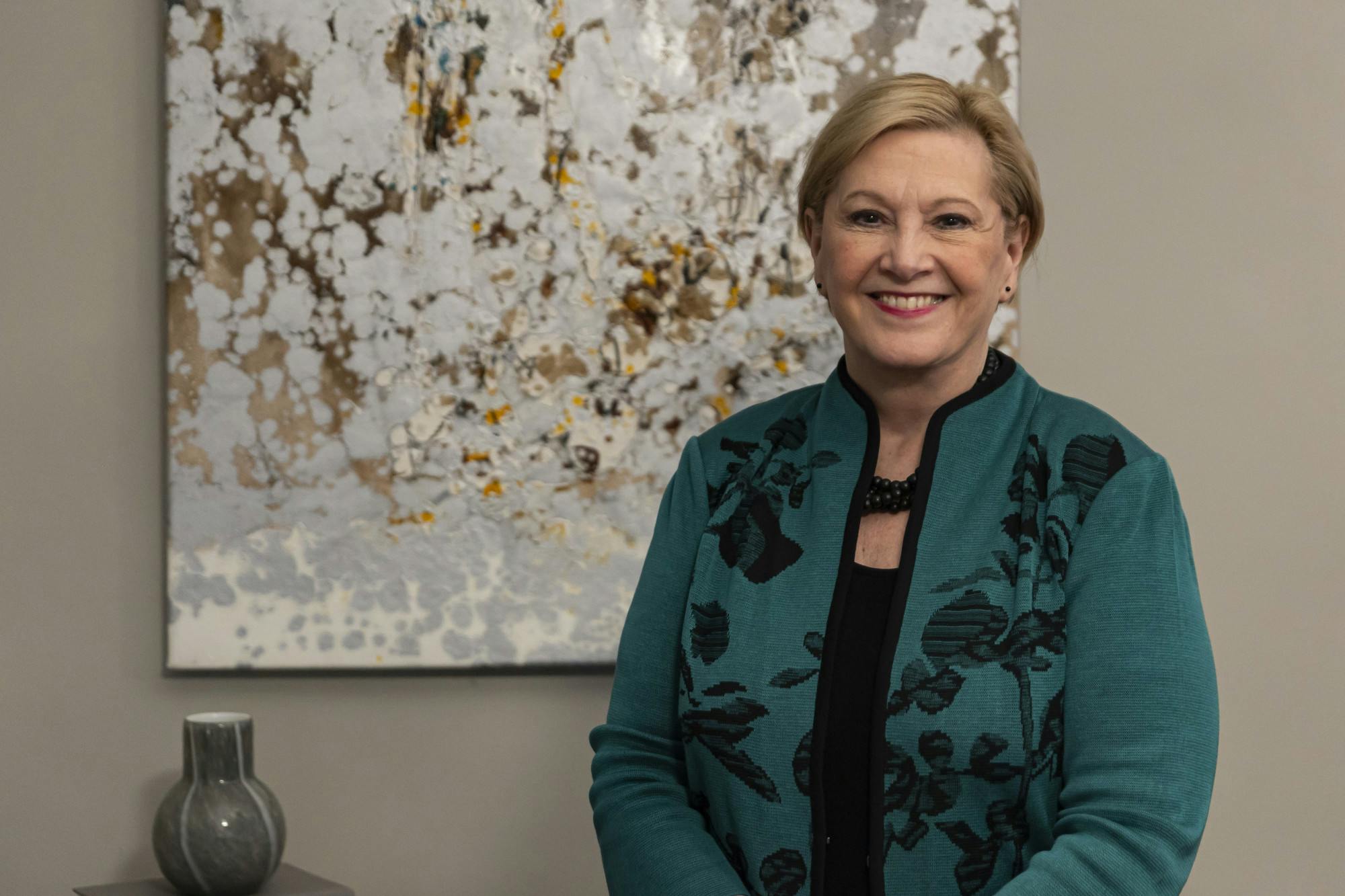
Ohio University President Lori Stewart Gonzalez was sworn in as both OU’s 23rd president and the university’s first woman president Oct. 18, 2023. She has had a long career in higher education administration that ultimately led her to OU. Before coming to Athens, she was the interim president at the University of Louisville from 2022-23, and has been an administrator at the University of Kentucky, Appalachian State University and the University of Tennessee. She earned her bachelor’s degree from the University of Kentucky and her master’s and doctoral degrees in communication disorders from Eastern Kentucky University and the University of Florida.
OU has navigated significant changes during Gonzalez’s tenure, particularly following the passage of Senate Bill 1, also known as the Advance Ohio Higher Education Act, which was signed into law in March 2025 and took effect in June. At the time, Gonzalez announced the university would sunset its Division of Diversity and Inclusion, emphasizing that the university must “work collectively to preserve the legacy of their work and carry it forever forward.”
That same spring, faculty voted to unionize under the United Academics of Ohio University, with negotiations beginning in August. Gonzalez said the university remained committed to “good faith dialogue” throughout the bargaining process.
The Post’s executive editors – Jackson McCoy, editor-in-chief, Sophia Rooksberry, managing editor, Alexandra Hopkins, community standards editor, and Abby Waechter, director of business strategy – sat down with Gonzalez for a 20-minute conversation March 3. The discussion covered UAOU negotiations, the impact of SB1 on OU’s campus, the termination of head football coach Brian Smith and her perspective on the state of her presidency.
Editor’s Note: President Lori Stewart Gonzalez’s responses have been edited minimally for clarity.
Jackson McCoy: What influenced you to work in higher education, and how did you get to Cutler Hall?
President Lori Stewart Gonzalez: I am a speech language pathologist by education. I had a mentor in my graduate program as a master’s student that encouraged me to get my doctoral degree, so I followed her to the University of Florida. I came from a small town in Kentucky, and everyone thought I'd go get a Ph.D. and just come back to this town of about 2,000, and I was thinking maybe that's what I would do, but I got to teach while I was a doctoral student. I was in research, and then that just led to the faculty life.
I started as an assistant professor. I went all the way through the ranks. I was an associate dean, a dean, a provost, and I never really had a presidential appointment in my mood board, but I was nominated for this position in my previous position at University of Louisville. I stepped in as the president when we had a transition until they got the new president, and I really enjoyed the work with alumni, closer work with athletics, all those things that are part of a president's portfolio.
I knew about Ohio University because I was from southeast Kentucky and just started digging around in the website and thought, “I'm going to try for this position.” As soon as I interviewed with the search committee … it was just such a wonderful experience, and sometimes you think that's just going to be nerve wracking, right? But it was so positive and (there was) such pride of place at OHIO that really resonated a lot with me.
JM: You are from the Appalachian region – how has that shaped your goals in your presidency at OU?
LSG: My dad was a first generation student. He went to Berea College in Kentucky, and it's a labor school, so students do a lot of the work and they don't hire as many employees. He was the first in our family to go to college, and then after he graduated, I didn't know that I could choose not to go to college. We would be around the dinner table and he'd say, “What do you want to be when you grow up?” My sister said she wanted to be a mommy, and my dad said, “Where are you going to study to do that?” It was just not even a decision, and I knew other students could choose not to go. Education was so important in my family, and then the other thing that was important to me as I was in my faculty role was opening doors of access.
In Appalachia, we have high rates of poverty, but a third of my students were from Appalachia. I could see they were going to go back home and work, and a lot of them in the schools because this was speech pathology. Seeing the pride of place in Appalachia – I don't know if anyone here is from Appalachia – but whatever your small community is, people are so proud of their roots, and they all come together to work together to fix issues. Not saying that doesn't happen in urban areas, but it's really part of the history, the legacy of Appalachia. That was another advantage to me for OHIO because I had moved away from Appalachia in my career, and then I had a chance to come back home to Appalachia at a school who is totally committed to the region, so that was kind of the cherry on top of the presidency.
Sophia Rooksberry: Regarding the UAOU negotiations, what is something you wish students knew about the negotiation process?
LSG: Well, I'm not going to talk about the negotiation process because I'm not in it, and the way negotiations work is the faculty representatives and our representatives come together, so I think questions should go to representation. What I want people to know is that I'm a faculty member. I have tenure in the College of Health Sciences and Professions, and without the faculty, there is no OHIO. Even though maybe it seems like there is an adversarial relationship, for me, the goal is that faculty are well paid, that they can thrive here, because when they do that, you have a better experience.
SR: Was that a choice you had to make, whether or not you stepped into the negotiations?
LSG: No, the President is never involved in those negotiations.
SR: If the negotiations end up resulting in a faculty strike, how do you think students would be most directly affected by that?
LSG: If you read Senate Bill 1, which is the Advance Ohio Higher Education Act, the police, first responders and faculty are prohibited from striking. The police and first responders were in another law, and then in SB1 – which is what I'm calling it, but it's the Advance Ohio Higher Education Act – (faculty striking) is prohibited.
Alexandra Hopkins: As student media members and people active on campus, we've heard quite a few students express concerns about safety and lack of acceptance following SB1. How do you reconcile with the closures of these safe spaces?
LSG: If you look at our world today, there's a lot going on out there, things that we individuals may have problems with. Before SB1, we had a policy that's based on the Kalven Report that came out of the University of Chicago, and it came out in about the '70s, I believe. It says that the president of a university should not take a position on social issues because if I'm for something and I come out for it and all of you are against it, then you believe, “I bet I don't have a voice because I shouldn't speak out against the president,” so it can have a chilling effect on speech.
The Kalven Report was around for a long time. We accepted it as a policy, and there are so many issues that one group feels 100% passionate about, while the others are completely against it. I'm not talking about my own personal thing because the way I handle my personal opinion is I vote. I vote for people that share my values, share my belief in what I think our country ought to look like. We made decisions based on the law, and I didn't make any comments about whether that was right or not because for every student that says, “I don’t feel safe,” another student would say, “I didn't feel safe when we had those centers.”
We just met with students (Feb. 26), and I think you all covered it in The Post. What we're doing is making sure that every student not only feels welcome, but valued. You can find your tribe, can find your people, can find the way that you thrive, not only in academics because the beauty of Ohio University is you get to become the person you're meant to be. You don’t come to us as a blank slate. I'm not insulting you and saying, “You just come here as a blob and we make you into this.” Sometimes being away from home and being independent opens doors that you didn't even know to find yourself in a way you couldn't do (before). That's what we have to protect, so we're looking at those signature spaces. What can they be so that I could walk in as a student that needs guidance to find the right student organization or what kind of counseling services would they have for me? … If I were allowed to give my personal opinion about everything, I have a lot of them, but in my role, I want to be careful so that you wouldn't feel like, if you had a difference of opinion, that the administration would devalue you.
JM: Do you feel that taking a neutral stance can upset students?
LSG: I know it upsets students. We get demand letters from student organizations all the time to take a stance on topic A, topic B, topic C. But … we're a small city. We have 22,000 people around here. There's not one voice. I mean, there are all sorts of things where the majority of Americans feel this way, but we don't have very many things that 100% of Americans (agree on), and that's the same thing on our campus. Students are upset by that, but I want you to speak out. I want you to protest on the green. I want you to do the graffiti wall. I want you to rally around causes that are near and dear to your passion, your values and your beliefs, and that's what university can give you. We have great policies on how to protest. Our students do it often, and we always welcome that.
AH: At the Martin Luther King Jr. Day Celebration, you referenced MLK’s belief that progress arises amid tension. What progress has been made following the tension caused by SB1?
LSG: I'm just going to talk about the spaces because the spaces are a living embodiment of what students are saying they're missing. Our Student Affairs Office has been charged with talking to lots of students to say, “We put up new names on those centers, and they're just temporary names.” We want students to tell us – what do you want in there? What kinds of offices? Some students say, “We want all the old centers back.” We're not allowed to do that. But what can we do? What kinds of people would you like in there? We're putting all those rooms on a reservation so small groups (and) large groups can meet in those spaces. What do we want the spaces to be, and what kind of furniture do we need, and what kind of technology do we need so that people know this is my space? The Multicultural Center is the largest, with that beautiful room in the back, so what can we do that students would want to have there?
For me, progress is saying we no longer can do this, but let's pivot to what we can do. I will tell you, when we were first talking about it, we were saying, “Well, we should have this in there,” and then we said, “No, it's not our center. It's the student’s center.” They had focus groups and individual conversations, and I've asked them to broaden that and have more of those conversations, so we get those centers to maybe not exactly what everybody wants, but in some way that they can go in and feel comfortable.
Abby Waechter: What does your relationship with Ohio’s athletics department look like?
LSG: Well, the thing that I love about OHIO is I think our athletes have a student-athlete experience. They raise our graduation rate, they raise our retention rate and they give us something to cheer about, right? I was at the game on Friday night, and it was full of students. I bet we won't have as many at the Miami game because I think spring break starts on Friday, but it is the thing that brings our alumni back home. It's the way we get in the press. When you win the (Mid-American Conference) championship or you win a bowl game and you're on TV, students say, “I wonder what that Ohio University is about,” and they'll check us out.
I think that we are lucky in our coaches that we have on campus right now. I believe in helping people become more than just an athlete, so a leader, a leader of men, a leader of women. The Bobcats have been around a long time. We've been in the NCAA championship in basketball many, many years ago. I think it's a good thing for our students because I don't think people want to come and just have a mascot and nothing to cheer about. I really like the level that we're in.
AW: In light of recent attention surrounding the football program and leadership following Brian Smith’s termination, how do you approach institutional oversight and communication?
LSG: Well, the thing about the communication about any kind of personnel issue, I know you wrote an article about it, chastising me for not saying much. I'm not going to say anything about anybody's personnel issue. You wouldn't want me to report on something where you might be involved in a personnel issue. We put things forward when we were at the right point. In this world of everybody wanting information right away, the expectation is that we owe everyone that information, and we don't. I have to take into account all things about HR and all things about personnel.
What we do to ensure that our coaches are sharing the values that we have is we have contracts with clauses that say you have to perform a certain way. We don't put in there that you have to win the MAC. It's more like you have to be a leader of young people, so that's how we handle that and monitor that, and that's how we got to the point we have John Hauser now as our football coach.
JM: How do you know when you're at the right point to share that information?
LSG: We have lawyers with us all the time, so we're following the time and the place, and it's only fair until a decision is made that we don't say, “We think we're going to do something.” It's not fair to individuals, so that's all I'm going to say about this because that's a personnel issue, and anything that's out there in the press is all that we're going to comment.
AW: What do you think your greatest accomplishment has been during your tenure as President of OU?
LSG: I think it's the greatest accomplishment for the university, but I was charged with making it happen, but there's not one thing that the president does that doesn't involve all sorts of other people. When I was hired, the Board of Trustees asked that I work with the campus to develop a plan – the Strategic Plan – and so we spent my first year working on what we call the Dynamic Strategy. I think it was great because we worked on it from a point of our strengths. If you look at appreciative inquiry, or if any of you have ever done StrengthFinder, they say, “Don't work on the last five things that are in your strengths. Work on the first five because you might correct those a little bit,” so we didn't look at our threats and we didn't look at our weaknesses. We looked at our opportunities and strength, so we had four pillars. I hope you've seen the plan – if not, it's on my website.
Under Learn, we really wanted to push experiential learning because we owe it to you. You all are all in experiential learning, so when you go to apply for a job, you're not going to say, “I studied how to take pictures and tell a story with the photo.” You're going to say, “Here's my portfolio. Here's my portfolio of articles that I wrote. Here's the methodology that I use.” We want that for all students, so we put more money in it. We're doing an inventory of all of that. To me, that can be a distinction of OHIO that other schools might not have, and we have to be purposeful about it because while you all have The Post here, an English major may not have the same opportunity to slot into an English internship, but there are many internships that would be of value to the student and the organization.
We're R1, so the Discover pillar said we're not going to spread all our money around research where we just have small things. We're going to put it in areas where we already have a lot of funding, and that was healthy aging, energy and the environment. But we also said OHIO is a diverse institution, so there may be emerging areas that we don't know about yet, so we said that would be one of our goals. In Engage, we wanted mentoring from our alumni – Bobcats help Bobcats, right? We wanted to make sure that we brought some of those people back because hearing somebody's journey, even if they started in journalism and then they ended up owning their own business in something else, it's worth hearing about that journey.
When you see somebody that's in a C-suite, you think they were born as a leader. You didn't know they started in the mail room or those kinds of things … Then we opened our Center for Community Impact because when you all volunteer, we want to make sure you get something out of the volunteering and that the place you are volunteering benefits from having you there.
Finally, the last pillar was Work, and we want to make sure that we're a destination employer because we want good people here so you have great experiences. That's one thing that I think set us on the path where we're getting ready to start year three, and after the end of that one, we will have years four, five and six in the hopper … I think it has been successful because we said we were going to do something, (and) we've done it and measured it. We're doing it and measuring it, and we're going to do it again one more year, and then some things may change, but it's not like we're throwing that plan out and getting a brand new one. Experiential learning should always be part of our portfolio. We should grow it and grow it.
JM: Is there anything you have for the future that you want to share?
LSG: I think the future is going to be decided by the campus, but I want to continue to identify those experiences that you can get at OHIO better than any place you can go and do a major. We have 14 public (universities in Ohio), right? What is it that makes people call this – and it's been called this by hundreds of people – a special place? You have to make your way here. There's not a lot of distractions like in a big city, but making your way is part of the beauty of this university. I think protecting that is really important, and then making sure that our students are prepared for what they'll face out in the workforce because you may have a job and in two years another job and in two years another job. The days of 50 years in a company (and) getting the gold watch are kind of by the wayside now, so we want to make sure you have all the skills you need, and not just the skills for that job.