Since she was a teenager, Talisa Lemke has pursued diving and the arts in equal measure. Lemke is a five-time Mid-American Conference Diving Champion, an actor in award-winning German films and the Ohio diving coach with the best MAC Championship results since 2013.
Lemke started her diving career while growing up in Berlin, Germany, in the early 2000s. At the age of six, her grandmother recommended she start taking diving lessons at the community pool to expend her excess energy.
“It was fun in the beginning to do it a couple times a week,” Lemke said. “I used to be scared of water, but I think the way they handled it made me not see it as something fearful anymore.”
In Germany, the high school system is divided into tracks, allowing students to pursue specializations at a young age. After diving became a consistent part of her life, Lemke committed to a Sportgymnasium (sports high school) where she trained for a professional career and competed for the junior national team.
Another difference between the American and German education systems is the lack of collegiate athlete programs in Germany. In her late teenage years, Lemke was not ready to give up diving, but she knew she wanted to pursue higher education. As she grappled with this decision, a member of her high school’s swimming team introduced her to the college athlete program at Bowling Green State University.
While attending BGSU as an accredited diver, Lemke earned her bachelor’s degree in communications and a master’s degree in theater. These specializations stemmed from a different passion she discovered in high school when she was cast in “Stopped on Track” (2011), a Cannes Film Festival entrant and multi-award-winning film. She went on to act in other feature films and found her two passions intersecting while studying at BGSU.
“The body does not know the difference between the diving board and the stage,” Lemke said. “Basically, it felt the same. When I was still actively a student athlete, I think it helped me a lot to overcome any stress … I would have no fear about presentations.”
Lemke came to Ohio University in 2021 to earn another master’s degree in film. Upon her arrival, she approached the diving team to volunteer for the coaching staff.
“When I started helping out, I was like, ‘This does not feel like work,’” Lemke said. “I loved the environment (and) the coaching staff, and then when the opportunity came up that the (coaching) position was opening, I took it.”
Lemke still assists in the film department as a production coordinator, helping students organize the logistics of creating films and preparing them for their careers. She also continues to find ways to apply her artistic skillset to her coaching work.
“Art is all about showcasing what you can do, and I would consider diving at some points an art,” Lemke said. “If you've seen diving pictures, it is pretty artsy, and there are judges and a judge’s score. Sometimes, when I coach the athletes, I'm like, ‘OK, this is the technical aspect, but if you want to get a higher score on it, you have to create that image.’”
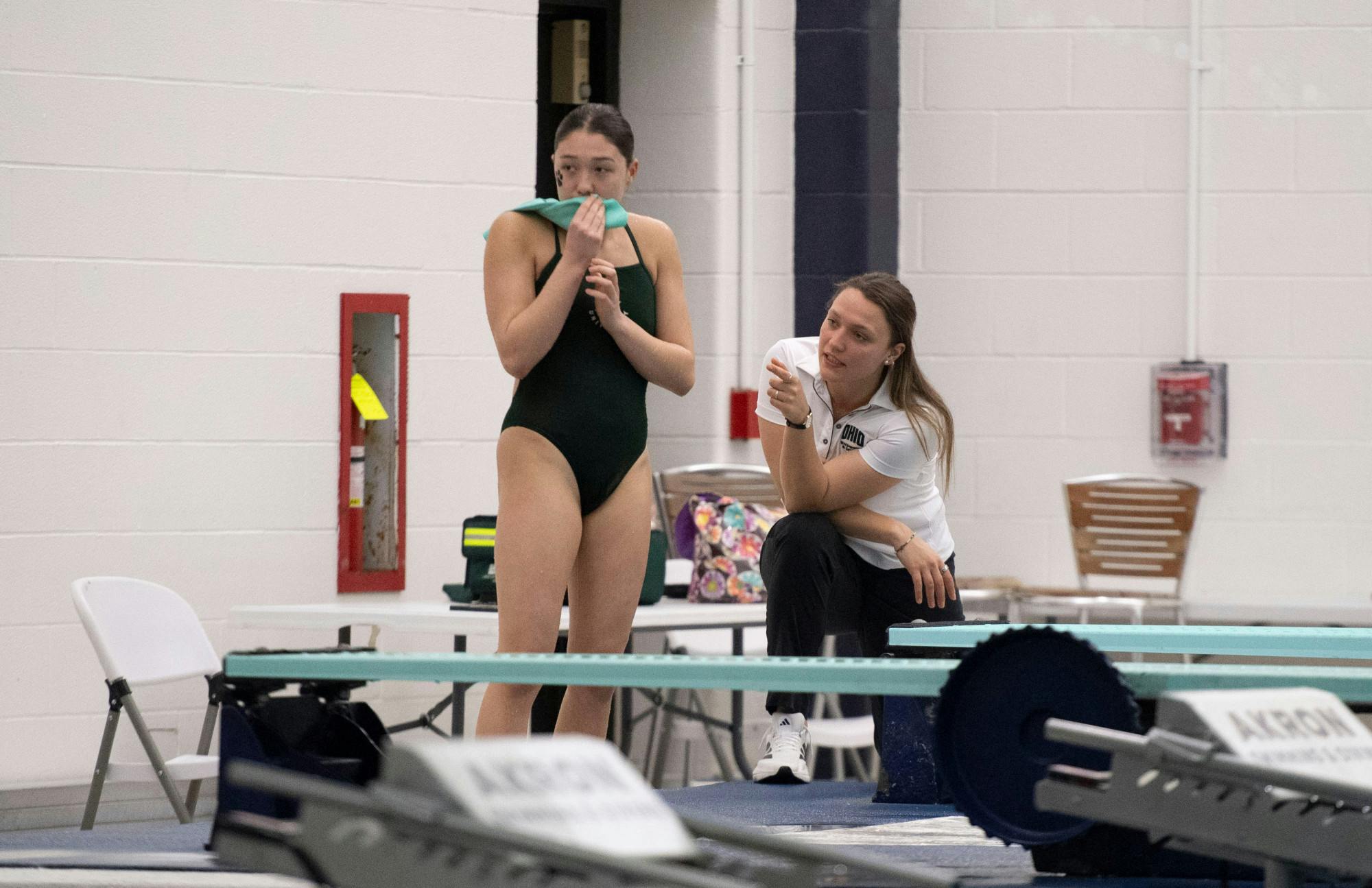
The MAC Swimming & Diving Championships took place from Feb. 25-28 in Akron, resulting in a seventh-place finish from junior diver Astrid Pichardo. Lemke prepares her divers for these big events by competing throughout the year and by mentally training them in the weeks leading up to championships. However, once the meet begins, the results are out of her control.
“It's a very confidence-driven sport, similar to gymnastics or figure skating,” Lemke said. “In the end, I have to just prepare them the best so when they're alone on the board, they're like, ‘Yeah, I know what to do.’”
Lemke is proud of the fact that the diving team scored higher than they have in years past, but more than that, she appreciates the teamwork the divers demonstrated while competing in the championship.
“They know how to help each other and know how to push each other, especially because we're a pretty good team in terms of doing very similar dives and difficulties,” Lemke said. “So there's also the competitive level at practice between each other, like, ‘I want to see my teammate do well, but at the same time, I need to do well so I don’t fall behind.’ I think that's overall what I think worked well and made us more competitive.”