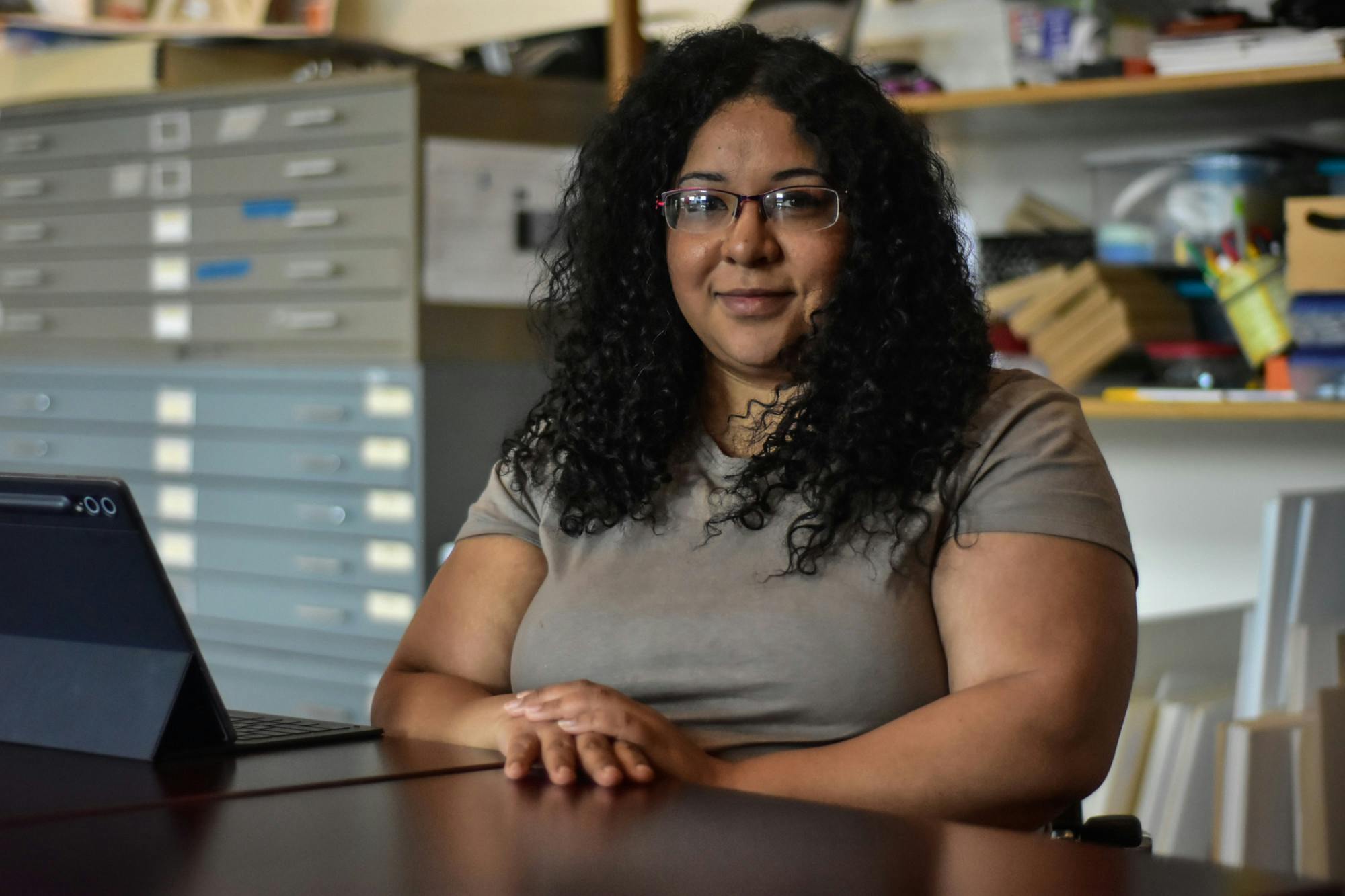
For more than 25 years, the Athens Photo Project has turned photography into a tool for healing, giving community members a creative path toward mental health and recovery.
Founder Elise Mitchell Sanford started the APP in 2000, seven years after The Ridges transferred its last patients and left many people without that sense of community support. Noticing the gap and motivated by her own son’s struggles with mental health, she developed the idea that would become APP.
“Whenever The Ridges closed, she recognized that many people were released and there wasn't anything for them to do,” Lacy Davis, the program director at APP, said. “Her background was photography. So she thought, ‘What can I do?’ And photography class was what she did.”
Every week, participants show up to the studio at 434 W. Union St. for peer-led classes where they take photos, reflect on their work and share it with others.
“We talk about some kind of prompt and think about ways we can approach that prompt,” Davis said about the classes. “We take our cameras outside, take some pictures, come back in, make prints of their favorite one and give them an opportunity to write about it, and then we all look at it together and discuss it.”
Participants move through multi-year programming, from learning self-expression to developing technical skills and eventually creating personal projects.
"Your first year. It's all about learning self-expression,” Davis said. “The second year is more about camera skills and learning about the genres of photography. The third year, we aim to help them make a book with all the things they've been working on. And then the fourth year, they move more into an advanced group where they're working on more individualized goals, or sometimes they'll have a theme.”
The deinstitutionalization movement that closed The Ridges, a mental health hospital, and similar institutions created both a gap in support and a shift in approach, Rebekah Crawford said.
“We know that having people who live with mental illness being incorporated into their communities is the gold standard of care,” Crawford said. “We don't want to marginalize or institutionalize or separate people. In some ways, it gave power back to the individuals who live with mental illness, to be incorporated into their families, into their communities. That being said, there was sort of nothing that was put into place to replace institutional care.”
That lack of institutional support led Sanford to create APP. While the issue extends beyond Appalachia, rural regions face distinct challenges in accessing mental health care. Programs like APP reflect one approach communities are using to respond to those gaps, using creative, community-based approaches to support mental health alongside traditional care. In areas where access to providers is limited, those programs can offer structure, connection and an alternative way to engage in recovery.
“Chronically, we have under-resourced everything in Appalachia,” Crawford said. “We don't have enough medical facilities. We don't have enough specialists, psychiatrists, in general. In the United States, there aren't enough trained psychiatrists to take care of the number of people who need a psychiatrist. We know those disparities are even more pronounced in rural areas like Appalachia.”
A 2024 survey by Mental Health America found Ohio had 310 mental health providers per 100,000 people, 10 fewer than the national average of 320. Among the 12 other states with regions in Appalachia, only two exceed the national average. Of the five states with the highest number of people per provider, three are in Appalachia.
APP began at a time when not only were mental health institutions drastically changing their approach, but also not long after former President Ronald Reagan pushed for health care privatization.
“About as long as the Athens Photo Project has been in existence, we have been defunding public services for folks, which always hits hardest among people who are in the lower socio-economic bracket,” Crawford said. “It's fine to take away public services if you have private alternatives, but so many people don't, and people in Appalachia really don't.”
Crawford said some informal support exists, one example being “neighborhood churches” where the community is very tight-knit. But religious communities don’t help everyone. A 2024 survey by Pew Research Center found 37% of Americans say they would not be too comfortable or not comfortable at all speaking with a religious or spiritual leader about their mental health.
Other informal support includes organizations such as the The Salvation Army that aim to aid struggling community members. However, some informal support organizations exclude groups such as the LGBTQ+ community.
However, that exclusion isn’t found at APP, Elena Caple, a current participant, said.
“This is a very welcoming space,” Caple said. “My experience is I can leave my race, my gender, whatever, at the door, and I don't even think about it here … (there is) an attitude of acceptance.”
Since APP isn’t as formal as a health center or clinic, Crawford called it “interestingly hybrid.” Looking at APP, it fills a niche in the community by offering a different approach to recovery than many formal institutions.
For some participants, that structure and consistency become part of their recovery. Caple first joined APP in 2010 after her psychiatrist recommended the program.
“She thought that it might be a useful program to try and keep me busy and stay out of trouble,” Caple said. “I wasn't used to being around people very much, so there were some growing pains. But ultimately, I've learned a lot. I've grown so much as a result of this project.”
Over time, Caple has returned to the program even after breaks, something staff see as a sign of its impact.
“I actually think the biggest measure of success is that people keep coming back,” Davis said. “Everybody's kind of reserved at first. They don't want to tell everything, but you can see them start to open up and feel more comfortable … but they keep coming.”
That consistency can be especially meaningful for people who find routine and social situations challenging, offering both structure and a sense of belonging. APP has also helped participants engage with the broader community through exhibitions and public displays of their work.
“When I started, I was actually a very angry person,” Caple said. “I had to learn through trial and error, you can't treat people poorly and still have people want to be around you. I've learned a lot, not just photography, but over the years, participation has shaped me in many ways.”
Experts say creative approaches like this can complement traditional therapy.
“There's something about knowing that you're here on this planet that you can take up space,” Katherine Jackson said. “That is healing for people, that you matter.”
Art can also help people express experiences that may be difficult to put into words.
“Having photography as a neutral topic to focus on sometimes frees people up so that they can express a little bit better how they're really feeling,” Jackson said.
Still, programs like APP face limitations. Access depends on staffing and capacity, and demand can exceed what the organization can offer.
“The thing that's the hardest right now is how fast we're growing,” Davis said. “We're growing at a rate that feels almost unsustainable, but we're doing it.”
At times, the waitlist to begin the program has stretched for years, Caple said.
For those who do participate, the program offers more than just photography. Even as APP provides an alternative path for some, broader challenges, including provider shortages and access to care, continue to shape mental health support in Appalachian Ohio.
“Giving people a place to belong while creating art and building each other up is truly something that is unique in the mental field, not just here, but in society at large,” Caple said.