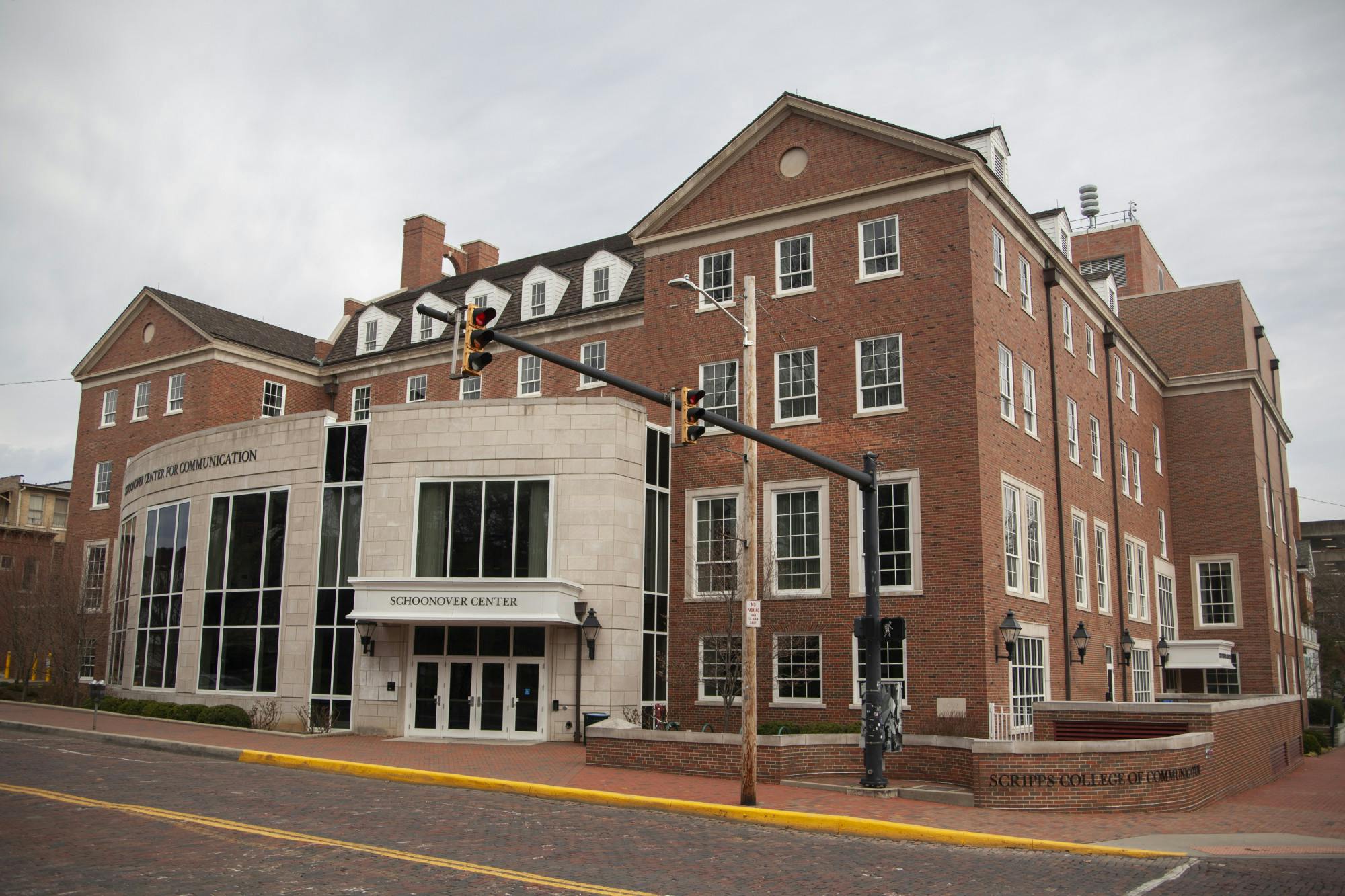
On Tuesday, the Ohio University chapter of the Ohio Student Association hosted a “No ICE (Immigration and Customs Enforcement) in Athens” town hall in Schoonover Center, bringing students and administrators together to discuss campus policy and concerns.
Tylar Ayers, OU’s OSA Vice President, moderated the event by outlining the structure, introducing speakers and directing questions to the panel.
The town hall was organized in response to OSA’s “No ICE in Athens” campaign, which OU’s OSA President Cami Jackson said had not previously received a public response from the university
"We want public statements stating that we’re not going to entertain this insane idea of letting ICE on campus,” Jackson said. “We want to see initiative, not just ‘we understand, legal stuff.’”
Jackson said strong student turnout could push the administration to respond more directly.
Students attended with a range of perspectives. Joshua Kennedy, a sophomore studying history pre-law and political science, attended the meeting as a member of Students for Justice in Palestine.
“All of it kind of lumps into one big, nasty pile where it's all taking away what our natural rights are as a human,” Kennedy said. “We have freedoms that we are guaranteed at birth, and ICE is taking those away. Israel takes those away, and it's important that we tear down these superstructures at their base.”
At about 6:30 p.m., Ayers announced the administrators would take their seats at 7 p.m. Attendees were encouraged to submit questions in advance or ask them directly during the event.
Some students raised concerns about the university’s preparedness for ICE's presence on campus. Lucy Ogle, a senior studying nutrition, pointed to confusion earlier in the year when rumors circulated about ICE being on campus, as reported in a previous report by The Post.
“I’m hoping to be able to advocate for a more prepared response if or when ICE does come,” Ogle said.
OSA also posted signs around the room emphasizing respectful dialogue and maintaining a safe space for discussion.
“Admin has given us their time, so we're all going to be respectful and leave this to be an open space to talk,” Ayers said. “This is a safe space, no judgment.”
At 7 p.m., six of the seven invited administrators took their seats. OU President Lori Stewart Gonzalez did not attend, leaving an empty chair at the center of the panel.
Panelists included OUPD Chief of Police Andrew Powers, Vice President for Student Affairs Lyn Redington, Dean of Students Kathy Fahl, Managing Attorney for the Center for Student Legal Services Kimberlee Francis and Student Senate President Dan Gordillo.
Spencer Singer, a member of Athens Safety Network and a sophomore studying wildlife and conservation biology, spoke first, calling on the university to act on student demands.
"We need the university to take action,” Singer said. “By agreeing to our demands, our university has the power to help keep people safe and stop people from living in fear.”
One topic discussed was whether OUPD would enter into the 278(g) Program, which allows local law enforcement to perform certain federal immigration functions and gain access to ICE resources and training. Powers said the department does not plan to sign such an agreement.
“We have the responsibility of protecting our community and enforcing Ohio’s laws, and that takes up all of our time,” Powers said. “That’s what we spend our job doing. Signing into the 287g agreement and taking on the additional responsibility of enforcing federal immigration laws is not something that we have the capacity to do … It's not our responsibility to enforce federal immigration laws.”
However, he said OUPD will continue to cooperate with the Department of Homeland Security and would not commit to refusing all collaboration with federal agencies, as DHS also includes the Homeland Security Investigations, the Office of Intelligence and Analysis and other resources that Powers said OUPD relies on to keep Athens safe.
“Making a statement like that would cut us off from a lot of resources that we rely on,” Powers said.
Redington addressed calls for the university to refuse data sharing with ICE beyond what is legally required.
“I can’t speak about demographic information, but I can share that as a university, we do not disclose student data lightly or easily,” Redington said. “In fact, just recently, we developed a data privacy policy, which I’m not able to recite to you.”
Gordillo also outlined a proposed notification system that Student Senate has been working on with Athens Safety Network to credibly inform students if ICE is reported in the city of Athens. He said the system would likely involve a mass email alert with general information and a link to resources about students’ rights.
“My number one fear is that Student Senate is liable for sending out misinformation,” Gordillo said.
Because of delays between a reported sighting and sending an alert, Gordillo said the notification would not include a specific location because such details could mislead students in a walkable town.
Questions also addressed whether ICE could enter campus buildings. Fahl explained that public spaces such as Baker University Center would generally be accessible, while private areas like residence halls and classrooms would not be.
“What we're seeing currently across the country is ICE is using what are administrative warrants, like a judicial warrant, and going in places where they maybe wouldn't have previously with that type of warrant,” Fahl said. “The rules seem to be shifting at that national, federal level.”
Redington also addressed the university’s legal obligations as a public institution.
“As a state institution and as an employee of the state institution, it is incumbent upon me in my role, I'm not speaking for the President, to uphold the laws, whether I agree with them or not, that is what I am bound to do,” Redington said
The Center for Student Legal Services, a non-profit separate from the university, provides support to students with legal concerns, including those related to immigration enforcement, according to Francis.
“It's a good moment for me to remind everybody about your student legal fee that you have to either opt out of every year,” Francis said. “If you've opted out, you can re-enroll, but the issue becomes if the incident has already occurred.”
By the end of the night, students said they were still looking for the university to match its “Make Respect Visible” branding with firmer protections against immigration enforcement.
“You cannot turn a corner without seeing ‘Make Respect Visible,’ and that needs to go deeper than just words and just signs and just facts on our website,” Jaidyn Hughes, a sophomore studying wildlife conservation biology, said.