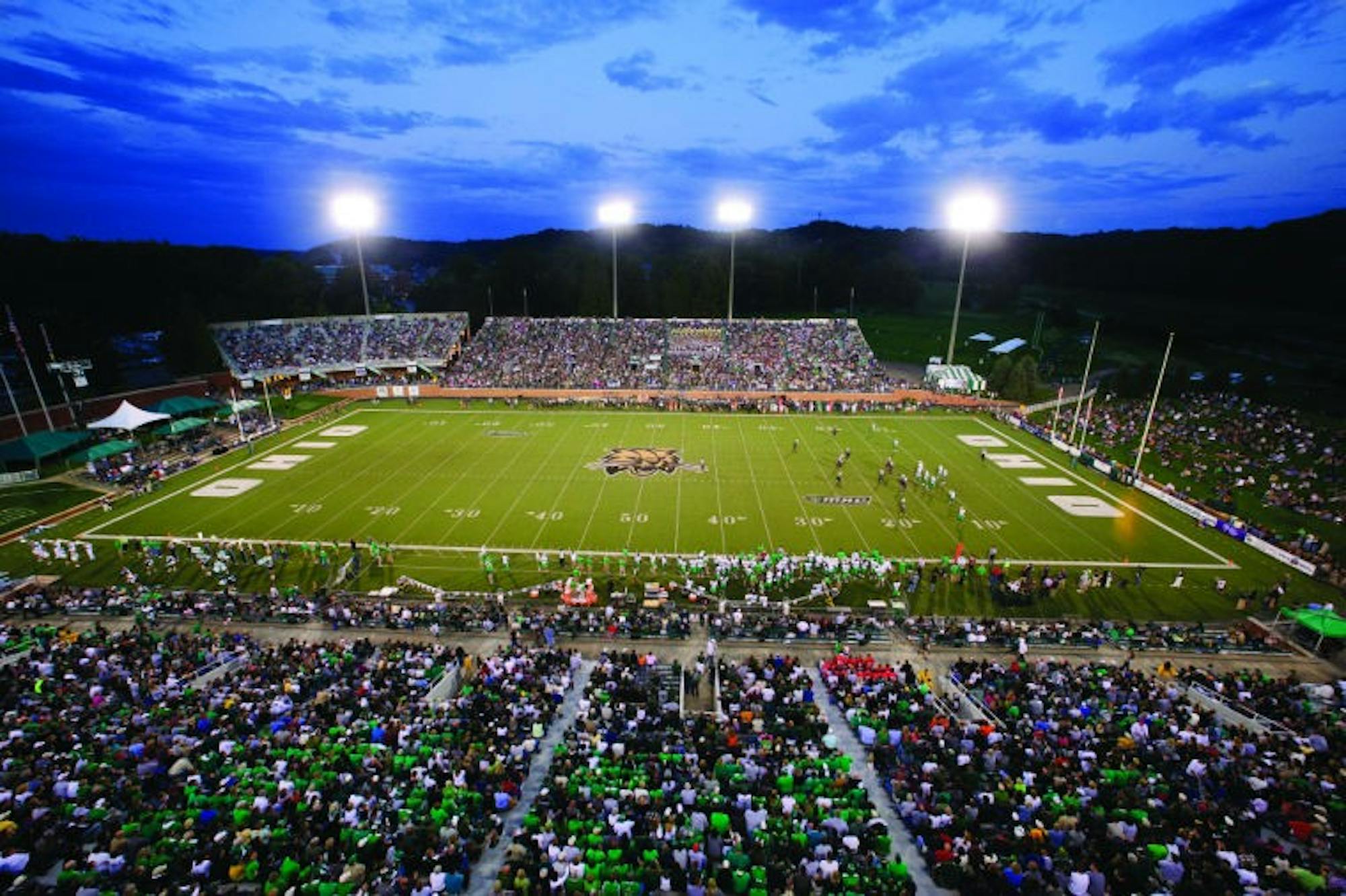
Just as baseball fans smile at the sight of historic Wrigley Field, some Ohio University football lovers view Peden Stadium as a college football landmark. To others, the stadium is a simple concrete structure just off Richland Avenue and abutting the Hocking River.
The ties between Wrigley and Peden go deeper than petty analogy, though. Ivy used to shower the façade of various campus buildings, and Peden is the oldest stadium in the Mid-American Conference.
Ohio Athletics facilities and operations director Jason Farmer said many people are shocked to hear about the history of the stadium.
“Most people assume that it’s been here for a while, but most people are surprised how long it actually has been here,” he said. “We’re talking about 80 years, 90 years and that definitely surprises a lot of folks.”
In 1929, what is now known as Peden Stadium opened as Ohio University’s Athletic Plant. It was renamed in 1960 to honor legendary coach Don Peden, who led the Bobcats from 1924 to 1946. He only had one losing season during his tenure; amassing 121 wins to just 46 losses during his career.
Just as Wrigley Field has adapted to the demands of modern fans, Peden Stadium expanded from its original capacity of 12,000 to 19,000 in 1986 and again to 24,000 in 2001. Even though the stadium’s capacity has doubled, Farmer says the stadium has retained its charm.
“I think we have made plenty of additions, upgrades and enhancements of the stadium over the years, and I think we have maintained that look and that feel of the original stadium,” Farmer said.
The first game was a 14-0 win against the Miami University in 1929. Other historic events at the stadium include visits by Presidents Lyndon B. Johnson and Dwight D. Eisenhower, with Eisenhower landing on the field via helicopter.
Because of its rich football and community history, Peden has been recognized by the Ohio Historical Society with a historical marker, which is located at the north end of the venue along South Green Drive.
The idea of posting an Ohio Historical Society marker at Peden Stadium came from alumnus Michael Massa, who graduated in 1982.
“I was checking out some things online, and it occurred to me Peden Stadium was the oldest stadium in the MAC and one of the oldest football stadiums in the country,” Massa said. “I knew the university had several historical markers on campus and Athens County. I just thought it would be appropriate to also nominate Peden Stadium as an official Ohio historical marker.”
He contacted the Ohio Historical Society about a marker, and the sign was placed at Drew Park after Peden Stadium met all the criteria for validation.
Massa only contacted OU after discussing his idea with the Ohio Historical Society, which had not planned to put a marker there until Massa called.
“I was kind of surprised the university on its own did not consider doing that,” Massa said.
The marker was erected in 2009, which was the stadium’s 80th year.
Ironically, the marker has several inaccuracies. The sign says Peden began coaching in 1929, not 1924. The marker says he had one tie during his coaching career, but he actually had 11.
Massa stays involved with OU mainly because of family ties, but he enjoys supporting the university. He started the nonprofit organization Renaissance America to provide ideas to public institutions around the country. Massa was a major proponent of having a contest to name Ohio’s mascot.
With the help of Texas State University, whose mascot is also the Bobcats, Massa learned how to market the new brand of Ohio sports teams. He is currently working on a plan that involves playing the Cutler Hall chimes after every Ohio home football win.
Farmer says Peden is a great place to play that harkens back to an older generation.
“The ambiance, the architecture of it does speak to a different era,” he said. “I think the brick architecture is something you don’t really see anymore. It mirrors and blends in so well with the campus.”
Football coach Frank Solich, who played and coached in Nebraska’s larger and older Memorial Stadium, said that Peden is a premier venue for college football.
"I think it’s a great college setting,” Solich said. “I don’t think it gets much prettier than this in terms of our campus in general, but obviously if you look at the surroundings of the stadium and the hills, then it doesn’t get much prettier.
“What makes the stadium is the people in it, and so filling the stadium up is, to me, what makes a great stadium."
mk277809@ohiou.edu