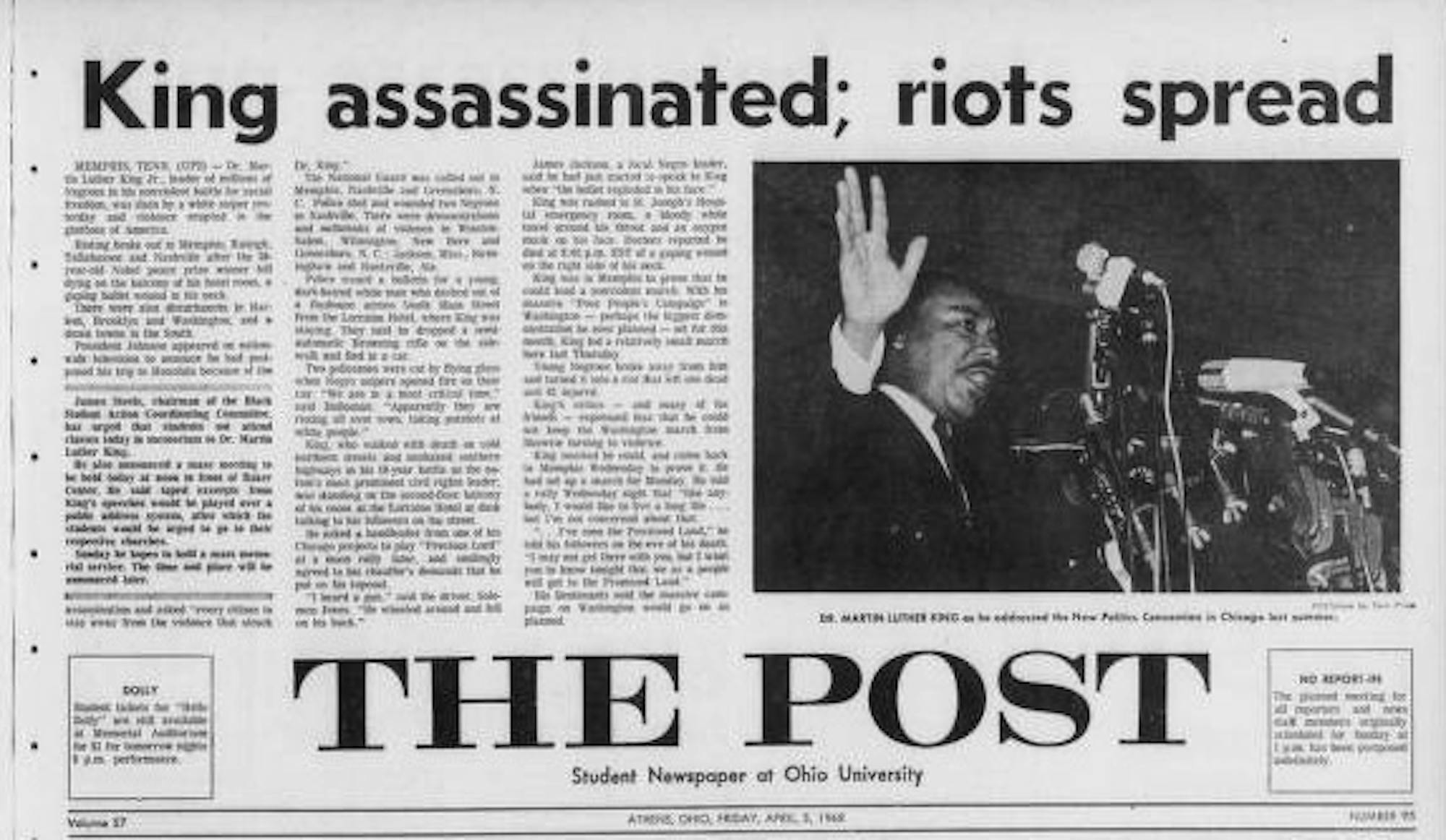
Monday morning, over 100 Ohio University students, faculty and staff gathered at Galbreath Chapel to commemorate the life and legacy of Rev. Dr. Martin Luther King, Jr. Members of The Post joined the Celebration Silent March led by the Alpha Phi Alpha Fraternity, Inc. and Celebratory Brunch held by OU’s Center for Student Engagement & Leadership to remember and honor Dr. King’s contribution to upholding the freedoms upon which our newsroom is built: speech and press.
Dr. King was the most influential and prominent leader of the American Civil Rights Movement. He led nonviolent rallies across the nation in protest of Jim Crow laws, including the March on Washington where he delivered his famous “I Have a Dream Speech.”
In 1959, Dr. King visited OU for the 18th Ecumenical Student Conference on the Christian World Mission, where he was a featured speaker. He spoke to thousands of students about racial tensions in America, drawing from his experience as a Baptist pastor.
Dr. King was assassinated April 4, 1968, in Memphis and left behind a lasting legacy. In 1971, states began to recognize Martin Luther King Jr. Day, and in 1986, it was observed as a federal holiday.
He was an active proponent of the five freedoms protected by the First Amendment, which often acted as the basis for his speeches, including his last April 3, 1968.
Known as “I’ve Been to the Mountaintop,” Dr. King spoke in support of Memphis’ sanitation workers, who had been prohibited from rallying by the city. This denial, Dr. King said, was a violation of America’s unique commitment to the First Amendment and citizen rights.
“But somewhere I read of the freedom of assembly,” Dr. King said. “Somewhere I read of the freedom of speech. Somewhere, I read of the freedom of the press. Somewhere I read that the greatness of America is the right to protest for right. And so just as I say, we aren't going to let any injunction turn us around. We are going on.”
We continue to go on. Student leaders across campus criticize the administration and take on the responsibilities vacated as a result of Senate Bill 1. Protestors march against Immigration and Customs Enforcement in Minneapolis. Millions demonstrate against international violence in the Middle East, Venezuela and Gaza.
Free speech and press allow these protests, rallies and criticisms to occur. Yet, the past year has also brought the reach of these freedoms into question.
Each of these events shorten the rope the First Amendment extends American citizens, bringing them in closer to government control: Indiana University’s censorship and closure of its student newspaper, the Indiana Daily Student; an FBI raid of Washington Post reporter Hannah Natanson’s home; defunding of the Corporation for Public Broadcasting; the White House barring the Associated Press from certain events due to its refusal to adopt “Gulf of America” and its creation of a site titled “Media Offenders” to “expose” journalists.
Despite these roadblocks that seem like blatant violations of free speech and the press, we are reminded of what Dr. King preached. Following the silent march, Nancy Edwards-Grady, assistant director of OU Career Services, opened the Celebratory Brunch with a critical reminder of King's lessons.
“Dr. King taught us that justice requires us to act out loud, to speak when it would be easier to remain quiet, to show up when it would be easier to step back and to remain committed, even when progress feels uncertain,” Edwards-Grady said.
Following Dr. King’s assassination, thousands of college students memorialized his legacy and protested against discrimination in his honor through walk-outs, sit-ins and rallies. Today, college students continue to mobilize against injustice, even when progress feels uncertain.
In 1960, the New York Times published “Heed Their Rising Voices,” a full-page ad criticizing police officers in Montgomery for their harsh treatment of protestors and calling for donations to defend King in court. However, the advertisement included “several minor factual inaccuracies.” Montgomery Public Safety Commissioner, L.B. Sullivan, requested the NYT retract this information. When the publication refused, Sullivan filed a libel suit.
Four years later, the Supreme Court reached a unanimous decision in support of the NYT, ruling that public officials are required to prove a libelous statement was made “with knowledge that it was false or with reckless disregard of whether it was false or not.”
Without fear of libel, media coverage of the Civil Rights Movement expanded. Dr. King utilized the press to his advantage and worked with journalists to showcase the nonviolent nature of the Civil Rights Movement protests.
Similarly, The Post works to ensure OU students and Athens residents are represented by our newspaper. Our newspaper will continue to cover this cause and pressure OU by challenging the official truth and the power of authority. In fact, this effort would not be possible without Dr. King’s work.
On MLK Jr. Day, we reflect on the hopes in which America was created, read Dr. King’s words and honor his legacy. We owe our success and our freedom to his work and recognize that, without his legacy, students would remain voiceless.
Alexandra Hopkins is a senior studying journalism at Ohio University. Please note the views expressed in this column do not reflect those of The Post. Want to talk to Alexandra? Email her at ah875121@ohio.edu.