

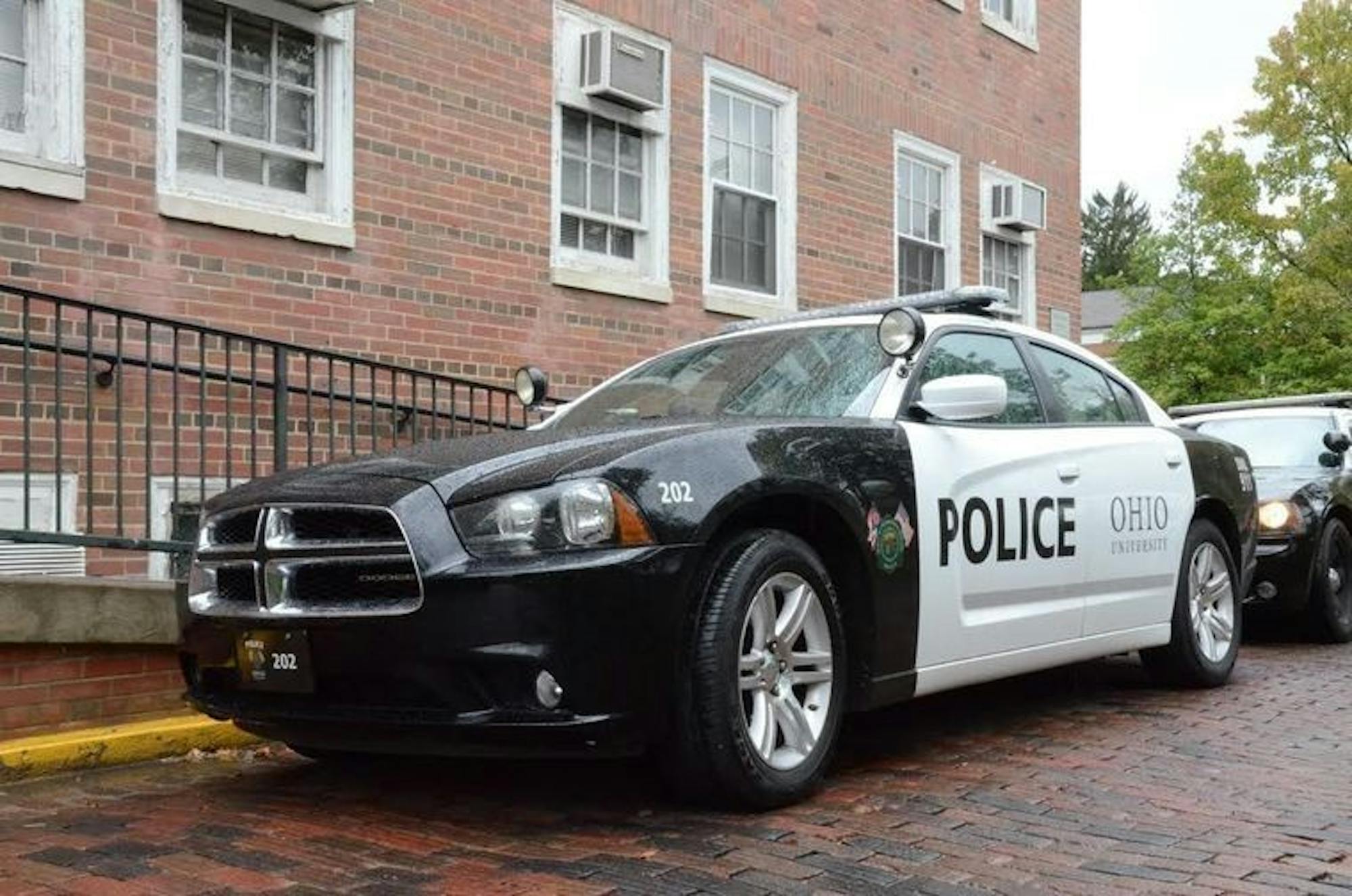
Local law enforcement agencies see different needs for worker's compensation, they might have some restrictions for filing compensation too.
Throughout the past three years, the City of Athens has steadily spent less on worker’s compensation benefits for the Athens Police Department.
In 2014, APD officers received $84,275 in worker’s compensation benefits. So far in 2015, they’ve received $47,540.
That amount is based on the percentage of department employees, their position and claims by the city, Athens City Auditor Kathy Hecht said in an email.
Athens Police Chief Tom Pyle said police injuries can include anything from broken wrists to serious spinal injuries caused mostly by confrontation situations between an officer and citizen.
“Law enforcement and fire (department) is a little different animal, it’s, to my knowledge, the only job that requires 100 percent fit for duty,” Pyle said.
{{tncms-asset app="editorial" id="6d8c08ae-8740-11e5-a68e-33f2bd227266"}}
The immediate impact to the department and the community is the loss of a position for any time between a few months to years, Pyle said.
“It can cause a lot of problems,” Pyle said.
Pyle added that the most common injuries are deemed “support injuries” to locations like the knees, legs, torn ACLs or necks.
“Our injuries are caused almost exclusively by confrontation with people,” Pyle said.
Pyle added that those injuries can be avoided by using a stun gun during an encounter with someone.
“It’s saved officers … it’s saved suspects,” Pyle said.
Stun guns can be used as a force technique to bring a situation quickly under control, Pyle said.
“The taser for us is much more humane approach to stopping these things from happening,” Pyle said.
In the event that an APD officer does get hurt, they go through the process of filing for workers compensation with Jennifer Galbraith, the City of Athens Human Resources director.
“If a police officer is injured in the line of duty and the officer seeks or needs medical attention, an incident report along with a supervisor evaluation form is forwarded to the HR director,” Galbraith said in an email.
She added that any injury occurring while an officer is on duty can be filed for workers compensation.
Galbraith then sends the report to CompManagement, a third party administrator that assists the city with processing Ohio Bureau of Workers Compensation claims.
“CompManagement acts as a liaison between the City and BWC,” Galbraith said in an email.
Sometimes, though, a workers compensation request could be denied.
“If it is determined by the BWC that the injury does not qualify for reimbursement or wage continuation … the claim can be denied,” Galbraith said in an email.
Melissa Vince, the spokeswoman for the Ohio Bureau of Workers Compensation, said an employee being under the influence of alcohol when an injury occurred could be a reason they don't receive worker's compensation.
If an injury was caused solely by a natural phenomenon — like a flood or tornado — the claim could also be denied, Vince said.
“There are many exceptions to those cases,” Vince said.
A physical altercation, horseplay and exposure to blood or other potentially infectious material — without an injury alongside the infection — could also be reasons a claim might be denied, according to the Ohio BWC website.
“If you were performing your jobs duties and you were injured, very generally you would be eligible for workers compensation and have a claim approved,” Vince said.
The Ohio University Police Department officers are under similar regulations for receiving worker’s compensation and approved injury leave.
According to the OUPD contract for 2014-2017, examples of activities for approved injury leave include anything from being struck by a passing vehicle while issuing a traffic citation to an officer handling a crowd disturbance or subduing a violator.
Activities that result in an officer being denied their request include an officer tripping on a sidewalk while issuing a citation, any incident of horseplay and some other instances.
Larry Wines, OU’s workers' compensation manager, said he doesn’t receive claims from OUPD often, but they do happen.
“They’re chasing down suspects, doings things that are little bit risky,” Wines said. “Maybe they bang up a wrist or a knee, so they’ll fill out an instant report for that.”
@Fair3Julia
Jf311013@ohio.edu


