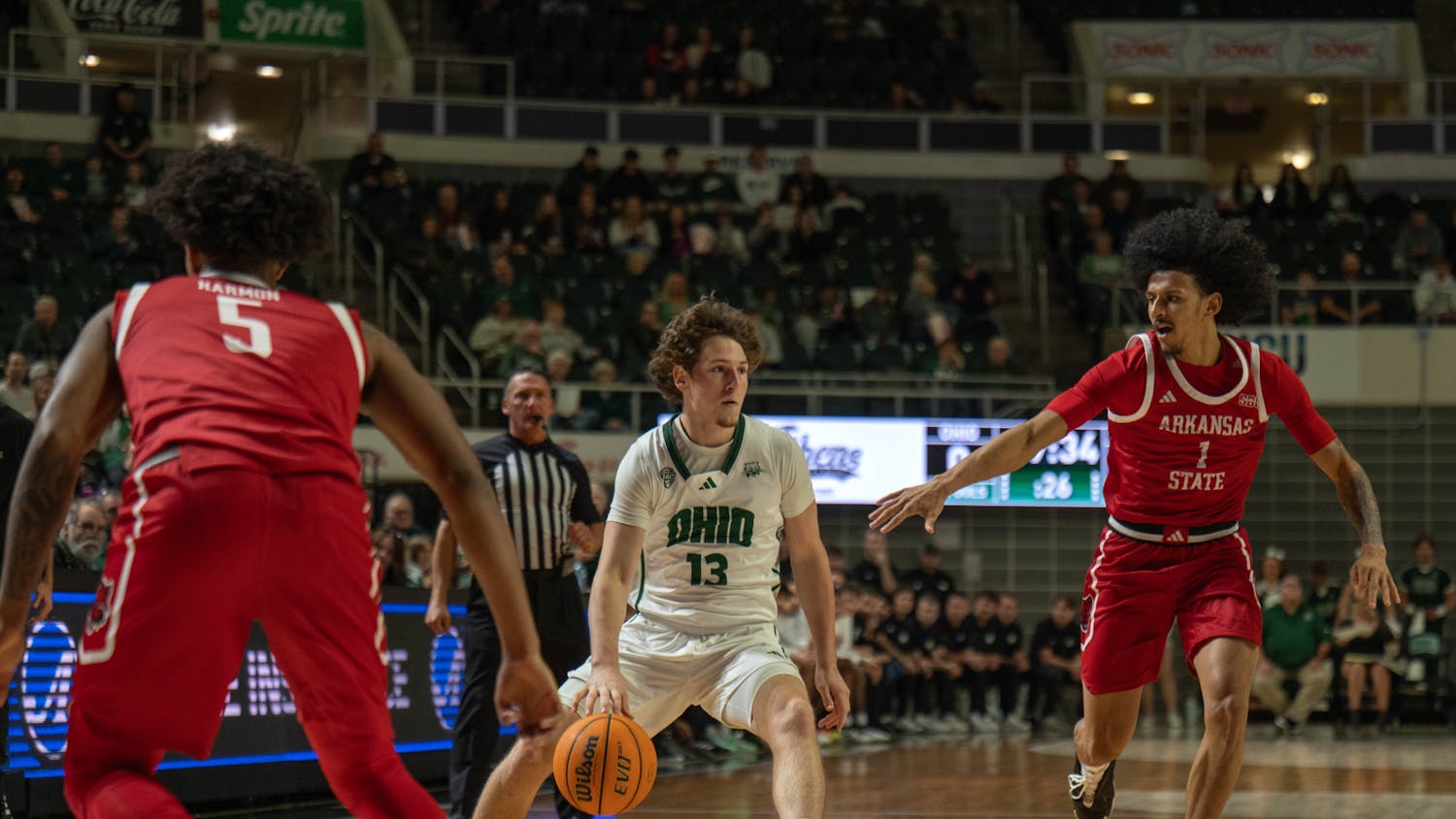
In 2007, Kirby Hocutt, then athletic director at Ohio University, announced that the school was cutting three men's sports and one women's sport to help balance its budget and satisfy Title IX requirements.
Now, two years later, the department is still operating at a deficit and is struggling to comply with Title IX.
Title IX, a federal law prohibiting sex discrimination in educational institutions, has three prongs of compliance: participation, expansion and accommodation.
Universities can prove equality in participation in both scholarship and non-scholarship sports. An institution can demonstrate a continual expansion of athletic opportunities for the underrepresented sex. It also can prove full and effective accommodation of the interest and ability of the underrepresented sex.
After getting advice from Lamar Daniel, a consultant for Gender Equity and Sports Management, the athletic department decided to try to satisfy the participation component of Title IX, according to a 2008 Peer-Review Team Report.
To be compliant, Ohio's breakdown of male and female athletes should roughly equal the percentages of males and females in the student population.
Hocutt and current Senior Associate Athletic Director Amy Dean assured the 10-person ad hoc committee which recommended cutting varsity sports that, once the changes were made, the athletic department would be in full compliance, according to Patrick Washburn, a journalism professor and NCAA faculty representative.
But that did not happen.
It was said several times that once we cut these sports they would instantly meet Title IX
said Washburn, who was a member of the committee. I thought if we made these cuts we were going to meet Title IX.
Well, we haven't quite met it yet. And I, frankly, can't understand what has happened.
A confluence of factors have kept the department from achieving compliance including a two-year grace period to align rosters with the student population and the tough financial climate.
Intercollegiate Athletics implemented a two-year phase-in of the roster limits. But during that phase-in women's programs would outpace the desired participation level
according to the report.
Before cutting varsity sports
48.8 percent of students were male and about 51.1 percent were female. But
at that time male athletes outnumbered female athletes. Only 46.1 percent of athletes were female
compared to 53.8 percent male.
After the cuts
in 2007-08
males on campus accounted for 49.4 percent of the total population
compared to 50.6 percent for females. That compared to 46.9 percent of the athlete population being male and 53.1 percent of the athlete population being females -a difference of about 2.5 percent.
Tricia Turley
an NCAA compliance officer