

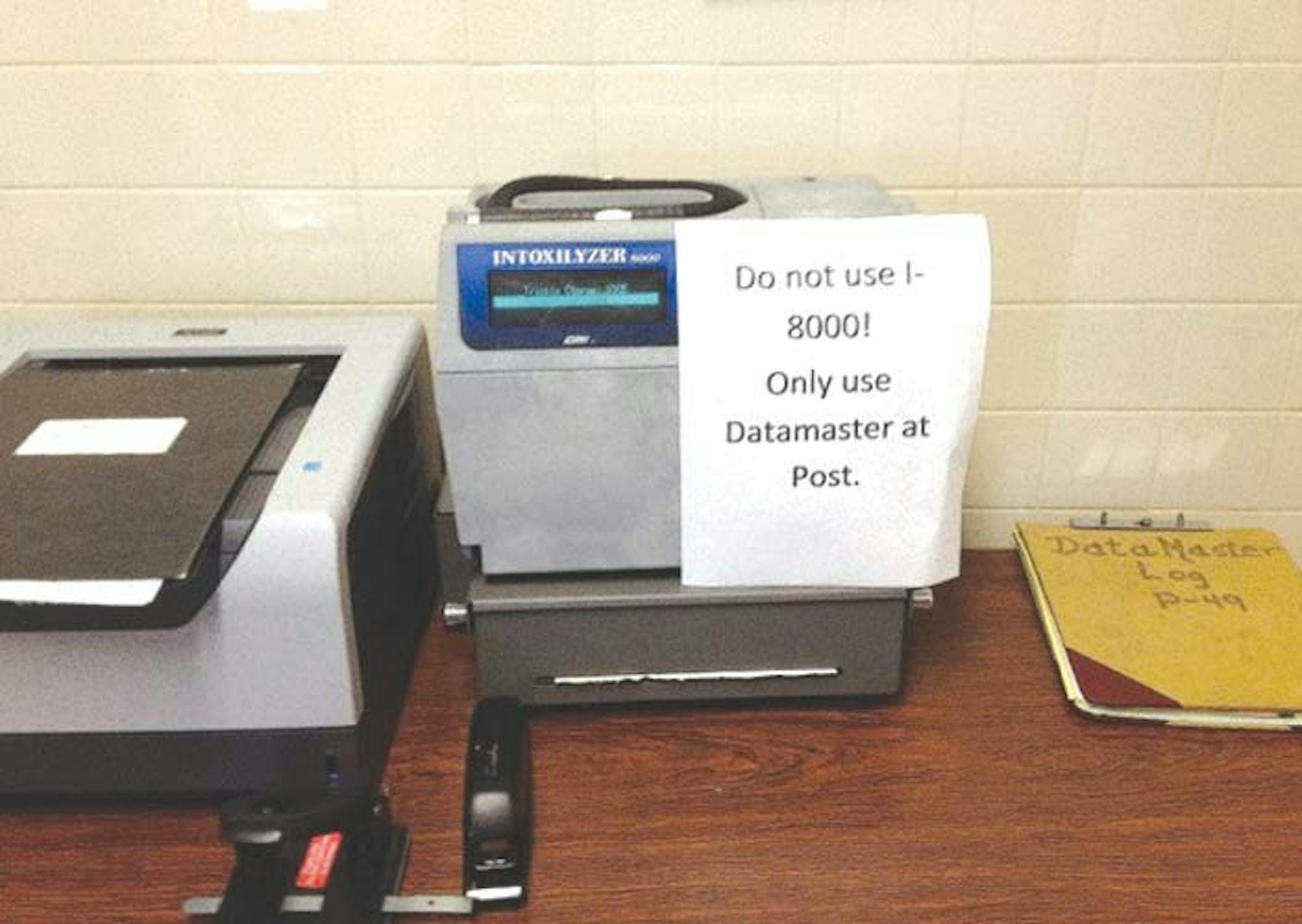
The Ohio Association of Criminal Defense Lawyers is fighting the use of a Breathalyzer that shows inaccurate results that has caused thousands of court cases and wrongly convicted people.
One of these cases, State v. Gerome, took place in the Athens County Municipal Court in June 2011.
Nicole Gerome pleaded no contest to reckless operation, operating a vehicle while impaired with a level of between .08 (the legal limit) and .171, and speeding. She had originally pleaded not guilty.
Gerome received an alcohol-counseling requirement that was completed in August 2011 and was fined $350 with a court cost of $229. Both fees were paid, according to the court docket.
However, the lawyers argue that if the Intoxilyzer 8000 had not been used, State v. Gerome and many other cases could have been avoided.
Ohio law enforcement first began to use the Intoxilyzer 8000 in September 2009 when state officials purchased 700 machines. It has also been used in other states since 2002. Ohio’s contract price with the company is about $9,100 per device; the prices paid in other states vary.
However, it is used most often in less-populated counties rather than metropolitan areas such as Columbus, Cleveland and Cincinnati, according to an article published by Jon Saia, a lawyer in the association.
The Intoxilyzer 8000 is out of service at the Ohio University Police Department. Athens County Municipal Court Judge William Grim decided not to accept the device’s results after several legal challenges, OUPD Chief Andrew Powers said.
“(However), to the best of my knowledge, the Intoxilyzer 8000 has never given any inaccurate readings when properly used,” Powers said in an email.
Athens Police Department Chief Tom Pyle could not be reached for comment.
The association says there are a number of problems that can crop up with the Intoxilyzer 8000. It can cause inaccuracies in a person’s blood alcohol concentration, said Shawn Dominy, a lawyer in the association.
“The software in the machine assumes breath temperature is 34 degrees, (but) it varies from person to person,” Dominy said. “Results will be off by approximately 7 percent.”
Another problem with the Breathalyzer is that the longer the person breathes into it, the higher the result will be, he added.
Dean Ward, chief of the Bureau of Alcohol and Drug Testing at the Ohio Department of Health, originally selected the Intoxilyzer 8000 for use in Ohio. He later took a job with CMI Inc., the Kentucky-based manufacturer of the instrument, Saia said.
“There was lots of speculation at the time Ohio was going through the process of selecting an instrument,” Saia said in an email.
CMI Inc. has already begun work on the Intoxilyzer 9000, which has “the same technology inside the machine,” Saia said.
However, there are other options available such as the DataMaster, which is “probably the most prominent machine used in Ohio,” Saia said. It is still qualified in the state, and people are qualified under the law to use it.
The Ohio Department of Health could not be reached for comment.
“The Intoxilyzer 8000 (OH-5) is a huge step in the wrong direction,” Saia said in his article. “Until it is decided that the determination of the reliability of breath-testing instruments is within the purview of the court, many individuals will be wrongly convicted in Ohio.”
kf398711@ohiou.edu


