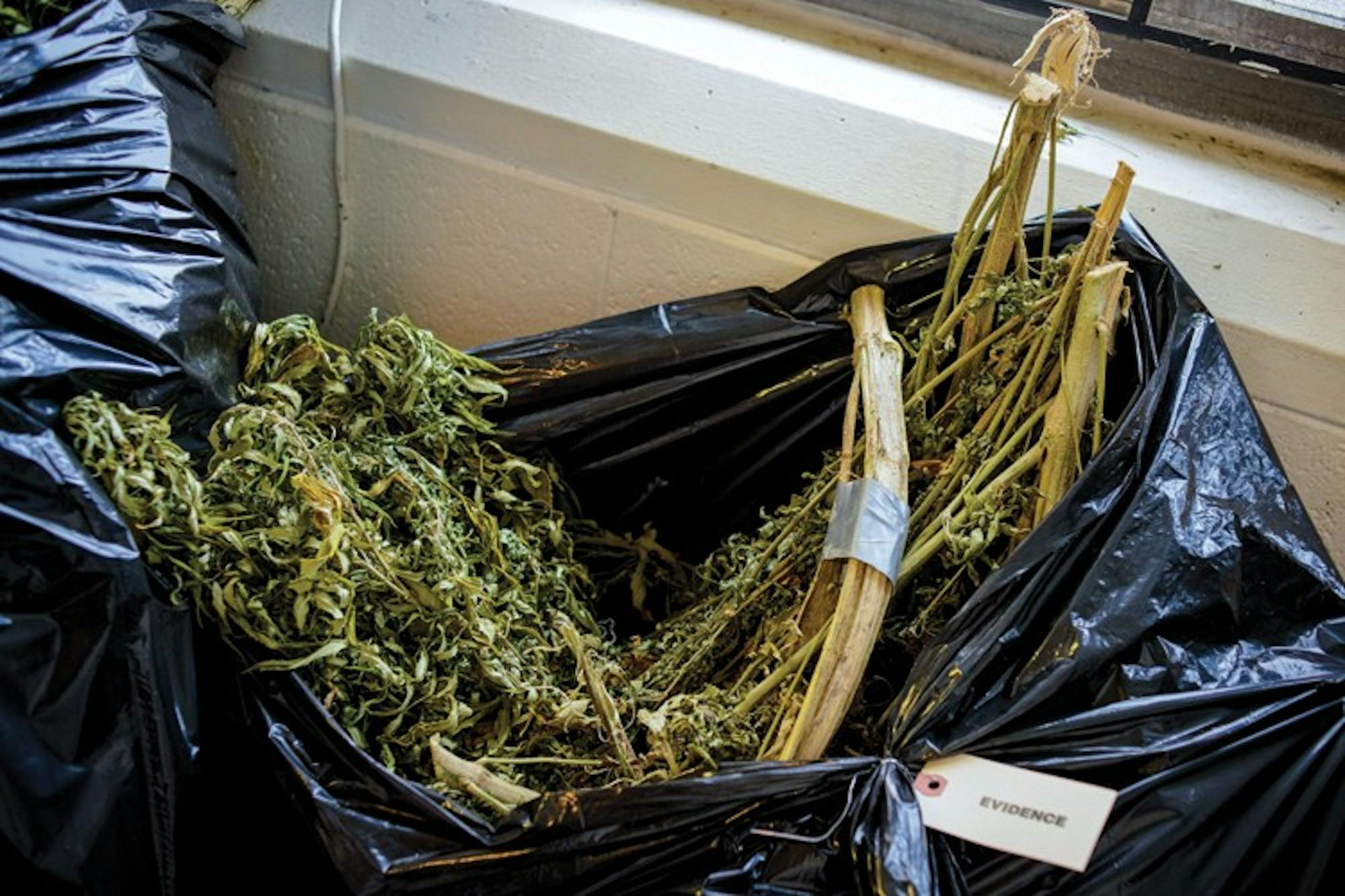
The Athens County Sheriff’s Office confiscates various drugs worth millions of dollars, and it's required by law to incinerate every ounce.
The Sheriff’s Office collects illegal drugs through criminal acts, search warrants and its drop-off program — where people drop off their unused and unwanted pills — and instead of selling some of the drugs to pharmacies or places that could use the drugs for good, the Ohio Revised Code requires them to be destroyed, Sheriff Pat Kelly said.
“I can’t imagine they’re going to put (drugs) back out on the street, because you don’t know if (they’ve) been tainted or something like that.” Kelly said. “We don’t even purify (the drugs), because we don’t give (pharmacies) a chance to. We just destroy the stuff and get it off the streets.”
The Sheriff’s Office has collected about 25 pounds of unused pills and medications from its drug drop-off program, Kelly said.
He added that, immediately after an illegal drug is confiscated, it is taken to the evidence room at the office, where it is put into a tracking system until a court order is issued to destroy the drug at the Ohio University incinerators. Other than Kelly, only two deputies are ever allowed inside the evidence room.
“(The drugs) could be worth millions through pharmaceuticals, but we’re not going to sell drugs to fund the sheriff’s office,” Kelly said. “We wouldn’t ever try or attempt to do that, because it would violate federal law, and we have no authority to do something like that.”
Although some prescription pills are valuable, pharmacies are forbidden from accepting or buying unused drugs, said Ben Holter, PharmD, RPh, Pharmacy manager at the Drugstore at O’Bleness.
Holter said that purifying donated or sold drugs would be extremely expensive, although drugs can be tested for purity. He added that he doesn’t know of a safe way for confiscated drugs to be re-introduced into pharmacies’ drug supplies.
“The way that the laws are written, at least in Ohio, anything that is dispensed from a pharmacy cannot be taken back to be reused in any way, and it gets to the point that I legally can’t give used drugs to someone else,” Holter said. “I have to destroy (the drugs), because there’s no way for us to know for sure.”
The Ohio Revised Code states that drugs must be disposed of or placed in custody of the secretary of the treasury of the United States for use for medical or scientific purposes.
“Since there is currently no way to reuse these medicines, storing them only creates the opportunity for diversion or misuse,” Holter said. “I think proper drug disposal is something that needs addressed. The lack of a formal system for drug disposal often leads to the public either storing the medication or disposing of it in undesirable ways such as flushing.”
Holter said he receives calls about whether flushing unused drugs down the toilet is a safe method, but he said it is the worst thing to do because it enters the drugs into the water supply.
“We usually suggest putting them in coffee grounds or in cat litter and then throwing them away in the trash, so it just goes to a landfill somewhere,” he said. “It’s an issue, but I still think incineration is the best method.”
The law even prohibits non-recreational drugs such as cancer treatments from being donated, Probate Court Judge Robert Stewart said.
“There are stories of the patient dying, and sometimes the family wants the pills to go to a good cause,” Stewart said. “The rules prohibit the distribution of those drugs in any fashion, even if it’s clearly not for profit or satisfaction.”
Stewart said the topic is a valid social question, but the rules are taken very seriously, and selling or giving out drugs is a felony.
“Some see it as wasteful, but the big picture is that we’re making sure it’s not unsafe,” Stewart said. “My guess is that out of the whole population, only a very small percentage of those confiscated drugs are prescription drugs that can be used for good, so maybe that’s why (it’s illegal).”
az346610@ohiou.edu