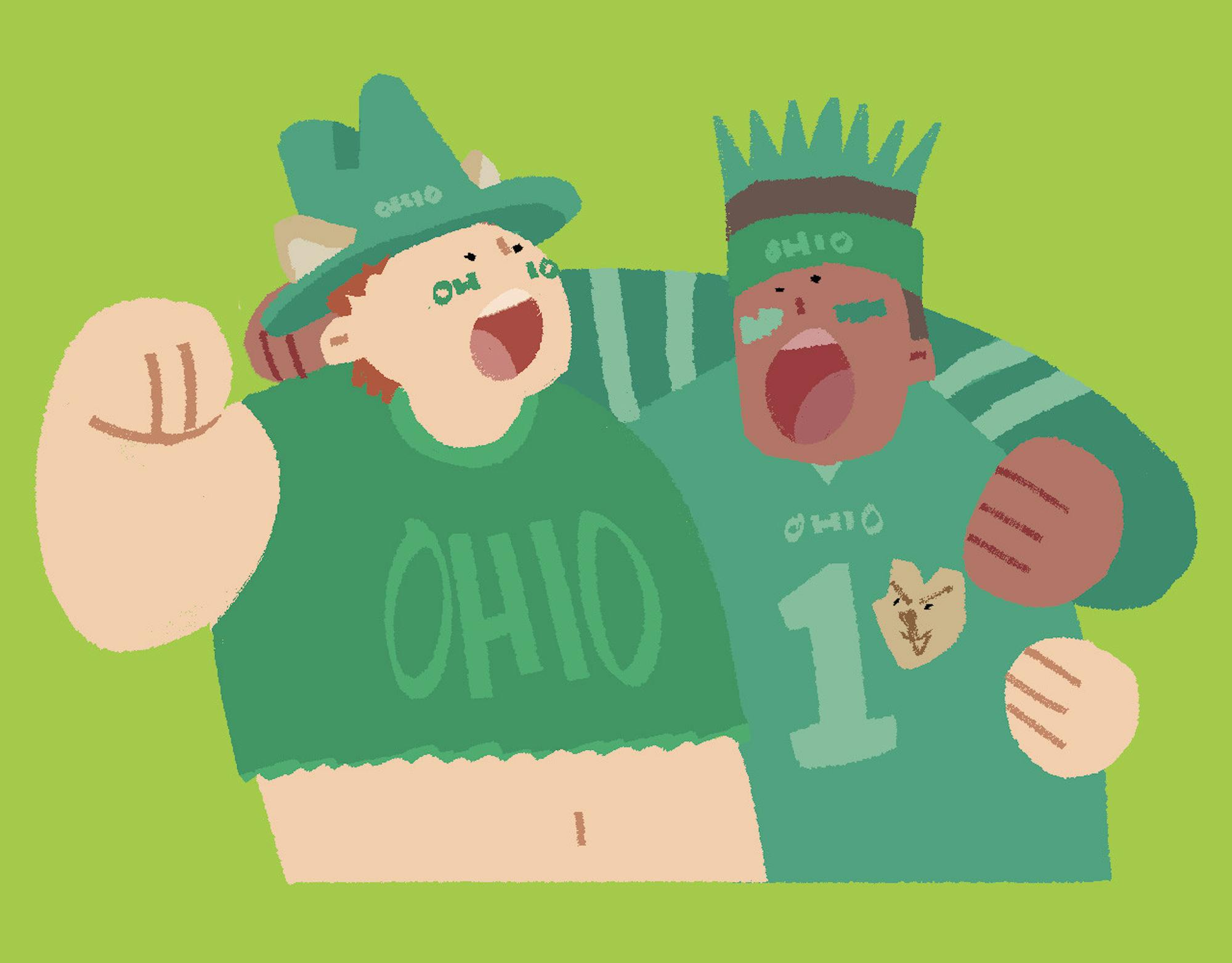
Football. The most-watched sport in the United States, America’s new favorite pastime and one of the largest collections of passionate fans in the world. Yet, its popularity isn’t dependent on what goes down on the field, but rather on who is in the stands.
American football has always been popular, and it does not seem to be slowing down. College football viewership is up 21% from last season, and the National Football League achieved its most-watched Week 1 ever, averaging 22.3 million viewers across platforms.
Football is worth billions and means much to millions, and the Ohio Bobcats, estimated to have spent around $35 million last year and what welcomes thousands of fans annually, are no exception.
Earlier this month, the Ohio Bobcats took on the Ohio State Buckeyes, reuniting on the gridiron after 15 years. The sold-out Ohio Stadium bled both red and green, erupting into cheers as each team succeeded. Despite losing 37-9, Ohio fans brought their A-game when cheering on their team.
Even those not typically interested in sports felt the passion of the stadium cheering for their respective teams. For the first time, many felt the power of football fanaticism.
Alex Boesch, a third-year doctoral student studying communication studies, currently researches fan behavior and parasocial relationships. As a Green Bay Packers fan, Boesch has spent ample time exploring what drives football fans to fanaticism.
“The real thing that makes football unique and drives a lot of its viewership is that it's so team-oriented,” Boesch said. “... The sport not only has more players involved in being a team (compared to other sports), but also kind of invites the fans to be part of that team.”
In December 1984, the Seattle Seahawks retired jersey No. 12 in honor of its fans, becoming the first football team to ever do so. Known since as the “12s,” Seahawks fans are considered the “12th man” on the field and literally influence games with their earth-trembling noise.
Like the “12s,” fans often bond over what they, or their team, are acclaimed for. Even association with a team may influence how others perceive someone because they’ve tied their social identity to that team, according to Boesch.
“I've talked to so many Cleveland Browns fans, and part of their identity, of who they are, is that the team loses,” Boesch said. “They're aware of that when they talk to other Browns fans, they're aware of that when they talk to other football fans. And it influences those relationships.”
In essence, being around other fans makes you more of a fan, and a shared love of a team, or even the same sport, creates a robust bond.
“A lot of (fanaticism) has to do with team affiliation,” Boesch said. “These people that I study tend to see their team as part of who they are. It's part of their social identity.”
Roger Cooper, director of the Semester-in-LA program, is a self-defined die-hard Kansas City Chiefs fan. Last fall, he spent his sabbatical touring the country for every Chiefs game. During that time, he observed fans while cheering on his own team.
“I think there's something built in football,“ Cooper said about why the sport is so beloved. "It's part of the actual sport itself, but I think the other thing with football is that there are fewer games, so each game carries more weight.”
In an average football season, there are only 17 regular-season games, not including preseason or playoffs. Compared to baseball, which plays an average of 162 games a season, football seems infrequent in comparison, and every game counts.
During his sabbatical, Cooper also saw Taylor Swift’s Eras Tour in Toronto, due to “the whole Travis Kelce (and) Taylor Swift thing.” He found that the fan behavior in the stadiums reflected each other.
"(The Eras Tour) kind of had similar aspects to it, where people who didn't even know each other were trading bracelets and talking with each other,” he said.
Fandom is defined by Cambridge Dictionary as “a group of fans of someone or something, especially very enthusiastic ones.” The football fandom is made of millions of fans across North America, many of whom wish to engage with other members.
Even when Cooper was in the middle of nowhere during his travels, if he was wearing Chiefs gear, he could expect someone to strike up a conversation about the team.
“I think that's missing in our larger society now, where we don't talk to each other, and fandom also provides some connection for people who might disagree on some other societal or political issues,” Cooper said. “That largely seems to wash away when you're with fans of a team or even another team.”
Football has always been about more than the men on the field. It’s driven by the fans, for the fans.
“Fandom serves as a really critical bonding agent in the world that we’re living in now,” Cooper said. Football is no exception.