

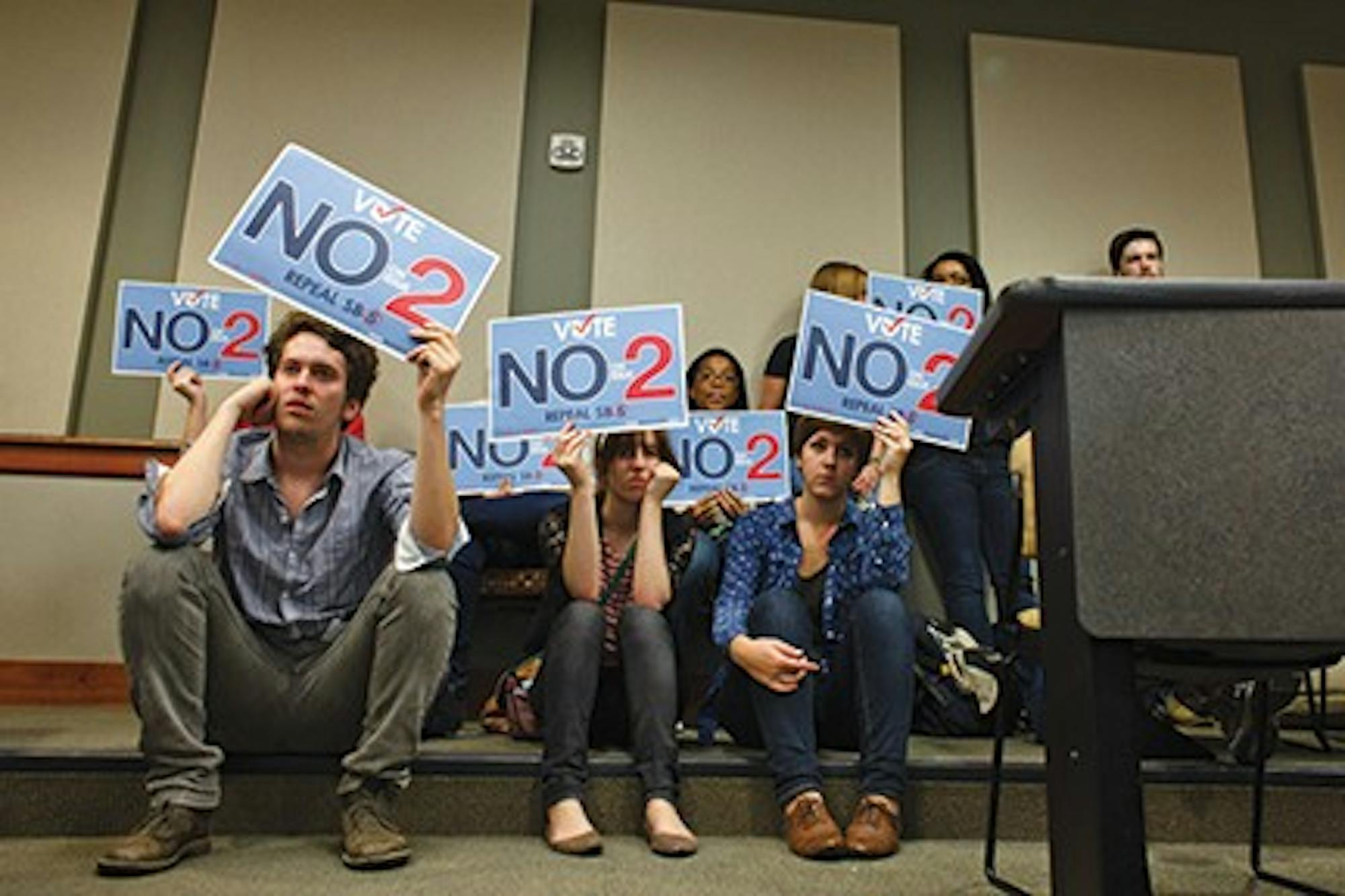
About 50 protesters stormed out of last night’s Ohio University Student Senate meeting after senate failed for the third week in a row to vote on a resolution condemning the wording of Senate Bill 5.
State and Federal Affairs Commissioner Taylor Abbott, who originally wrote the resolution, requested last night to add a vote on the resolution to the agenda because senate President Kyle Triplett decided not to include it.
Abbott drafted the resolution, which condemns the limits SB 5 places on public workers’ collective-bargaining rights, about three weeks ago.
Of senate’s 35 voting members, 18 approved the addition of the resolution to the agenda, nine opposed it and eight abstained.
The 18 students constituted a majority, but in order to add the resolution to the agenda, two-thirds of the body — or 24 senate members — would have needed to agree.
Senate’s rules do not specify whether a two-thirds vote or a simple majority vote is needed to add a resolution to the agenda, and the senate executives made the call in this case, Vice President Roger Jones said.
“A lot of things, you need a two-thirds vote over a majority vote,” Jones said.
“That (decision) was based on our interpretation of the rules.”
The names of the students who chose not to add the resolution or abstained from the vote are not available.
Protesters with We Are Ohio, an organization that opposes SB 5, and several other student organizations used senate’s “Student Speakout” session during the past three meetings to convince senate to vote on the resolution. After the senate’s rejection of Abbott’s request to vote on the resolution last night, the group left.
“I respect the decision of the senate, but it’s a big mistake, and they will realize it in the end,” Abbott said. “It sends a message that (senate is) not concerned.”
Tyler Barton, a senior studying chemistry and a student organizer for We Are
Ohio, said he was frustrated with senate’s decision.
“They say they want to be the voice of students, but they made every effort to silence the students,” he said. “They very easily could have put it on the agenda.”
Triplett said he did not include the resolution on the agenda because senate had not come to a unanimous decision about whether to vote. He said he felt a formal vote during the meeting regarding the resolution’s inclusion on the agenda was the most concrete way to address the divide.
“It’s a very important issue, and I don’t want this to be construed as that we don’t care,” Triplett said. “I think tonight’s vote says that students should take (how they feel) to the ballot box.”
After opposition to SB 5 gathered thousands of signatures, a voter referendum was placed on the November ballot. If state Issue 2 passes, SB 5 will remain law; however, if it is voted down, SB 5 will be repealed.
After the meeting, Shannon Welch, senate’s vice commissioner for state and federal affairs, walked up to Jones and resigned.
Welch, who presented an explanation of SB 5 to senate with Abbott at last week’s meeting in response to Triplett’s concern that senate didn’t know enough about SB 5, said Triplett should have added a resolution to the agenda without a vote.
“I felt that voting to add the resolution to the agenda was just wrong,” she said. “(Triplett) has the power to put it on the agenda, and he used this as another hoop for us to jump through.
“I felt that under the executives, I was not able to do my job efficiently or effectively.”
Although senate decided not to vote last night, the resolution can still be brought up again, Abbott said. However, he said he does not know when it will be addressed again.
“I’m sure it will be brought up again,” he said. “This is not the end.”
Barton agreed, saying We Are Ohio will continue to oppose senate’s decision not to vote.
“We are absolutely going to keep at it,” he said. “We have to keep going. We can’t let them silence us.”
tp674710@ohiou.edu


