

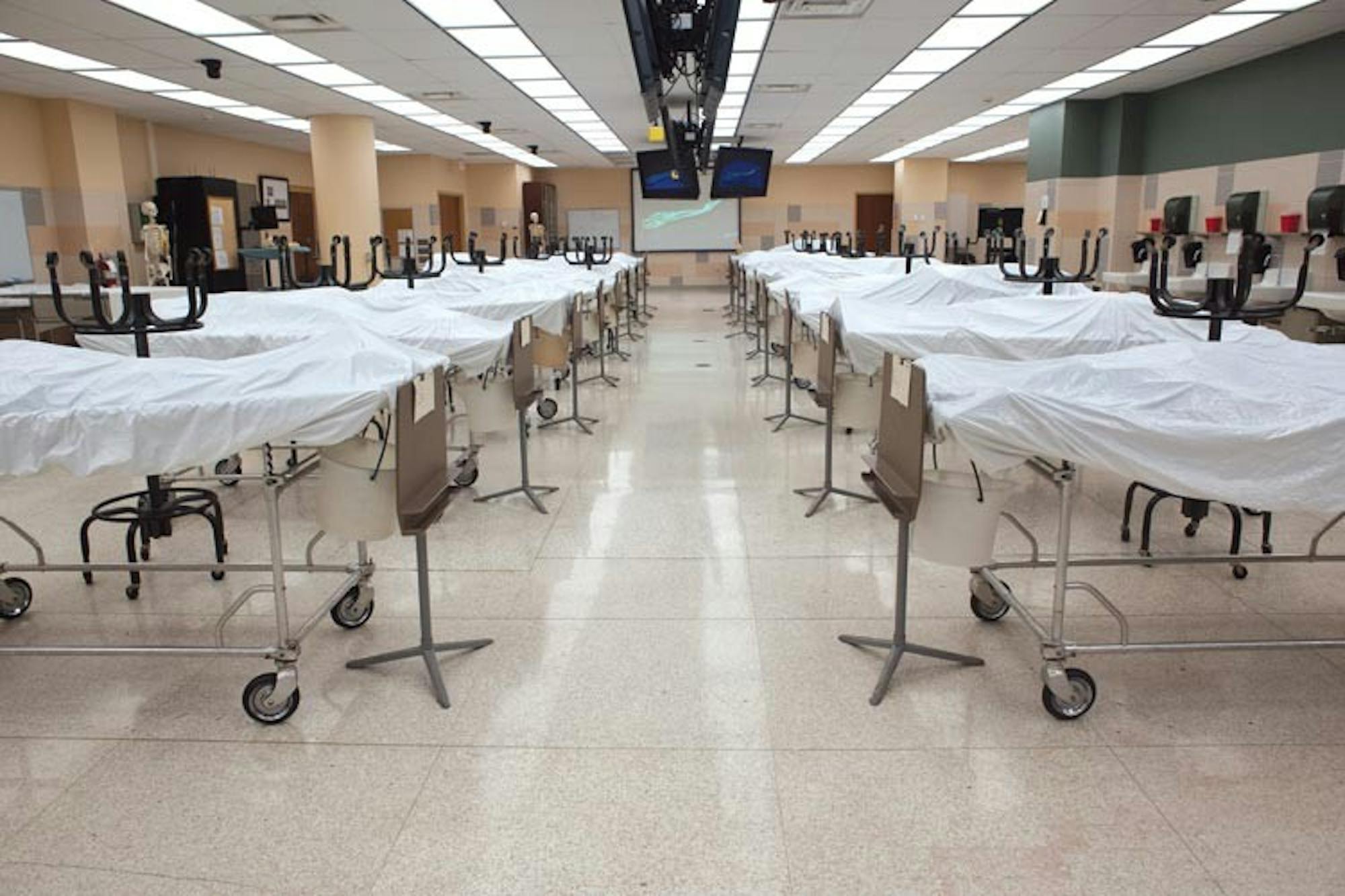
Some Ohio University students go to class with people that have perfect attendance, full participation points and no blood.
Ohio University’s Heritage College of Medicine’s body donor program, one of almost 10 in the state, provides cadavers to its students, allowing those enrolled in anatomy courses to get hands-on experience with cadavers beginning day one.
“We are very grateful to these families,” said Donald Kincaid, director of OU-HCOM’s body donor program. “We couldn’t have a medical school without these donations. Anatomy is essential to so many things students learn here.”
The cadavers are used in multiple health-science courses throughout OU. Still, OU is able to maintain an average of four to six students per cadaver in a state that averages five students.
“In this program, people are giving the supreme gift of themselves,” said Larry Witmer, an anatomy professor in OU-HCOM. “They donate their remains so that medical students better understand the human body. The medical students get it — they understand what that gift means.”
OU-HCOM has been running the body donor program for more than 20 years. Along the way, it began plastinating body parts that are especially beneficial to preserve for educational purposes, such as a damaged heart, lung or hip.
OU-HCOM is one of the first colleges in the state to do so, Kincaid said.
“I kind of had an idea it might be strange working with these bodies, but it was a learning experience,” said J.D. Adame, a second-year medical student. “We knew we had to go through with it, and in the end it didn’t end up being very strange at all.”
At the end of each gurney, students are provided with a notecard stating the donor’s occupation, age and cause of death.
This allows students to begin to establish a relationship with their patients and “get a sense of who they are,” Witmer said.
“The students feel strongly; it affects them,” said Jack Brose, dean of OU-HCOM. “In many ways, this is their first patient. They are very aware these are not nameless, faceless bodies — these are people.”
Those who register to allow their bodies to be used through the program must provide health information and proof of Ohio residence. They then receive a donor identification card, similar to a driver’s license, Kincaid said.
Though donors sign the bequeathal form, the agreement is not legally binding and families’ feelings toward their loved ones’ donation is sometimes hostile.
“You just have to learn how to assess a situation and deal with it,” Kincaid said.
“Sometimes they are sad; sometimes they are mad as hell. I just have to realize it’s nothing personal.”
After the donor passes away, Kincaid retrieves the body and brings it back to the college for embalming — a process that includes a unique dye to make arteries and muscles more pronounced for easier analysis.
Once students are finished dissecting the bodies, the remains are cremated and given to a recipient previously selected by the donor.
The donors are then honored in the spring with a memorial service that is held in Baker University Center. Donors’ families, OU-HCOM faculty and students are invited to attend. At the informal funeral service, the students dress in their lab coats.
“It’s a very important and moving ceremony not only for the families, though they really appreciate all the medical students and faculty honoring their loved ones,” Witmer said. “It’s important for medical students to see the humanity, see the families of the donors. It’s another mirror of the medical practice itself.”
sj950610@ohiou.edu


