There’s no elephant — only Democrats — in the room where Athens City Council meets every week, leading to a trend of unanimous voting.
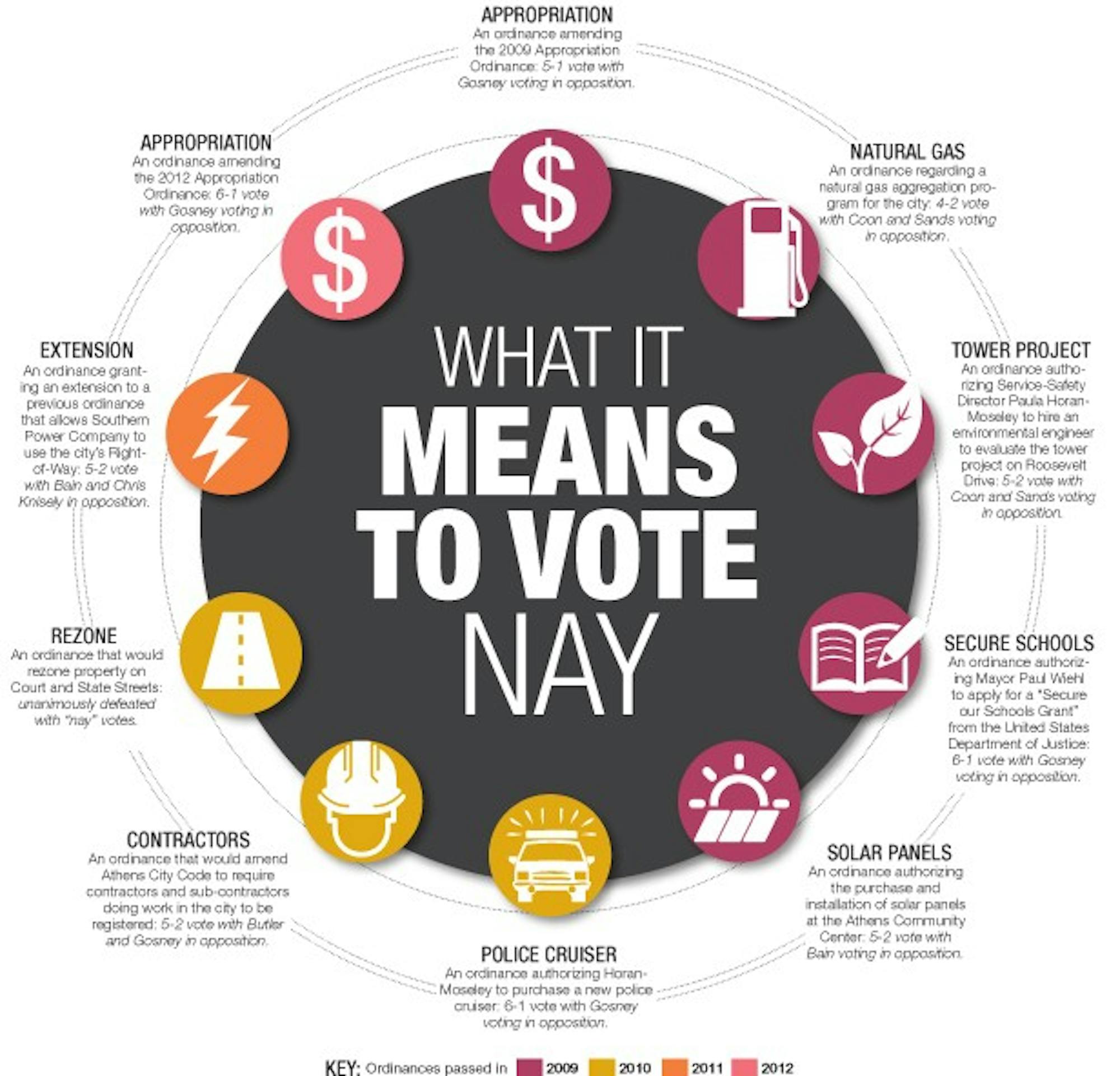
So far this year, council members have unanimously approved every adopted ordinance except one in June. Since 2009, only 10 ordinances have had “nay” votes, and nine of those ordinances were passed by a majority vote, according to research done by The Post and documents from Athens City Council Clerk Debbie Walker.
There have been 519 ordinances read before council since 2009. Councilman Elahu Gosney, D-at large, has voted in opposition of six ordinances since 2009, giving him the most “nay” votes.
The voting trend could be due to council members flushing out big concerns in committee meetings before putting an ordinance up for the first reading, said Bill Bias, who was on Council for 18 years, 10 of them as president.
The council is made up of seven voting members, four of whom represent the four wards of Athens and are elected by residents living in their respective wards. The other three members represent the city at large.
Any council member can pitch an ordinance to the other members in a committee meeting before having it discussed for adoption by Council.
“If there’s grand disagreement, or if it looks like (an ordinance) is not going to make it through Council, then they kill it in committee meetings,” Bias said.
“While we like things to go through committee, any member of Council can bring forth any ordinance that they wish and add it to agenda, but they need someone to second the ordinance to discuss it.”
Council President Jim Sands gave a similar reasoning for Council’s voting history: Nay votes are rare because council members smooth out differences in committee meetings.
“(Nay votes) are kind of unusual on this council,” he said. “I think the reason that the nay vote is unusual is because of our very open-ended discussion of the issues that are coming before Council. I think it’s a good thing.”
Sands said that when he was a voting council member, he remembers rarely voting “nay.” He also said Council does tend to generally agree on public policy but added that, in theory, the agreement should be a good thing for voters.
“Council is a relatively small family and there aren’t a lot of surprises that come before us,” he said. “Most council members are inclined to agree on a lot of issues ... All members are of the Democratic Party and we have somewhat similar basic concerns, but we have some real differences among individuals.”
Council members do a lot to encourage citizen input and a lot of citizens are satisfied with Council’s performance, Sands said, adding that he doesn’t think Council’s Democratic dominance and members’ tendency to vote together limits discussion on ordinances making their way through Council.
But some Athens voters could be turned off by the council’s voting record because citizens may feel they aren’t being heard, said Benjamin Bates, an associate professor of communication studies at Ohio University.
“The advantage is that it’s much easier to get things done because people already agree on what the outcomes should be,” Bates said. “The difficulty you run into is if you don’t have an outside voice asking, ‘Have you thought about this?’ and ‘Have you thought about that?’ you don’t have a voice of consciousness.”
Bates said a number of conservative voters have told him they feel they don’t have a voice in Athens. Some residents said it doesn’t matter whom they vote for because the person who is going to be on Council will be a Democrat no matter what, he said.
“If you don’t think you’re going to be heard from, you might not pay attention to local issues because you don’t feel like your opinion is going to matter,” Bates said. “Local Republicans need to explain why they should be put into office when they are running in various wards around the city.”
A council with Democratic members should represent people in the city because Athens is generally liberal, Bias said.
But he added that when he visited his first OU Student Senate meeting, he was “appalled” by the way senators always voted unanimously.
“Back then, I was Council president and some senator told me that I shouldn’t be worried about senate agreeing on everything because concerns are flushed out in committees, and now that’s how I’m defending Athens City Council,” Bias said. “Maybe it’s time for some new people to run.”
jj360410@ohiou.edu